“Jesus said to him in reply ‘What do you want me to do for you?’ The blind man replied to him, ‘Master, I want to see.’ “
In today’s Gospel of Mark, we see the encounter Jesus had with Bartimaeus, a blind man. Bartimaeus must have known something of who Jesus was, and the power of healing he seemed to possess. Bartimaeus decided to take a risk and began calling out loudly to Jesus, begging for help. Some in the crowd thought of him as a nuisance.
Jesus did not think so, he had Batimaeus brought over to him. When this was done, Jesus did not lay his hands on him, as some of the people would have expected. Instead, Jesus told Bartimaeus that he could leave, “..your faith has saved you.” His sight was restored to him.
Now most of us do not have to deal with blindness; at least, not physical blindness. But what about social blindness, spiritual blindness? Where and when have we turned a “blind eye” to others in need, to others who are in suffering; to our own personal suffering?
It is moments such these, that we need to open ourselves to the Presence of Christ, to enter into prayer, to pray that our eyes, our minds, our hearts, our souls; be opened to the needs of others. And to our own need for healing.
So, I invite all of us, to, at the best of our ability, be present to our Savior in the Eucharist. And let ourselves be transformed, our eyes opened, and our journey with Christ renewed.
A looong time ago, I felt I had a calling to the Catholic priesthood. I spent four years in the Boston Archdiocesan College Seminary, then three years in their School of Theology. I finally came to the conclusion that was being called to another life path. Still, I never have regretted my time in the seminary.
The college seminary no longer exists, but the original seminary still stands and is training and forming men for the priesthood. The seminary is celebrating its 140th year of being in existence.
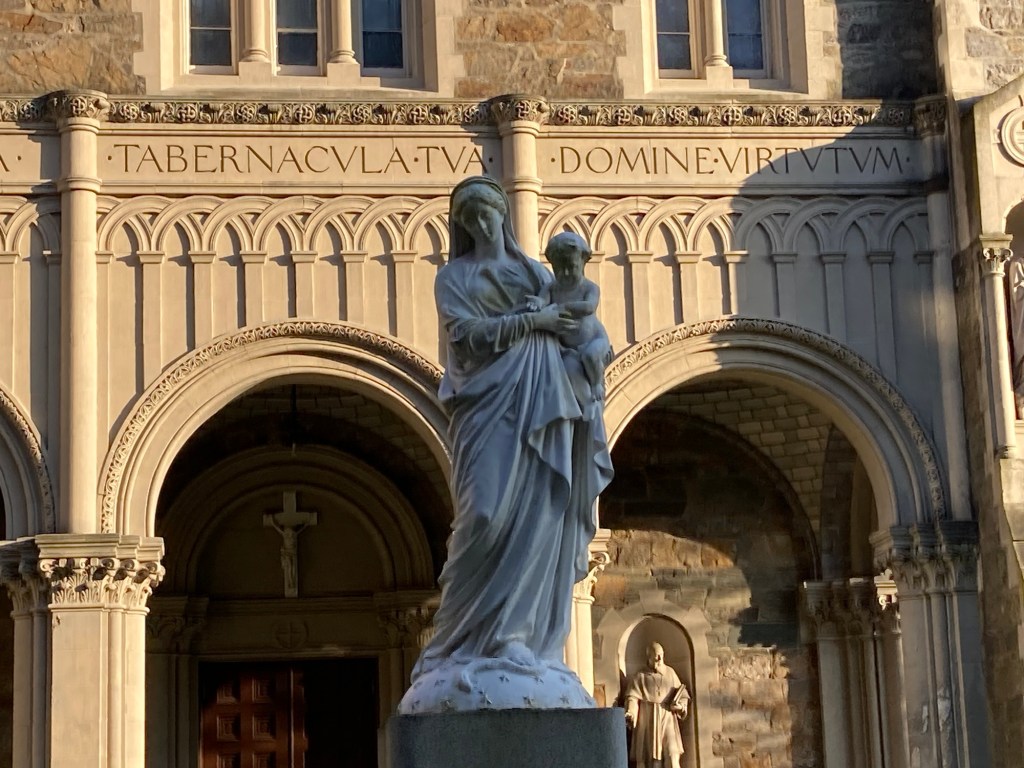
Statue of Saint Francis of Assisi, Our Lady of Lourdes Church, Carver MA
Saint Francis of Assisi
“I have done what was mine to do. May Christ teach you what is yours.” Saint Francis of Assisi
Every October 4th, people around the world, Catholics, Protestants, persons with no declared religion; celebrate the memory of Saint Francis of Assisi. Born in the year of 1182, Francis was an energetic young man, talented, had a gift for drawing other young men of Assisi to himself for parties. He would soon felt the desire to become a knight, a heroic defender of Assisi. Being a commoner, that only way he could achieve this goal, was on the battlefield. He joined his fellow citizens in a military campaign against a rival Italian city state. The battle went terribly wrong for Assisi, Francis and others who survived the battle were captured and held in dungeons. There they waited for their families to ransom them. For some, like Francis, it was a long wait as families and friends tried to gather enough ransom money. Francis returned to Assisi as a broken man.
During his recovery, he would ride out into the countryside. On one such ride, he come across a beggar, who was also suffering from leprosy. Out of fear, Francis turned his horse around, ready to flee. But something made him stop, turn his horse around to face the leper. Getting off his horse, he went to the leper, took his money pouch and put it into the hands of the beggar. And then he kissed them. It was a moment of transformation, a moment of conversion.
Later, Francis found himself walking by a dilapidated chapel. He felt a strong desire to go into the chapel to pray. K in Before a wooden cross, with the image of the Crucified Christ, he knelt. Deep in prayer, Francis heard the Lord speak to him from the cross, “Francis, rebuild my church, which, as you see, is falling down.” And the rest, as they say, is history!
His life of prayer, voluntary poverty, and caring for the poor; has inspired thousands of men and women around the world. Men have joined the Order of Friars Minors, in it’s various formations, to work amongst the poor, to help the ill and disabled. Francis’ lifestyle inspired a young noblewoman, by the name of Clare, to take up a life of poverty and prayer. Drawn by her example, other women joined together to form like communities. Today, these communities bear her name, now called the Poor Clares. And still, the influence of Saint Francis continued to grow, indeed, continues to grow. Lay men and women also found inspiration from Francis’ example. The more they heard about the lives of Francis and his followers, the more they wished to imitate the Franciscan lifestyle. These lay followers soon formed their own groups, to pray together, to help the poor, to serve their families as well.
The Franciscan Family continues, it may experience times of growth, and times of loss; but it continues. Pace e Bene!!





 Musings From St. Anthony's Walnut Tree