Chiara (Clare) Offreduccio was born in Assisi, Italy, on July 16, 1194. She belonged to a wealthy Assisi clan, during the time of the High Middle Ages.
At some time in her life, she came in contact with Saint Francis of Assisi, a young man who had encountered Christ, and was moved to turn his life around. The son a wealthy cloth merchant, he gave up his life of wealth and privilege, and dedicated his life to really living the Gospel of Jesus Christ. Francis wandered the streets of Assisi, proclaiming the Good News, and living a very simple life. He began to draw followers from among the young men of Assisi. And he drew the attention of Clare.
In conversations with Francis, she felt a fire being lit within her own soul. She gave up her life of wealth and privilege; dedicated herself to a life of strict poverty and intense prayer. Her life attracted other women and together they formed a community known as “The Order of Poor Ladies.” With help of Francis, Clare drew up their Rule. They would become a monastic Order, inspired by the example of Clare. They lived in simple quarters, next to one of the churches Francis repaired, San Damiano. And Francis, himself, would remain as a source of inspiration and guidance.
Clare lost her teacher and guide on the evening of October 3, 1226. She would live on until August 11, 1253. The community of sisters that survived her, became known as the ‘Poor Clares.”
August 2, is one day that is remembered by all Franciscan Friars, Poor Clare sisters, and all Third Order members, whether Friars, Sisters, or Laypersons; the Feast of Out Lady the Angels.
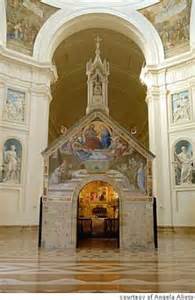
St. Francis of Assisi, came across the chapel as he wandered through the Italian countryside. He and his brother friars felt the Holy Spirit moving them. They realized that the Portiuncula, its Italian name, was special. They built simple huts around it, prayed and worshipped in it.
Eventually, long after Francis and his brethren had passed on; the chapel was enclosed in a magnificent basilica. Crowds of Franciscans, and laypersons, from the four corners of the earth still come to visit and worship the Lord. And the Lord touches the hearts of all who come.
Places of worship are built in many different ways, each is unique. In each one, though, is the potential to encounter the Living God. Be open to that potentiality.
Statue of Saint Francis of Assisi, Our Lady of Lourdes Church, Carver MA
Saint Francis of Assisi
“I have done what was mine to do. May Christ teach you what is yours.” Saint Francis of Assisi
Every October 4th, people around the world, Catholics, Protestants, persons with no declared religion; celebrate the memory of Saint Francis of Assisi. Born in the year of 1182, Francis was an energetic young man, talented, had a gift for drawing other young men of Assisi to himself for parties. He would soon felt the desire to become a knight, a heroic defender of Assisi. Being a commoner, that only way he could achieve this goal, was on the battlefield. He joined his fellow citizens in a military campaign against a rival Italian city state. The battle went terribly wrong for Assisi, Francis and others who survived the battle were captured and held in dungeons. There they waited for their families to ransom them. For some, like Francis, it was a long wait as families and friends tried to gather enough ransom money. Francis returned to Assisi as a broken man.
During his recovery, he would ride out into the countryside. On one such ride, he come across a beggar, who was also suffering from leprosy. Out of fear, Francis turned his horse around, ready to flee. But something made him stop, turn his horse around to face the leper. Getting off his horse, he went to the leper, took his money pouch and put it into the hands of the beggar. And then he kissed them. It was a moment of transformation, a moment of conversion.
Later, Francis found himself walking by a dilapidated chapel. He felt a strong desire to go into the chapel to pray. K in Before a wooden cross, with the image of the Crucified Christ, he knelt. Deep in prayer, Francis heard the Lord speak to him from the cross, “Francis, rebuild my church, which, as you see, is falling down.” And the rest, as they say, is history!
His life of prayer, voluntary poverty, and caring for the poor; has inspired thousands of men and women around the world. Men have joined the Order of Friars Minors, in it’s various formations, to work amongst the poor, to help the ill and disabled. Francis’ lifestyle inspired a young noblewoman, by the name of Clare, to take up a life of poverty and prayer. Drawn by her example, other women joined together to form like communities. Today, these communities bear her name, now called the Poor Clares. And still, the influence of Saint Francis continued to grow, indeed, continues to grow. Lay men and women also found inspiration from Francis’ example. The more they heard about the lives of Francis and his followers, the more they wished to imitate the Franciscan lifestyle. These lay followers soon formed their own groups, to pray together, to help the poor, to serve their families as well.
The Franciscan Family continues, it may experience times of growth, and times of loss; but it continues. Pace e Bene!!
Today, the Church, indeed, the world, celebrates the life and works of Saint Francis of Assisi! He was born into a merchant class family, in the town of Assisi, in the province of Umbria, Italy.
In his youth, he was known as a party boy. He had dreams of being something more. He dreamed of becoming a knight, of entering the noble class. He got the opportunity to earn a knighthood, when Assisi went to war with its rival town of Perugia. The battle went badly for Assisi, and its army was decimated. Francis found himself a prisoner of war, held in very harsh conditions. When he was released, his body and spirit were broken.
Back in Assisi, he underwent a conversion experience, determined to live a holy life. He began to visiting chapels that dotted the Umbrian countryside. He came upon a chapel, named San Damiano, that was dilapidated. While praying before its crucifix, he heard it speak to him, “Rebuild my house, for it is nearly falling down!” So began Francis life of service, starting with repairing chapels, to caring for the poor, to striving to live the Gospel life. By words and deed, he would attract followers from all over Italy. His example would inspire millions.
This day, in the days that follow, it be good for us to reflect on his life. To read his words, to follow his example of prayer and service, we can bring the Gospel to life, as he did!
The Portiuncula (“Mary’s little portion) was a small chapel built on the outskirts of Assisi. Owned by a local Benedictine monastery, the chapel had deteriorated over the years. By the time of St. Francis of Assisi, it was a shell of it’s former self. Francis had gone through his time of conversion, and was going about the Assisi countryside, repairing these abandoned chapels, including the Portiuncula.
Many of us have a place of worship that means a lot for us. It is a place where we may feel the Presence of God more deeply. So it was with Francis, and his brothers. But, as important as the Portiuncula was to them, it did not prevent them from going out into the fields, towns, and villages. They went out proclaiming the Good News, by word and deed.
Eventually, this chapel would become very dear to Francis and his brothers. They prayed in it daily together; celebrated Mass together. I once saw an illustration of the chapel, with it surrounded by small huts, built by the friars.
We are all called to go out and meet with others. We are all called to share the Good News of Jesus Christ with all we come in contact with.
The man who would become to be known in Franciscan history as Bonaventure, was born in central Italy, in the town of Bagnoregio. There is some disagreement over the year of his birth, though many experts and scholars have agreed on the year 1217. The son of a physician and housewife, he was baptized with the name “John.” He grew into manhood, and desired to become a scholar. In 1234, at seventeen, he entered the University of Paris. Now a new religious order of men were making news in Europe, the Franciscans. Founded by Saint Francis of Assisi, the “Poor Man of Assisi,” his followers were making a name for themselves, for their poverty, their sanctity, and their evangelical zeal. Their preaching and lifestyle drew many young men to come and join them. Among them was John, who received the name Bonaventure when he was admitted into the Order.
Upon his entry into the Order, Bonaventure took up the study of theology. In either 1253 or 1254, he became a master of theology, and head of the Franciscan school in Paris, until he was elected as the Minister General of Franciscan Order in 1257. His time in that office was spent trying to keep the Order from splintering into different factions. He strove to maintain a moderate approach to poverty, while at the same time, taking full advantage of the learning, the scholarship of his times. Always, he strove to remain faithful to the teachings and example of Saint Francis.
In 1273, Pope Gregory X named Bonaventure a cardinal bishop, and drew on his assistance in preparing for the Second Council of Lyons. It was during this Council that Bonaventure became ill and died on July 15th, 1274.
Bonaventure would be canonized on April 14th, 1482; and on March 14th, 1588, he was declared a Doctor of the Universal Church. He was given the title: “Seraphic Doctor.”
“Here Begins the Prologue To The Life Of Blessed Francis

In these last days the grace of God our Savior has appeared in his servant Francis to all who truly humble and lovers of holy poverty.

In him they can venerate God’s superabundant mercy and be taught by his example to utterly reject ungodliness and worldly passions, to live in conformity with Christ and to thirst after blessed hope with unflagging desire.

He was poor and lowly, but the Most High God looked upon him with such condescension and kindness that he not only lifted him up in his need from the dust of a worldly life, but made him a practitioner, a leader and a herald of Gospel perfection and set him up as a light for believers so that by bearing witness to the light he might prepare for the Lord a way of light and peace into the hearts of his faithful.”

From the Prologue of the Life of Saint Francis (Legenda Maior) by Saint Bonaventure
Moreover they should respect all creatures, animate and inanimate, which “bear the imprint of the Most High,” and they should strive to move from the temptation of exploiting creation to the Franciscan concept of universal kinship.Article 18, Rule of the Secular Franciscan Order
Morning weather reports speaks of drought conditions, of various degrees, existing in Massachusetts, and the rest of New England. A story on a morning news program shows drought conditions in Italy, and it’s affects on the Italian agriculture. And I have seen the pictures of the American West, forest fires burning up dried forests. The famous Lake Meade, slowly became a puddle. Yellowstone National Park, which I love with all my heart, damaged by floods, started by premature melting mountain snows.
All this confirms, for me anyway, that we are at a serious stage of global warming; that the window of opportunity to stop the effects is growing smaller. Special interests, who have a financial stake in keeping things as they are, are keeping the pressure up on civic leaders to leave things alone. And let’s be honest, we enjoy the comfort of our present lifestyle, and really do not want to change anything. But that may not be a choice we can maintain much longer.
It now that we followers of Saint Francis of Assisi need to act more forcefully, and take the implications of what it means love and respect God’s creation as St. Francis did. We are all created by God; we all share in the responsibility of maintaining life on this good Earth. All our actions, whether big or small, will have an effect. All our words, our political activity in defense of the environment can have an effect.
The work of a Franciscan is conversion, of ourself, of our society, of our world never ends. The time of taking it easy is past. The time of being silent is past. It is now time to roll up our shelves, and get to it.
Saint Clare of Assisi was born in 1194. A daughter of a noble Italian family of the city of Assisi. This young lady, who was not particularly interested in entering a noble marriage, heard Saint Francis preaching, and wanted to live the Gospel life he espoused. Because of the social strictures of her times, she began living the Gospel life behind the walls of a monastery.
From behind those walls, she was still able to inspire people to follow Christ. Women came to be admitted to her community located around the chapel of San Damiano, one of the first churches Francis repaired. They lived a simple life of prayer and work. They claimed nothing for their own, no dowries, no financial endowments. People came from all around Assisi, seeking her advice and guidance.
Her influence could be felt beyond the Italian borders; when a noble woman, Agnes of Prague, inspired by lives of Franciscan friars in Hungary, sought Clare’s advice. Agnes would herself establish a Franciscan monastery. Clare, would advise her in several letters. In her second letter to Agnes, she wrote:
O most noble Queen,
gaze upon Him,
consider Him,
contemplate Him,
as you desire to imitate Him.
If you suffer with Him, you will reign with Him.
If you weep with Him, you shall rejoice with Him;
If you die with Him on the cross of tribulation, you shall possess heavenly mansions in the splendor of the saints and,in the Book of Life, your name shall be called glorious among men.
“Christ is both the way and the door. Christ is the staircase and the vehicle, like the throne of mercy over the Ark of the Covenant, and the mystery hidden from the ages.
A person should turn his full attention to this throne of mercy, and should gaze at him hanging on the cross, full of faith, hope and charity; devoted, full of wonder and joy, marked with gratitude, and open to praise and jubilation. Then such a man will make with Christ, a pasch, that is, a passing over. Through the branches of the cross, he will pass over the Red Sea, leaving Egypt and entering the desert. There he will taste the hidden manna, and rest with Christ in the sepulcher, as if he were dead to things outside. He will experience as much as is possible for one who is still living, what was promised to the thief who hung beside Christ: ‘Today you will be with me in paradise.’”
– From “Journey of the Mind to God” By Saint Bonaventure, Seventh Minister General of the Order of Friars Minor (Franciscans)
“Father, you helped Elizabeth of Hungary to recognize and honor Christ in the poor of this world. Let her prayers help us help us to serve our brothers and sisters in time of trouble and need.
We ask this through our Lord Jesus Christ, your Son, who lives and reigns with you and the Holy Spirit, one God, forever and ever. Amen.”
From the FranciscanSupplement for Liturgy of Hours.
In times like the ones we are going through right now, we need St. Elizabeth’s example to inspire us; and her intercessions to strengthen us!






 Musings From St. Anthony's Walnut Tree