Feast of Our Lady of the Angels – Portiuncula

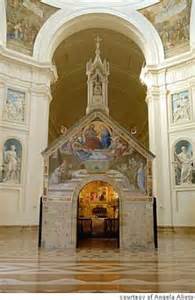
Chapel of Our Lady of the Angels – Portiuncula

August 2, is one day that is remembered by all Franciscan Friars, Poor Clare sisters, and all Third Order members, whether Friars, Sisters, or Laypersons; the Feast of Out Lady the Angels.

St. Francis of Assisi, came across the chapel as he wandered through the Italian countryside. He and his brother friars felt the Holy Spirit moving them. They realized that the Portiuncula, its Italian name, was special. They built simple huts around it, prayed and worshipped in it.

Eventually, long after Francis and his brethren had passed on; the chapel was enclosed in a magnificent basilica. Crowds of Franciscans, and laypersons, from the four corners of the earth still come to visit and worship the Lord. And the Lord touches the hearts of all who come.

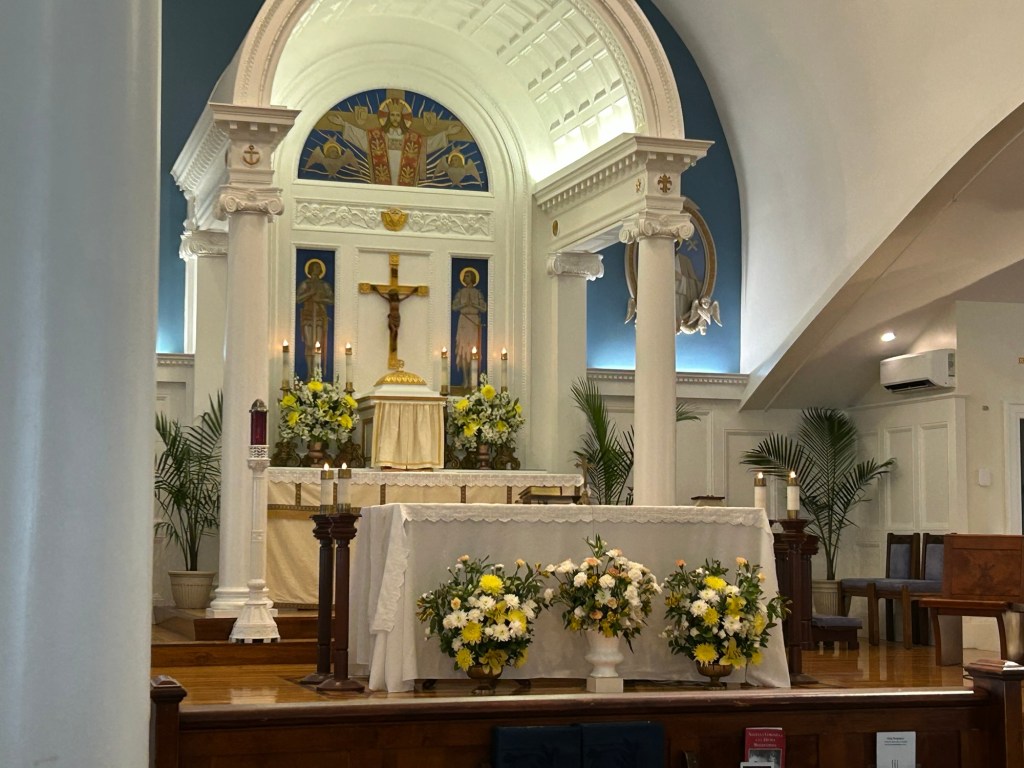
Places of worship are built in many different ways, each is unique. In each one, though, is the potential to encounter the Living God. Be open to that potentiality.

John Allen’s conspicuous absence explained

ROME – Regular readers of Crux, or regular consumers of my weekly video or podcast, will have noticed my rather conspicuous absence these past three …

John Allen’s conspicuous absence explained

Sad day! John Allen has always been one of my favorite columnists; both at National Catholic Reporter and Crux. I pray for his healing and recovery.

Homily for 30th Sunday In Ordinary Time

“Jesus said to him in reply ‘What do you want me to do for you?’ The blind man replied to him, ‘Master, I want to see.’ “

In today’s Gospel of Mark, we see the encounter Jesus had with Bartimaeus, a blind man. Bartimaeus must have known something of who Jesus was, and the power of healing he seemed to possess. Bartimaeus decided to take a risk and began calling out loudly to Jesus, begging for help. Some in the crowd thought of him as a nuisance.

Jesus did not think so, he had Batimaeus brought over to him. When this was done, Jesus did not lay his hands on him, as some of the people would have expected. Instead, Jesus told Bartimaeus that he could leave, “..your faith has saved you.” His sight was restored to him.

Now most of us do not have to deal with blindness; at least, not physical blindness. But what about social blindness, spiritual blindness? Where and when have we turned a “blind eye” to others in need, to others who are in suffering; to our own personal suffering?

It is moments such these, that we need to open ourselves to the Presence of Christ, to enter into prayer, to pray that our eyes, our minds, our hearts, our souls; be opened to the needs of others. And to our own need for healing.


So, I invite all of us, to, at the best of our ability, be present to our Savior in the Eucharist. And let ourselves be transformed, our eyes opened, and our journey with Christ renewed.

Saint Peter’s Church, Plymouth MA.

Palm Sunday Homily – 2024

Saint Kateri Tekakwitha Church, Plymouth, MA

“Christ became obedient to the point of death, even death on a cross. Because of this, God greatly exalted him and bestowed on him the name which is above every other name.”

This weekend, we are entering a time of holiness, a time of both remembering and reflecting on the events that lead up to the death and the resurrection of our Lord Jesus Christ.


Now, out there, in our communities, our towns and cities; Easter time has already taken hold. Bright colors, sweets, pastries and fancy meals are already popping up all over; enticing us, tempting us.

But here, in this church and in all other churches, other places of worship; the somber color of purple reigns. Especially in this moment, when we read, when we hear the Gospels that proclaim the story of the Passion of Our Lord. We are called to reflect more deeply on what Jesus went through for us, to save us finally from the grip that Original Sin had over us, and to give us new hope for the future.

We, in turn, are called to proclaim that Good News, by our words and deeds, to everyone we come in contact with.
As Holy Week begins, let us focus more deeply on what we entering into, let the Holy Spirit in and let it transform us. And on Easter morn, let us sing out with joy.

“Good Pope John!”

Pope John XXIII

Saint John XXIII was born Angelo Giuseppe Roncalli, in 1881. Born to an Italian peasant family, the fourth child in a family of fourteen. He felt called to the priesthood, and entered a seminary. Encouraged by his spiritual director, he joined and was professed into the Secular Franciscan Order. He was ordained a priest in 1904.

In 1905, he served as secretary to the bishop of the Diocese of Bergamo, Italy. When World War I began, Father Roncalli was drafted into the Italian Army as stretcher bearer. He would receive promotion to the rank of sergeant for his work. He eventually was made a chaplain within the army.

He would enter the diplomatic service for the Holy See, He was sent to Bulgaria, Turkey and Greece. He would be consecrated a bishop and eventually an Archbishop. While in Turkey, during World War II, he used his diplomatic status to help Jewish families escape the Nazi persecution.

After the war, Roncalli remained active in the Papal diplomatic service. He served as nuncio in France for a time. In 1958, he was both made a Cardinal and named Patriarch of Venice, Italy, which also made him an Archbishop.

In 1958, with the death of Pope Pius XII, a Papal Conclave was called. After eleven ballots with no results. The Cardinals settled on Cardinal Roncalli, as a “caretaker” Pope. He would prove be anything but a “caretaker.” He summoned the world’s bishops to an Ecumenical Council, known today as Vatican II. With his encouragement, the bishops discussed matters concerning the life of the Church, and its relationship with the world. From it would come documents that would renew the Church.

He would not see the end of this great project. John XXIII died on June 3rd, 1963. He was canonized a saint in 2014.