A Franciscan’s Perspective: Blessed Ramon Lull, His Life and the Takeaway.

Blessed Ramon Lull“Therefore, any brother who, by divine inspiration, desires to go among the Saracens and other unbelievers should go with the permission of his minister and servant…As for the brothers who go, they can live spiritually among [the Saracens and nonbelievers] in two ways.  One way is not to engage in arguments or disputes, but to be subject to every human creature for God’s sake (1 Pet 2:13) and to acknowledge that they are Christians.  Another way is to proclaim the word of God when they see that it pleases the Lord, so that they believe in the all-powerful God-Father, Son, and Holy Spirit-the Creator of all, in the Son Who is the Redeemer and Savior, and that they be baptized and become Christians; because whoever has not been born again of water and the Holy Spirit cannot enter into the Kingdom of God (cf. Jn 3:5).  (The Early Rule of the Order Friars Minor; Chap XVI: 2-3, 5-7)The

Today, June 30th, the Catholic Church remembers Blessed Ramon Lull, who was a member of the Secular Franciscan Order.  He was born in 1232 AD, on the island of Majorca.  He was extremely well-educated and served in various royal courts on the Iberian Peninsula.  After listening to a sermon that touched his heart, he earnestly strived to live the Gospel life as a Secular Franciscan.  He promoted missionary work among the peoples of North Africa; working to establish mission colleges, where missionaries could learn Arabic.  He firmly believed that the way to bring non-believers to Christ was not with the sword, but through prayer and dialogue.  He took time away from his college building efforts, and lived the life of a hermit for nine years.  During this time, he produced a substantial amount of spiritual and philosophical works.  In 1314, at age seventy-nine, he went to North Africa, to be a missionary himself.  There he encountered a mob of hostile Muslims, who stoned him, and mortally injured him.  Some merchants were able to get him on a ship bound for Europe.  He did in 1315.

Francis of Assisi once described himself as a herald of the Great King, Jesus Christ.  He encouraged his brother friars to go out and preach about the love of God, to all they came in contact with, believer and non-believer alike.  But he also wanted their words to be backed up by their actions; by their works of charity, and showing respect to all they came in contact with.  In the first draft of the Order’s Rule (Regula Non Bullata), he describes the two ways his friars were to evangelize, by way of life, or open proclamation of the Gospel of Jesus Christ.

The Catholic Church, and especially the Church here in the Archdiocese of Boston, are being called to engage in a New Evangelization.  One way of evangelization is live our lives as believers of the Good News; as those who have a relationship with God through Jesus Christ.  This relationship should color how we interact with others, in our families, our workplaces, and in the marketplace.  The other is to never be shy about sharing what our personal encounter with Christ has meant for us; what it has changed in us.  We share our struggles with our faith; we share the joys of our faith.  And we have the courage to invent others to come and see.

Evangelization is something God is calling us to be involved in, in our world today; right now, right here.  We are all called to be heralds of the Great King!
When a Deacon Made a Difference

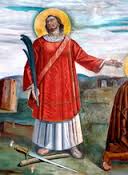
arialdoWhile surfing various topics on the Wikipedia, I came across an entry for Saint Arialdo, an Italian deacon who lived in the 11th Century.  Born of a noble family, he was well educated, attending a couple of universities.  He became a deacon in the Diocese of Milan, and joined a group of Milanese citizens with the goal of reforming the diocesan clergy, and Milan’s corrupt bishop.  The efforts by Arialdo and his compatriots eventually lead to the excommunication of the bishop.  On June 27, 1066, his henchmen would later ambush and assassinate Arialdo, while he was on a journey to Rome.  In 1067, Pope Alexander II would declare Arialdo a martyr and saint.

Even, in the early Middle Ages, deacons had an influential affect on the life of the Church.  The Diaconate may be different these days, but we deacons are still called to bring new life to our local parishes; by our ministries, and by the way we each live the Gospel of Jesus Christ.

What is Behind a Title?

st anthony walnut tree 2What was the genesis of my blog’s title?  To answer the question, I need to write a little about where I was coming from, when I finally decided to begin blogging.  Most of my adult life, from my college years, to the 1980’s, I have been in some type of religious, spiritual formation; feeling called to life as a Catholic priest, and later, to be a Franciscan friar.  I would finally discern that God wanted me to follow a different path; which lead me into the business world, and to my wonderful wife, Peg.  One thing that did not change for me, though, was the Franciscan spirit I inherited from the friars.  I found myself joining the Franciscan lay movement, known as the Secular Franciscan Order.

Fast forward a few years, to around 2008; where I was becoming more acquainted with the concept of Web blogging.  I inherited my interest in personal computing from my Dad, and I was finding this blogs, with these interesting articles.  I was wondering if there was anything I could contribute to mass of online information.  One day, I browsing through Border’s bookstore, (it was still in existence then!) when I came across a book, “The Huffington Post Complete Guide to Blogging!”  I purchased it, and devoured it in a few days.  I decided to give it a try, and in 2009, I opened my first blog on “Blogger.”  But what was I going to call this new blog?  It was suggested that any title I picked had to be unique, to separate it from the other blogs.  My hope was to share my observations of what was happening in my country, the world, and in my Church.  I would draw on whatever insights came to me from my Catholic, Franciscan spiritual life.  Now, for Franciscans, out of all the saints in the movement, the key ones are Saint Francis of Assisi, Saint Clare of Assisi, and Saint Anthony of Padua.

Saint Anthony of Padua has been popular with Roman Catholics, because of his reputation as a miracle worker; “Miracles waited on your every word, which you were ever ready to speak for those in trouble or anxiety.”  This is part of a prayer, addressed to St. Anthony; asking for his intercession.  However, St. Anthony was also famous as a preacher.  A trained theologian when he joined the Franciscan Order, he was sent on preaching tours throughout northern Italy, and southern France.  He was successful not only because of the quality of his sermons, but also the example of his life.  After many years of bringing the Gospel of Christ to all who would listen, he sensed his life was drawing to an end.  He went to a friary, located in a small village near the Italian city of Padua.  There, he asked his fellow friars to build him a tree house, in a walnut tree.  There, he intended to spend his last days in deep prayer and contemplation.  However, people still sought him out; seeking spiritual guidance, or a word on the Love of God.  St. Anthony died on June 13, 1231.

So I decided to name my blog; “From Saint Anthony’s Walnut Tree.”  Later, I would reestablish the blog on WordPress; and one of the Blogging 101 assignments was to tweak our titles.  It suddenly came to me tweak the title to:  “Musings from Saint Anthony’s Walnut Tree.”  I think it more accurately indicates what I hope to accomplish with this

All About Me

blog.

Book Review – Catholic Spiritual Practices, A Treasury of Old & New

Catholic Spirituality: A Treasury of Prayers and PracticesCatholic Spirituality: A Treasury of Prayers and Practices by Colleen M. Griffith

My rating: 5 of 5 stars

View all my reviews

For the Catholic who wishes to update his/her knowledge of the Catholic Spiritual life, this is a very good primer. It talks about the traditional Catholic devotions and practices, but with a modern tone. Some of the devotions of my youth, that I abandoned as I have grown older; I now find myself wishing to engage in again. I hope others will have the same experience.

Laudato Si’ is Out; And it is Shaking Things Up!

Laudato Si 2On June 18th, the Vatican officially released Pope Francis’ encyclical on the environment:  “Laudato Si’.”  Truth be told, I have not actually read the document myself; I am basing my own observations on the analysis and commentary of others, whose opinions I trust.  Chief among them is John Allen, Jr. of Crux who has done some analysis on the encyclical.

The theological analysis of the document I have; comes from Father Dan Horan OFM, of Dating God, who gives a Franciscan perspective on the encyclical.  The other comes from Jay Michaelson, of Religion News Service.  He brings out some of the theological points in the document that he considers truly radical.

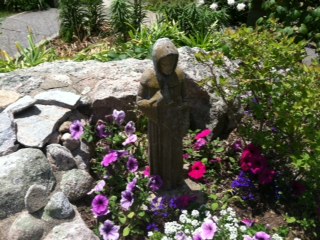
As a Franciscan, the theological points that grabbed my attention were found in Chapter 2: “Human life is grounded in three fundamental and closely intertwined relationships: with God, with our neighbors, and with the earth itself.”  And in Chapter 3: “Our ‘dominion’ over the universe should be understood more properly in the sense of responsible stewardship.”  To Western ears these statements may seem very strange, but they are not new.  If one was to get beyond the image of St. Francis of Assisi as a statue holding a birdbath, one can see a Francis who knew that because of his intimate relationship with God, he had to have an intimate relationship with all people, and all creation.  Joined intimately with Christ, through the Gospels, through the Eucharist, and prayer, he was fully open to, and accepted the reality that he shared a kinship with all people, with all creatures, with everything that exists.

Francis passed this realization on to his followers, through his words and his actions.  Sadly, some of his children did not realize the depth of his teaching, but in recent times, we are finally beginning to get the point.  In our Secular Franciscan Rule, we have Article 18: “Moreover they should respect all creatures, animate and inanimate, which bear the imprint of the Most High, and they should strive to move from the temptation of exploiting creation to the Franciscan concept of universal kinship.”

It is this idea of “universal kinship” that Pope Francis is calling on the world, on all of us, to realize, and to act on.  It is a call to change our way of life, that is abusing our earth, and live in ways that will enhance our planet.

I do plan to read this encyclical myself, and hopefully I will be able share my own insights with you soon.  Pace e Bene!

Countdown to the “Eco Encyclical”

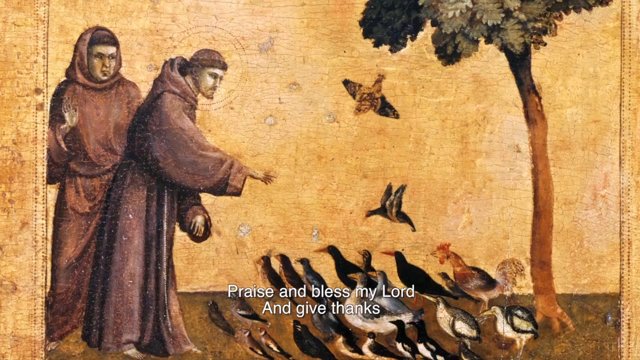
Canticle of the SunIn anticipation of the release this morning (5:00 AM EST) of Pope Francis papal encyclical on the environment; the “Canticle of the Sun” by St. Francis of Assisi:

Most high, all powerful, all good Lord!

All praise is Yours, all glory, all honor, and all blessing.

To You, alone, Most High, do they belong.
No mortal lips are worthy to pronounce Your name.

Be praised, my Lord, through all Your creatures,
especially through my lord Brother Sun,
who brings the day; and You give light through him.
And he is beautiful and radiant in all his splendor!
Of You, Most High, he bears the likeness.

Be praised, my Lord, through Sister Moon and the stars;
in the heavens You have made them bright, precious and beautiful.

Be praised, my Lord, through Brothers Wind and Air,
and clouds and storms, and all the weather,
through which You give Your creatures sustenance.

Be praised, my Lord, through Sister Water;
she is very useful, and humble, and precious, and pure.

Be praised, my Lord, through Brother Fire,
through whom You brighten the night.
He is beautiful and cheerful, and powerful and strong.

Be praised, my Lord, through our sister Mother Earth,
who feeds us and rules us,
and produces various fruits with colored flowers and herbs.

Be praised, my Lord, through those who forgive for love of You;
through those who endure sickness and trial.

Happy those who endure in peace,
for by You, Most High, they will be crowned.

Be praised, my Lord, through our sister Bodily Death,
from whose embrace no living person can escape.
Woe to those who die in mortal sin!
Happy those she finds doing Your most holy will.
The second death can do no harm to them.

Praise and bless my Lord, and give thanks,
and serve Him with great humility.

Reflection on Last Weekend’s Retreat

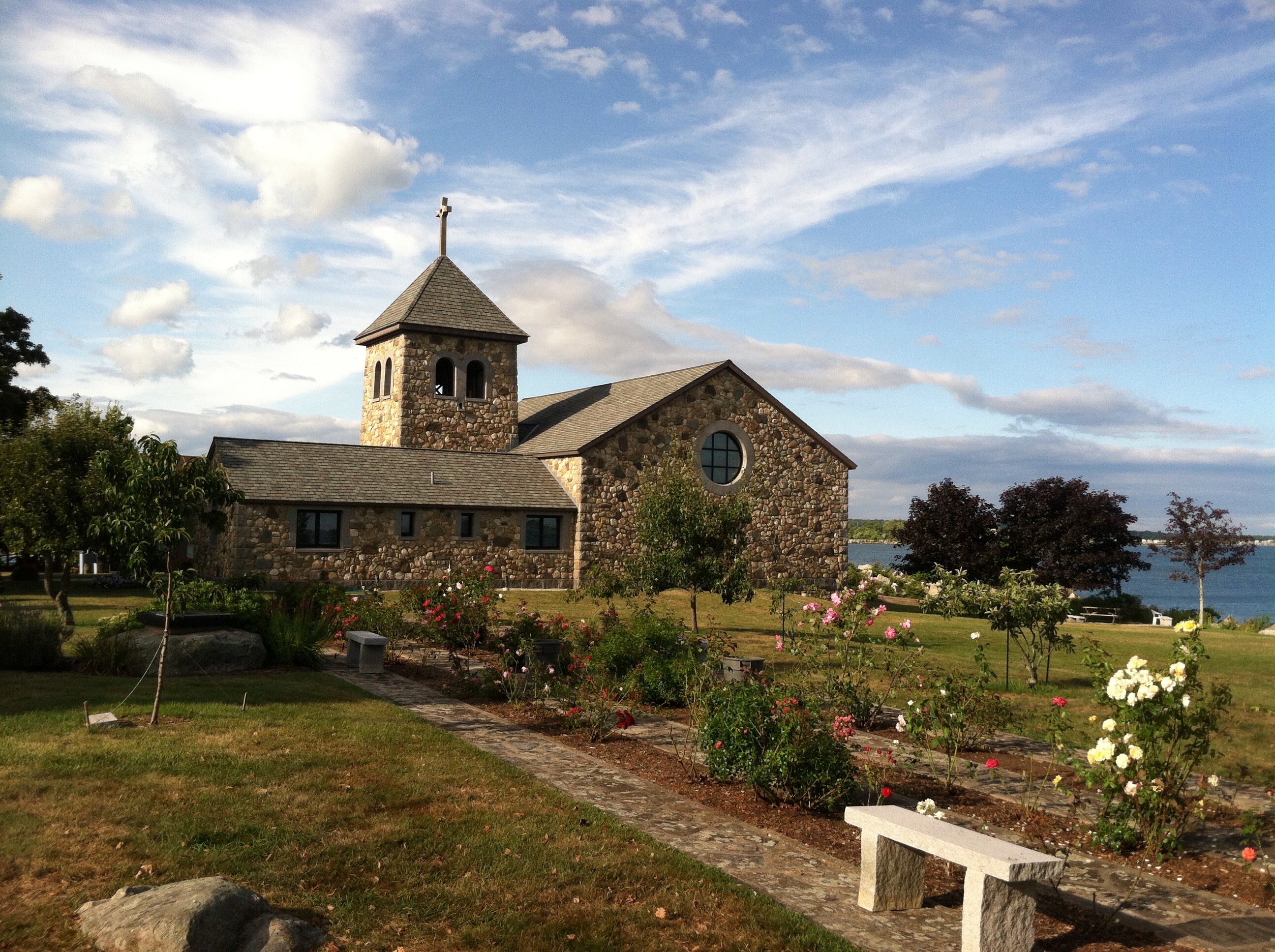
As I have posted previously, members of the Diaconate classes ordained in 2012, 2013, and 2014, are required to come together for a jointEnders Island Chapel retreat.  This year’s retreat was held at Saint Edmund’s Retreat Center, on Enders Island, Mystic, CT.  Our retreat director was Father William Murphy, who is on the staff of St. Pope John XXIII National Seminary, MA.
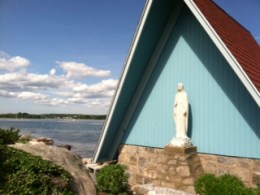
Some random thoughts from the retreat:

The Church’s primary message, received from Jesus Christ, what we Deacons are to proclaim by our words and actions: God loves us, God cares for us.

No matter what matter troubles afflict us, no matter what anxieties there are in our lives, “we are being held in God’s arms, we are safe!”

In the Book of Exodus, we see the Hebrews threatened by Pharaoh’s army, God tells them to stand firm, and not to be afraid, and He will save them.  God is also telling us to stand firm in the face of pain and suffering we may be experiencing; He will be there to help us.  God wants us bring all thing to Him, our joys and our fears.  In the Gospels, Jesus promises that He will be there to help us with our burdens.

As Deacons, we are to be witnesses of the Love of God.  When we proclaim the Good News of Jesus Christ, by the words we speak to others, by the care we give to others, we are witnessing to God’s love.  When we help to raise people up from their burdens, we are witnessing to the love and hope that comes to us through Jesus Christ.

I know that for some these words may sound hollow; I will admit that at times the road ahead right now looks dark threatening.  But I also know that God cares for me, and is trying to help me, right here, right now, if only I just open my heart and soul to his Presence.  I trust in the words of Jesus, when today, He promises to be with me, and will be with me till the end of the agEnders Chapel JFJe.

This is the truth all of us Christians, especially we ministers of His Word must witness to, at every moment of every day.

A task Father gave to us Deacons was to remember the words from our Ordination and live them: “receive the Gospel of Jesus Christ whose heralds you have become.  Believe what you read, teach what you believe, and practice what you teach.”

The retreat was definitely a time to practice deeper prayer, to be more present and open to my God.  The challenge now is carrying that experience forward into my daily life. Enders Island 3

End of Retreat -Packing Up

Enders Is ChapelIt is Sunday, and our Deacon weekend retreat at Enders Island is coming to an end.  The day’s were filled with conferences, times for silent reflection and prayer.  I will be honest, I have not felt like writing and sharing on this blog, for which I am apologize.  Even this post will be brief, because, first all the laptop is being particularly cranky now; and I have to pack it it soon, and it needs time to cool down.

Just let me say it has been a very refreshing retreat, a challenging retreat, a prayerful retreat, and a retreat full of good fellowship.  The day I spent gazing at the sea; the evenings looking up at a star filled night.  Once is reminded of the beauty, and awesomeness of God, who created all this, and yet still cares for each one us, who loves each one of us.

More later.

Howdy!!…….One More Time!

My modified profileHowdy, my name is Jonathan Francis Jones. I am a 62 year old man, who is happily married, a Roman Catholic, a Secular Franciscan, and an ordained Permanent Deacon.  Oh, and as of January, 2015, I have been unemployed.  This is my second go-round with Blogging 101; but to all of you newbies, allow me to reintroduce myself.

Ever since I was a kid in elementary school, I felt that God was calling me to some sort of service.  After high school, I entered the Catholic seminary for the Archdiocese of Boston, and spent eight years in studies.  I felt the need to take a leave of absence for a year to sort some things out.  I spent the year with an ecumenical organization called: “A Christian Ministry in the National Parks.”  It recruits theology students, and other college students, to go out into the country’s national parks, lead Sunday worship services, Bible studies and other activities.  I spent the summer in Yellowstone National Park, leading Sunday services at Old Faithful Inn; and washing dishes the rest of the time.  The Fall and Winter of that year, I was in Texas, at Big Bend National Park, right on the Rio Grande River.  My “earn my keep” job was being a night watchman; after which, on Sunday morning, I lead 2 worship services.  It was in the midst of all this natural beauty that I began to sense the Holy Spirit drawing me to testing a calling to be a Franciscan friar.  I spent at year and half in formation, when I came to discern that maybe I was meant to go down a different road.

So I found myself working in the Mutual Fund industry, servicing customers, but I was still felt being called to be a follower of St. Francis of Assisi.  Fortunately, the Franciscan movement has a lay branch, the Secular Franciscan Order.   I became a professed member in 1988, coincidently, the same year I married my beautiful, wonderful wife, Peg.  I remained active in the Church, as a member of my parish choir, and as a reader during the Sunday Mass.  I continued my life of prayer and service, still feeling called to go deeper.  I, along with my wife, entered the formation program for the Permanent Diaconate.  In September, 2012, I, along with my fellow classmates, were ordained as Deacons.  Peg, with the other wives, gave me the vestments I was to wear.  I have been assigned to several parishes in Beverly, Massachusetts, serving the people there I whatever way I can.

While, still in the Diaconal formation program, I felt called to blog; yes, called!  As I surfed the Web, I came across blogs that I really enjoyed, some that infuriated me, and others that confused me to no end.  One day, during 2009, in a downtown Boston bookstore, I found a book: “The Huffington Post Complete Guide to Blogging.”  I bought it, read it cover to cover.  I felt God calling me to share my faith experience with others, to try my hand at being an electronic evangelizer.  At the same time, I wanted to share my own observations of what is happening in my community, my Church, and my world.  So in 2009, I started my first blog, on Google’s Blogger, I would later move to WordPress.

I am hoping that through my random scribbles, I can inform, get people thinking, and in some small way, share the Good News of Jesus Christ.