All Souls Day in Beverly – 2015

“For this is the will of my Father, that everyone who sees the Son and believes in him may have eternal life, and I shall raise him up on the last day.”  (John 6:40)

All Souls a 2015On the Catholic Church calendar, yesterday, November 2, 2015, was the Commemoration of All the Faithful Departed; also known as All Souls Day.  The Beverly Catholic community celebrated an evening Mass of Remembrance for all the deceased members of the three parishes in the city: St. Mary, Star of the Sea, St. Margaret of Scotland, and St. John the Evangelist.  The Mass was celebrated at St. Mary’s, with our pastor, Father Mark, our parochial vicar, Father Karlo, and one of our two deacons, me!  St. Mary’s is one of those 19th century churches that no one can afford to build anymore; with a high vaulted ceiling, beautiful stain glass windows, and an impressive sanctuary.

We had a good turnout of parishioners from all three parishes.  St. Mary’s choir beautifully provided music for the service.  I proclaimed the Gospel reading, which was taken from Matthew 11: 25-30.  Father Mark then gave a very moving homily.  After the homily, he read a roll of those from the Beverly Catholic community, who passed away since November, 2014 till now.  Every votive candle in the church had been gathered in front of the sanctuary; as a deceased person’s name was announced, a candle was lit.  Should a member of the deceased’s family, or a close friend was present; they were invited to light a candle.  Soon, the majority of the candles were lighted, quite a few family members had come up.

A couple of years ago, my mother had passed away; I was an ordained deacon, and I preached at her funeral Mass.  I took as my text, John 14: 1-14 (I think).  I focused on John 14: 2-3: “In my Father’s house there are many dwelling places.”  I focused on the theme of pilgrimage; that from the moment we are born, the moment we are baptized, we begin a pilgrimage; a journey of exploration as to what it means to be an adopted child of God the Father.  And this pilgrimage does not end when we die, but it becomes a journey of purification; helped by the prayers of the loved ones we left behind.  Our pilgrimage will end when we finally reach the place that Jesus Christ has prepared for us; and we are in the Holy Presence of our God.

All Souls Day expresses our hope, that those who have gone before us will find the final destination of their pilgrimage soon.  And that they will be praying for us, when we ourselves will begin the next leg of our own life journeys.

All Souls 2015l

Feast of All Saints

“After this I had a vision of a great multitude, which no one could count, from every nation, race, people, and tongue.  They stood before the throne and before the Lamb, wearing white robes and holding palm branches in their hands.  They cried out in a loud voice: ‘Salvation comes from our God, who is seated on the throne, and from the Lamb.”  (Revelation 7: 9-10)

All SaintsToday, the Christian world, especially the Catholic Church, celebrates the Feast of All Saints.  The Church remembers all those who are saints; those officially recognized by the Church and those who are unknown but to God.  The Church believes that when we die, our souls are in need of purification before we can enter into heaven.  This purification takes place in purgatory.  There are those, however, because of how well they lived the Gospel life, are admitted into heaven; come face to face with God, and experience perfect happiness.  These individuals are considered saints.

How does one become a saint; the Gospel reading for today’s Mass, the Beatitudes shows a starting point for one to begin the process.  So is living the two greatest commandments, “You shall love the Lord, your God, with all your heart, with all your soul, and with all your mind.  This is the greatest and the first commandment.  The second is like it: You shall love your neighbor as yourself.”  (Matt 22: 37-39).  To become a saint is no easy task; it requires a radical interior change, a conversion.  Trying to do it on our own is impossible.  But we are not alone, God is with us.  If we open our hearts to him, he will give us the strength, the grace, to achieve the goal of sainthood.  Jesus Christ, coming to us in the Eucharist, gives us the food for this journey; the Holy Spirit gives us the guidance, the inspiration to continue the journey.

There is no measure that will tell us how successful we are.  We can only continue to strive to live the teachings of Jesus, to strive, through prayer, to be in a close relationship with God.  And we must accept the fact, that there will be times when we will fail.  There will days of dryness, disappointments, feelings of failure.  It is at moments like these, that the lives of saints can be a source of inspiration for us.  In particular, those biographies that reveals both the successes and failures of a saint trying to live the Gospel; because we can identify with them.  We can learn how they overcome their obstacles, and begin thinking about starting again.

I like to think of the communion of saints, something like those crowds of people gathered at the end of a race.  They have run their race; and now they are calling out to us, urging us on to the finish line.

“Who can ascend the mountain of the Lord?

or who may stand in his holy place?

One whose hands are sinless, whose heart is clean,

who desires not what is vain.

He shall receive a blessing from the Lord,

a reward from the God his savior.

Such is the race that seeks him

that seeks the face of the God of Jacob.  “(Psalm 24)

Finish Line

“Do Not Worry About Tomorrow…”

sermon-on-the-mount

“Therefore, I tell you, do not worry about your life, what you will eat, or drink, or about your body, what you will wear.  Is not life more than food and the body more than clothing?…Can any of you by worrying add a single moment to your life-span?… If God so clothes the grass of the field, which grows today and is thrown into the oven tomorrow, will he not much more provide for you.  O you of little faith?  So do not worry and say, ‘What are we to eat?’ or ‘What are we to drink?’ or ‘What are we to wear?’  All these things the pagans seek.  Your heavenly Father knows that you need them all.  But seek first the kingdom of God and his righteousness, and all these things will be given you besides.  Do not worry about tomorrow; tomorrow will take care of itself.”  (Matt 6: 25, 27, 30-34)

For the past few weeks, I have been attending a bible study, sponsored by the Beverly Catholic Collaborative.  There are nine of us in the group, and we are looking at the Gospel of Matthew.  We are following a bible study program called: “The Great Adventure: Matthew,” written by Jeff Cavins, and Sarah Christmyer.  The program utilizes videos of talks by Mr. Cavins, after there has been a discussion of the material.

Last night, I was the facilitator.  The evening went well, and I got positive feedback on my efforts.  I did find it interesting that it was Chapter Six of the Gospel of Matthew, that we were discussing, especially verses 25 to 34.  I do not know of anybody, who is not at least a little anxious about his/hers personal  and family finances.  This is especially true if one has been unemployed for an extended period of time, and unemployment insurance is running out.  The anxiety can be overwhelming at times, so much so that it can distract us from our relationships; with family, with friends, and ultimately, with God.  And this the subtle threat of anxiety, of worry; it can wear us down, cause us to despair, and become depressed.  We then find ourselves in a deep dark hole.

The Gospel seems to promise that if we trust the Father, all will be provided for us.  Jesus is encouraging us to let go of the anxiety, let go the fear.  This is easier said than done, especially when the realities of life come knocking at our door.  What Jesus Christ is asking of us, is to remain focus on God, to remain faithful to the teachings he is giving.  Through the Letter of St. Paul to Philippians, Christ indicates what we can expect that will help us through trying times: “Have no anxiety at all, but in everything, by prayer and petition, with thanksgiving, make your requests known to God.  Then the peace of God that surpasses all understanding will guard your hearts and minds in Christ Jesus.”  (Phil 4: 6-7)

If we strive to maintain that peace of Christ in our hearts and minds, then as Julian of Norwich is quoted of saying: “All will be well.”

Bus Trip Home, and Then Some! – Friday Fictioneers

copyright-ron-pruitt

She came to LA with dreams.  She is returning home on a bus, with broken dreams, and a baby.  The baby becomes very fussy; passengers getting annoyed.  At one stop, a brown robed friar, straight from central casting, takes the seat next to her.  He offers to hold the child, she accepts.  He sings Italian lullabies to the baby.  Entering Frisco, he hands the child back to her, looks into her eyes, and whispers: “Pace e Bene!”  Squeal of brakes makes her look forward; turning back, he has disappeared!  The bus quickly passes a church, she glimpses a familiar statue.


Photo by Ron Pruitt

New Executive Council Elected for the National Fraternity (USA) of the Secular Franciscan Order!

“The Secular Franciscan Order holds a special place in this (Franciscan) family circle.  It is an organic union of all Catholic fraternities scattered throughout the world and open to every group of the faithful.  In these fraternities the brothers and sisters, led by the Spirit, strive for perfect charity in their own secular state.  By their profession they pledge themselves to live the gospel in the manner of St. Francis (of Assisi) by means of this rule approved by the Church”  (Rule of the Secular Franciscan Order, Art. 2)

“The Secular Franciscan Order is divided into fraternities of various levels-local, regional, national, and international.  Each one has its own moral personality in the Church.  These various fraternities are coordinated and united according to the norm of this rule and the constitutions.

On various levels, each fraternity is animated and guided by a council and minister (or president) who are elected by the professed according to the constitutions.”  (Rule OFS, Art. 20-21)

National Council NAFRA OFS

When the Secular Franciscan Order was first established in 1221, it was a movement that was lead by laypersons, elected by the professed members.  As time went on, for various reasons, the Franciscan Friars began to exercise more authority over the movement.  The Order was divided among the First Orders’ provinces.  After the Second Vatican Council, with its directive for religious orders to rediscover their roots and charism, the Seculars took a new look at their founding history and documents.  A renewal took place; the various worldwide OFS fraternities were united under one Minister General and international council.  Nationally and regionally, fraternities were united, governed by their own elected ministers and councils, with guidance from Franciscan friars and sisters.

On October 17th, representatives from the regional fraternities gathered in Clinton, New Jersey, in a Chapter of Elections.  The results being that Jan Parker, OFS, is our new National Minister.  The names of the rest of the National Executive Council are available at this link.  Through the intercession of St. Francis, may God bless them with wisdom, charity, and inspiration, which will guide us well in coming years.

A Very Different Way of Outreach!

From Catholic News Agency.

From Catholic News Agency.

There have been many polls that indicate that there are many Catholics, both in the United States and other countries, who have fallen away from regular Church attendance, and receiving the Sacraments.  Many dioceses are trying to figure out ways of bringing people back; how to engage with them.  The Catholic News Agency has reported on one very imaginative approach.  At a shopping mall in Bogata, Columbia, 350 priests participated in a “Confess-a-Thon,” that ran from October 6th to the 7th.  The priests set up Confession stations throughout the mall, and anyone who wished, could receive the Sacrament of Reconciliation.  Many took advantage of the opportunity.  Other individuals took the opportunity to just be able to talk to a priest.  Think of how many persons were touched by these priests, who were willing to think, and act outside the “box!”

A Reflection On Pope Francis Speech Before Congress.

I am just now beginning to reflect and put into words what I have taken away from Pope Francis’ visit to the United States.  What I would like to first write about is the Holy Father’s speech before the joint session of Congress.  I was floored by his references to four Americans; President Abraham Lincoln, Reverend Martin Luther King, Jr., Dorothy Day, and Thomas Merton.

Abraham LincolnGrowing up, the only thing I knew about Abraham Lincoln was that he led the country through the Civil War, and that he freed the slaves.  It was not until I watched Ken Burns’ documentary: “The Civil War,” that I came to appreciate the depth of Lincoln’s character, his determination, and his sacrifices.  When he began his presidency, he was not a fervent abolitionist.  He believed that if he could restrict slavery to the Deep South; keep it out of the new territories, it would die out from economic pressures.  When the Civil War began, his primary concern was to preserve the Union, even if it meant keeping slavery.  However, as the war continued, with the vast amount of blood spilled in the conflict, Lincoln came to realize that a higher cause needed to be recognize, the cause of freedom for all persons in America.  He expressed this higher cause in his Gettysburg Address, calling for “a new breath of freedom.”  It began with the Emancipation Proclamation, which freed the slaves in the Confederate States, and concluded with the passage of the Thirteenth Amendment, which ended slavery forever.

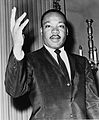
Martin Luther King, Jr.It was to further the cause of liberty that brought Martin Luther King, Jr., to take on the mantle of leadership of the Civil Rights Movement.  I grew up during those tumultuous years, and was somewhat aware of the importance of Reverend King, and the Movement.  My admiration for him grew, as I began to read biographies, and watch documentaries about him.  I remember watching a docudrama series about him when I was in seminary, which had an effect on me.  The last movie I saw about MLK, was the film “Selma.”  It was a film that brought home to me the sacrifices, the sufferings that those marchers experienced as they headed to Selma, Alabama.  Martin Luther King, Jr. indeed had a dream of liberty for all, a dream that would be fulfilled by nonviolent action.

Dorothy DayNonviolent action was part and parcel of Dorothy Day’s work.  I cannot exactly remember when I became aware of her story.  Dorothy Day always had a passion for justice for the poor and oppressed.  As young adult, she reported for various socialist newspapers, and was a suffragette.  As a young adult, she was known for living a bohemian life style; and having some love affairs.  One of these affairs resulted in a pregnancy, and an abortion.  Day believed that the abortion caused her to become sterile.  While living in New York, she entered into another relationship, this time with an anarchist.  She discovered that she was pregnant again; something about that realization caused her to experience a conversion.  She had her baby girl baptized, and then she herself was baptized into the Catholic faith.

Still very much the social activist, only now from a faith perspective; she, with Peter Maurin, founded the Catholic Worker Movement.  They published a newspaper, “Catholic Worker,” which had columns about worker rights, Catholic social teaching, and care for the poor.  Putting theory into practice, she organized “Houses of Hospitality,” where the poor and hungry could find a meal, and a comforting embrace.  I visited one such house in New York City, St. Joseph’s House, which is considered the unofficial headquarters of the movement.  I was in NYC, testing a vocation to the Franciscan Friars.  One of the friars had a connection with the House, and brought a group of us over for a visit.  Dorothy was in residence, but was ill and confined to her room, so we did not get to meet her.  We were given a copy of her autobiography.  After I read through it, I found myself looking for and reading many of her books (she was a prolific writer).  I would like to say that I was inspired to go out and volunteer at a soup kitchen, but that would be a lie.  I could make the excuse that there was a lack of opportunity; but the truth of the matter is that it would have been way out of my comfort zone.  I am trying to get out the box I find myself in; I try to provide financial support to St. Joseph House.  And I am trying to see the world through the lenses of Dorothy Day.

MertonFinally, Pope Francis mentioned the Trappist monk, Thomas Merton.  Born to an artist couple, he grew up in both United States and Europe.  He was baptized into the Church of England, though his family was not that religious.  He attended Cambridge University, but was not a very good student, living a very wild lifestyle.  He eventually found himself studying at Columbia University in New York City.  It was there that he himself had a conversion experience.  He received Catholic religious instruction, and was baptized.  He would later discern a call to the monastic life.  He entered the Trappist Abbey of Gethsemani, in Kentucky, USA.  He wrote an autobiographical book about his life, conversion, and the development of his spiritual life.  It became a best seller, and he became the most popular Catholic spiritual writer in the United States.  He also wrote about social justice issues, and anti-war and peace matters.  Later in his life, he explored what Eastern religions could teach Christians about meditation, contemplation, and the spiritual life.  He pursued dialogues with Eastern spiritual masters.

My encounter with Thomas Merton came during my seminary days.  Reading his books on prayer and contemplation, I discovered a desire for a more intense spiritual life.  Merton became one of my guides, especially through his journals.  Truth be told, it is still a struggle for me, even at this point in my life.  Issues of discipline, and a very active mind, (I call it the monkey mind, skittering from one thought to another!)

Two famous Americans, two Americans not so well known; but all four can a source of inspiration for all of us.  They can provide us with inspirations on how we as a country can live together, dialogue with each other, and serve one another.  And perhaps we as a country can live up to the expectations of our founders.

A Place of Solitude

Attic

“There should be at least one room, or some corner, where no one will find you and disturb you.  You should be able to untether yourself from the world and set yourself free, losing all the fine strings and strands of tension that bind you, by sight, by sound, by thought, to the presence of other men.”  (Thomas Merton, New Seeds of Contemplation)

Thomas Merton was a Trappist monk of the Abbey of Gethsemane in Kentucky, who achieved fame as a spiritual writer.  His books were written in such a way, that many Catholic Christians could understand and strive for a deeper spiritual life.  To help one’s spiritual life along, Merton, along with spiritual writers before and after him, saw the need for some solitude.  Merton had his own hermitage, for many of us; it may be a room with a closed door or a secluded spot in a backyard.  We may find seclusion in a park, or even in a public library.  It may be found in a church, or on a beach.  It is just important to find a place where one can be still, both in body and mind.  In that stillness, one becomes open to the Presence of God.

Of course, this is easier said, than done!  When I try to sit quietly in a room, by myself, the more I try to quiet my mind, the more the monkey inside my head comes out to play.  Some Zen meditation practitioners speak of the monkey mind, which skitters from one thought to another.  One remedy is the practice of centering prayer, focusing on a one word mantra, like “Father,” or “Jesus”; repeating the word slowly, slowing your breath; when a thought pops up, acknowledge it, and let it go.  Another remedy is the Jesus Prayer; slowly repeating the prayer: “Lord Jesus Christ, Son of the Living God, have mercy on us!”  Finally, there is reading Sacred Scripture, slowly, prayerfully, until a word or phrase suddenly strikes you, you begin to repeat the word or phrase over and over, reflecting on the word or phrase means for you.

The ultimate goal is to be still in mind and soul, to be open so that God can come in and touch us.  The experience can be intense, it can be mild; but each of us is called to be open to an encounter with our loving God.

Uncertainty in Life

“Hear me, Lord, and answer me,Question mark

for I am poor and oppressed.

Preserve my life, for I am loyal;

save your servant who trusts in you.

You are my God; pity me, Lord;

to you I call all the day.”

(Psalm 86: 1-3)

Uncertainty, it is a word that is definitely in the lexicon of any worker in the American workplace.  It is especially true for anyone who suddenly finds himself or herself laid off from the job, unemployed.  There was a time that the longer you were with a particular company or firm, the more certain you were that your position was reasonably safe.  In today’s business world, that is no longer the case.  Five years or nineteen years on the job, we all can find ourselves escorted out of the office, with our personal belongings in a box or bag.  We all can be standing on the street, wondering, what next?  We all can be struggling with the sudden loss of certainty in our lives.

I was laid off in January, 2015, and I have been on the job search since then.  I have been scanning the Web, looking at online job boards, filling out electronic job applications, and sending them out.  Checking my e-mail box daily, and hoping that the phone will ring; and so far there have been no hits.  I get dressed up and go to job fairs; I walk around scanning the tables.  If I am lucky, I might find one table that offers possible positions that match my knowledge and experience.  So I leave a resume, and hope for a call.  In the meantime, my wife and I are taking steps to reduce the draw on our resources.  So what our lifestyle will be in the future is also uncertain.

There can be so much uncertainty in one’s life, that it can wear a person down, and there are times that I can identify with the psalmist who the above words.  These are the times when I turn to prayer, to reflection on Scripture, reflecting on the beauty of God’s Creation, to let a little light in, and experience some hope, some peace; the peace that comes only from God.