Feast Day for Saint Clare of Assisi

Saint Clare of Assisi

Chiara (Clare) Offreduccio was born in Assisi, Italy, on July 16, 1194. She belonged to a wealthy Assisi clan, during the time of the High Middle Ages.

At some time in her life, she came in contact with Saint Francis of Assisi, a young man who had encountered Christ, and was moved to turn his life around. The son a wealthy cloth merchant, he gave up his life of wealth and privilege, and dedicated his life to really living the Gospel of Jesus Christ. Francis wandered the streets of Assisi, proclaiming the Good News, and living a very simple life. He began to draw followers from among the young men of Assisi. And he drew the attention of Clare.

In conversations with Francis, she felt a fire being lit within her own soul. She gave up her life of wealth and privilege; dedicated herself to a life of strict poverty and intense prayer. Her life attracted other women and together they formed a community known as “The Order of Poor Ladies.” With help of Francis, Clare drew up their Rule. They would become a monastic Order, inspired by the example of Clare. They lived in simple quarters, next to one of the churches Francis repaired, San Damiano. And Francis, himself, would remain as a source of inspiration and guidance.

Clare lost her teacher and guide on the evening of October 3, 1226. She would live on until August 11, 1253. The community of sisters that survived her, became known as the ‘Poor Clares.”
Feast of Our Lady of the Angels – Portiuncula

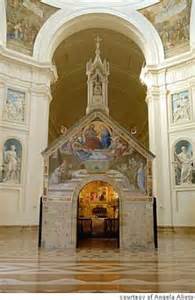
Chapel of Our Lady of the Angels – Portiuncula

August 2, is one day that is remembered by all Franciscan Friars, Poor Clare sisters, and all Third Order members, whether Friars, Sisters, or Laypersons; the Feast of Out Lady the Angels.

St. Francis of Assisi, came across the chapel as he wandered through the Italian countryside. He and his brother friars felt the Holy Spirit moving them. They realized that the Portiuncula, its Italian name, was special. They built simple huts around it, prayed and worshipped in it.

Eventually, long after Francis and his brethren had passed on; the chapel was enclosed in a magnificent basilica. Crowds of Franciscans, and laypersons, from the four corners of the earth still come to visit and worship the Lord. And the Lord touches the hearts of all who come.

Places of worship are built in many different ways, each is unique. In each one, though, is the potential to encounter the Living God. Be open to that potentiality.

Changes in the Franciscan Family

St. Francis of Assisi

On October 17, 2023, six American Provinces of Franciscan Friars (Order of Friars Minor) gathered together in a joint Chapter. The Friars then officially merged into one Province, to be known as the Province of Our Lady of Guadalupe. One can see the need for such an action; the number of Friars have been dwindling. It was probably felt that the Friars could be more effective together in one Province, than in multiple Provinces.

At one time, a loooong time ago, I entered the formation program for the Franciscan Friars of Holy Name Province. I would eventually feel that I was being called elsewhere, but I treasured my experiences with the Friars. When I was working in Boston, I would regularly visit St. Anthony’s Shrine, located in downtown Boston. It was maintained by the Friars of HNP. It was and still is a place where people can find spiritual refreshment. A place where one can find a kind and understanding Friar for confession.

Hopefully, this merger will be a source of rebirth for the American Franciscans.

If you are interested in learning more the Franciscans merger, go on Facebook and look for “The Anthonian Franciscan.”

Feast Day of Saint Anthony of Padua

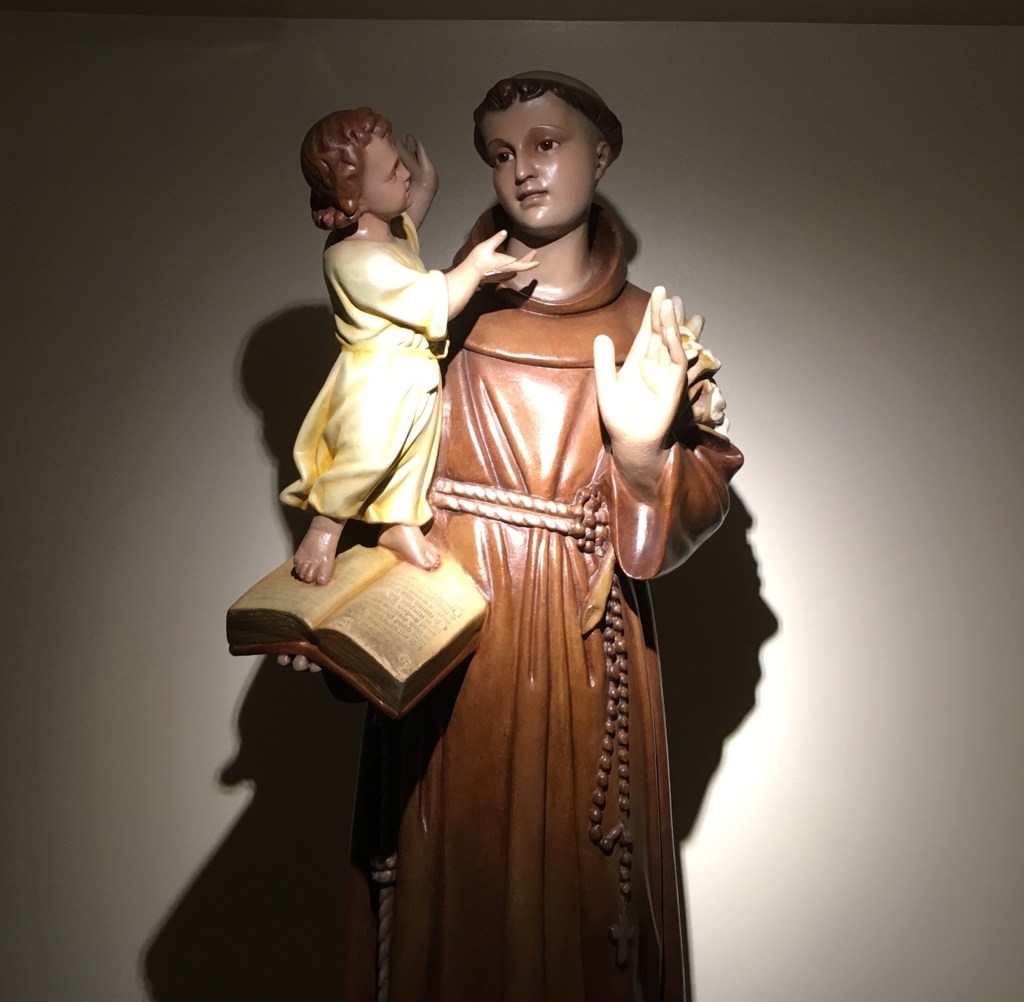
Saint Anthony of Padua with the Christ Child

Among the list of Franciscan saints, the most popular among them, after Saint Francis of Assisi, is Saint Anthony of Padua (1195-1231). But, were it not for a chance encounter, things might have been different.

He was born in Lisbon, Portugal, with the name of Fernando Martins de Bulhoes. The family was well off, and arranged for him to be educated in a local cathedral school. He would eventually join an Augustinian community near Lisbon. He would be ordained a priest and was giving the responsibility of welcoming visitors and guests to the monastery. It was then, that one could say, that the Holy Spirit then took over. Near the monastery was a small community of newly arrived Franciscan friars. They had established a small hermitage, and Fernando had frequent contact with them. He found their evangelical way of life attractive.

The Franciscans had sent a group of their brothers to North African country of Morocco, to evangelize. This group would suffer beheading at the hands of the Moroccan rulers. Their remains were returned to Portugal, and were buried at the Augustinian monastery. Fernando was inspired by their courage and their faith. He asked for, and received permission from the Augustinians to transfer over to the Franciscan order. He took the name Anthony, after an early Saint, Anthony the Great.

He joined another group of Franciscan friars being sent to Morocco, but he became seriously ill upon arrival. He was sent home back to Portugal. But stormy weather drove his ship further into the Mediterranean, winding up in Sicily. He went to the last great gathering of Franciscan friars with Saint Francis present. At the conclusion of it, he was sent to a small community of lay brothers, in Italy. There, the story goes, the community was celebrating the ordination of a friar, but the guest speaker had not arrived. Anthony was asked to preached. It was then the depth of his learning was revealed, as was also his skill as a speaker. And the rest, as they say, is history.

He would be sent out on preaching tours, up and down throughout Italy. It was said the thousands of people gathered to hear him speak. They came away inspired to live the Gospel of Jesus Christ more intensely. Francis himself, gave Anthony the work of teaching theology to the friars, and how to preach.

He became ill in his thirties, and died on June 13, 1231, in Padua.

He was canonized as Saint in 1232. He proclaimed a Doctor of the Church by Pope Prius XII, in 1946.

Sons & Daughters of St. Francis and St. Clare.

Saint Catherine of Bologna

St. Catherine was born into a noble family of Bologna, Italy, in 1413. As she grew into a teenage girl, it became obvious that she wanted to live a life very different from other daughters of the nobility. She persuaded her parents to allow her to join a community of lay Franciscan women (Secular Franciscan Order).

As a member of that community, she grew in the spiritual life, both the joys and challenges. She became known as a mystic; known to have experienced intense visions of Christ and the Blessed Mother. Now Bologna had a community of Poor Clare sisters, that must have been afflicted with laxity, because Catherine was ordered to take over the community.

She lead the convent by example, gentleness, and wisdom. The community became known for it’s holiness of life, attracting many new novices.

Saint Catherine died in 1463. She was canonized a Saint in 1712. Her feast day is March 9.

“Blessed be God in his angels and in his saints.”

Saint Elizabeth of Portugal

Born in 1271, Elizabeth was a daughter of one of the rulers of the kingdom of Aragon; which would eventually become part of modern Spain. At age 12, she was married to the king of Portugal, who at that time was named, Denis. She would eventually give birth to two children. While her husband was a philanderer, she remained faithful to him, and fulfilled all her royal duties. She was also a woman of faith, attending church regularly, and maintaining a life of prayer and charity.

She was drawn into royal politics and diplomacy, when her husband and her son’s relationship had deteriorated to the degree that civil war threatened the country. Through her efforts, peace was maintained. Much later in her life, she worked to prevent war between the kingdom of Portugal and the Spanish kingdom of Castile. For her efforts, she became known as “the Peacemaker!”

When her husband died, she left the royal court and took up residence in a Poor Clare monastery. She put on the habit of a Third Order Franciscan tertiary, and lived a life of prayer and charity. Still, she was continually called on to come out and apply her diplomatic skills to keep peace on the Iberian Peninsula.

Elizabeth died in 1336; in 1625, she was canonized as a Saint, in the Roman Catholic Church.

All Franciscans are called to be peacemakers; in our families, communities, churches, nations, the whole world. We do this by actively working for peace, speaking out for peace, supporting peacemaking organizations. And ultimately, maintaining peace within ourselves!

“Praised be You, O my Lord and God”

“Praise the Lord for our Mother Earth, who sustains us and keeps us, and brings forth the grass and all of the fruits and flowers of many colors.”

From the “Canticle of the Creatures;” written by Saint Francis of Assisi, around 1225 AD. Picture is of the first sunflowers I have seen blooming this summer.

“Praised be You, my Lord…”

Most High, all-powerful, good Lord, Yours are the praises, the glory, the honor, and all blessing.

To you alone, Most High, do they belong, and no man is worthy to mention Your name….

Praised be You, my Lord, through our Sister Mother Earth, who sustains and governs us, and who produces varied fruits with colored flowers and herbs

Praise and bless my Lord and give Him thanks and serve Him with great humility.    

(The Canticle of Brother Sun, by St. Francis of Assisi; Verses1, 2, 9, 14)

Feast of St. Anthony of Padua

img_0635On this day, the Catholic Church, and especially members of the Franciscan family, celebrate the life of St. Anthony of Padua.

In many Franciscan parishes, chapels and shrines; the friars will be distributing “St. Anthony’s Bread.” It a practice of charity, harkening back to a time when bread was actually distributed to the poor and hungry. One legend has it that a French cloth merchant could not get into her shop, because of a broken lock. She asked for help and intercession of St. Anthony, promising to give bread to the poor, in return. The lock miraculously opened, the shop was in business, and woman made good on her promise.

Since that time, Franciscan friary distribute small, blessed loaves of bread to people, as a reminder that as they receive blessings from God, they are to share it with those in need, for the love of God.