
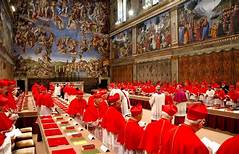
It is very rare for any information to come out on what happened during a Conclave that elects the next Pope of the Roman Catholic Church. It appears, however, that Gerard O’Connell, Vatican Correspondent for the Jesuit magazine, America has found such a crack in the wall of silence. The information he gathered is now contained in a book he has written “The Election of Pope Francis: An Inside Account of the Conclave That Changed History.” It being published by Orbis Books, and I hear it will be in the stores in late April , 2019. An excerpt from the book was posted, March 22, 2019, on the America magazine website.
In the excerpt, Mr. O’Connell describes what took place in the Sistine Chapel during the first ballot of the Conclave, the preparations for it, how the ballots were marked, the ceremony involved in casting a vote, the counting of the ballots, and the disposal of the ballots, describing the elaborate system of creating the right smoke from the burning ballots in the stove, so that the crowd in St. Peter’s Square would know if a new Pope had been elected or not. There was a surprise for the cardinals when the results were announced; of the 115 cardinals present in the Conclave, at least 23 of them received at least one vote. Keep in mind, a two-thirds majority of cardinals voting was required for election. Reading the vote tallies, reported by Mr. O’Connell, one name stood out for me; Cardinal Sean O’Malley, OFM CAP, an American, who came in fourth, with 10 votes!
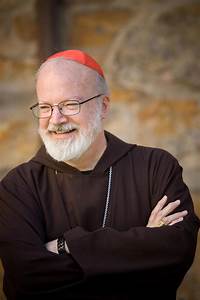
It was not too much of a surprise to see that voting result. In the days leading up to the Conclave, the Italian press took notice of a Cardinal, who most of the time in Rome wore the brown robe of a Franciscan Friar. The American news media began to pick up the story. And soon Cardinal Sean was considered one of the papabile, the first American in my memory. Cardinal Sean Patrick O’Malley, 74, is a member of Franciscan Order of Capuchin. Ordained to the priesthood in 1970, he studied at the Catholic University of America, and graduated with a MA in religious education, and a Ph.d in Spanish and Portuguese literature. After some years as an university professor, he began ministering to the Latinos living in Washington D.C. He would eventually be appointed episcopal vicar for the Hispanic, Portuguese, and Haitian communities in the Washington, D.C. archdiocese. In 1985, he became Bishop of St. Thomas, V.I. In 1992, he was installed as the Bishop of Fall River, MA. It was there that he addressed the sexual abuse by clergy scandal, that was coming to light in the Diocese. He would be sent to the Diocese of Palm Beach, FL.,in 2002, to address again a clergy sexual abuse scandal coming to light. He would be at Palm Beach for only a year, when he was sent to the Archdiocese of Boston, MA. The Archdiocese had been rocked by reports in the Boston Globe, of clergy sexual abuse, and cover up by Church officials. The Archdiocese was also going through an, in my opinion, ill considered process of consolidating parishes, that caused additional trauma to parishioners.
Since his appointment in 2003, Cardinal Sean, again, in my opinion, has been a key person, pushing the Catholic hierarchy acknowledge the facts of clergy sexual abuse, and caring for the victims of that abuse. He was appointed by Pope Francis to an advisory council of Cardinals, called to come up with recommendations to reform the bureaucracy of the Vatican. He chaired a commission of clergy and laity, including survivors, to examine how the Vatican has failed to respond to the crisis, put forward corrections. When both Pope Benedict XVI, and Pope Francis visited the United States, Cardinal O’Malley arranged to have them both meet with American clergy sexual abuse survivors. Now, word has been leaking out that there is tension between Cardinal O’Malley and Pope Francis over the slow pace of reforms being implemented. Some Vatican observers felt is was significant that the Cardinal did not play any significant role in the planning of the meeting of heads of the national conferences of bishops to discuss the issue of clergy sexual abuse in the world wide Church. That said, he did address the gathering about the issue.
With Pope Francis seeming to still be in good health, it is way too early to discuss a future Conclave, but, aww heck, let’s go for it. Now Cardinal O’Malley is 74 years old, chances are good he will be one of the electors in the next Conclave. Question is will he once again be considered one of the top papabile. Conventional wisdom is that it will be unlikely, the Cardinals of the Southern Hemisphere and Asia would never support the election of an American Pope. Still, conventional wisdom went out the window with the election of Pope Francis! The Holy Spirit always wins out!
 There has been a lot of
  This past Saturday, my brother Deacons and I gathered at St. Edith Stein Church, in Brockton, MA. We were there to celebrate the ordination of 7 new Deacons for the Archdiocese of Boston. It was being held at St. Edith Stein, rather than at Holy Cross Cathedral, because the cathedral is undergoing a massive interior renovation. St. Edith Stein is a beautiful church, with an interior decoration that you do not see in more modern designed churches. It does have one drawback, very narrow stairs between the basement and main levels. The basement was where we gathered to vest for the ceremony.
 stopped long enough for us to organize the procession into St. Edith Stein. The church itself was packed with the families and friends of the men to be ordained. A choral group from Holy Cross Cathedral lead the congregation in song, as we walked down the main aisle; bowed before the altar and took our seats
 Over a cup of coffee, I would apologize for not coming to the counter for a while. One could say I have been struggling with one huge case of writer’s block. It is a combination of trying to carve out a period of time to write something online; and not be able to think of anything to write.

 known as Padre Pio. Padre Pio was a Franciscan Capuchin friar, born in 1885, in Italy, and died on September 23, 1968. He was ordained a priest in 1910. In 1918, he received the stigmata, after experiencing a powerful vision of the Crucified Christ. He bore the five wounds of Christ for the rest of his life. News of this miracle got out to the world, crowds of people gathered to witness it. Padre Pio would be examined many times by physicians, with conflicting diagnosis’. The Church would investigate him many times; would forbid him to say Mass or hear confessions for a period of time. He would eventually be cleared of unorthodox thinking or practices, and returned to his priestly ministry. He would spend a good deal of his time hearing confessions, offering spiritual council, and celebrating the Eucharist. He remained at the Capuchin friary at San Giovanni Rotondo for the rest of his life. He worked at, and successfully caused a hospital to be built near the town. 34 years after his death, he was declared a saint, by Pope St. John Paul II.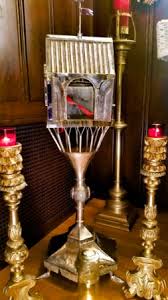
 Yale Humanist Community, have been gathering in New Haven CT, Albany, NY, Providence, RI, and on September 27, 2016, in Boston, to hold a town meeting style discussions on the Bible. These locations, according to recent surveys, are the least Bible minded cities in America. The final meeting in Boston, will actually be held at Harvard University; the event will be
 Musings From St. Anthony's Walnut Tree
