August 2, is one day that is remembered by all Franciscan Friars, Poor Clare sisters, and all Third Order members, whether Friars, Sisters, or Laypersons; the Feast of Out Lady the Angels.
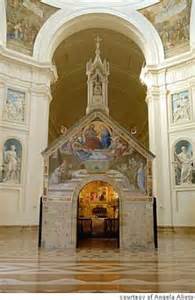
St. Francis of Assisi, came across the chapel as he wandered through the Italian countryside. He and his brother friars felt the Holy Spirit moving them. They realized that the Portiuncula, its Italian name, was special. They built simple huts around it, prayed and worshipped in it.
Eventually, long after Francis and his brethren had passed on; the chapel was enclosed in a magnificent basilica. Crowds of Franciscans, and laypersons, from the four corners of the earth still come to visit and worship the Lord. And the Lord touches the hearts of all who come.
Places of worship are built in many different ways, each is unique. In each one, though, is the potential to encounter the Living God. Be open to that potentiality.
Statue of Saint Francis of Assisi, Our Lady of Lourdes Church, Carver MA
Saint Francis of Assisi
“I have done what was mine to do. May Christ teach you what is yours.” Saint Francis of Assisi
Every October 4th, people around the world, Catholics, Protestants, persons with no declared religion; celebrate the memory of Saint Francis of Assisi. Born in the year of 1182, Francis was an energetic young man, talented, had a gift for drawing other young men of Assisi to himself for parties. He would soon felt the desire to become a knight, a heroic defender of Assisi. Being a commoner, that only way he could achieve this goal, was on the battlefield. He joined his fellow citizens in a military campaign against a rival Italian city state. The battle went terribly wrong for Assisi, Francis and others who survived the battle were captured and held in dungeons. There they waited for their families to ransom them. For some, like Francis, it was a long wait as families and friends tried to gather enough ransom money. Francis returned to Assisi as a broken man.
During his recovery, he would ride out into the countryside. On one such ride, he come across a beggar, who was also suffering from leprosy. Out of fear, Francis turned his horse around, ready to flee. But something made him stop, turn his horse around to face the leper. Getting off his horse, he went to the leper, took his money pouch and put it into the hands of the beggar. And then he kissed them. It was a moment of transformation, a moment of conversion.
Later, Francis found himself walking by a dilapidated chapel. He felt a strong desire to go into the chapel to pray. K in Before a wooden cross, with the image of the Crucified Christ, he knelt. Deep in prayer, Francis heard the Lord speak to him from the cross, “Francis, rebuild my church, which, as you see, is falling down.” And the rest, as they say, is history!
His life of prayer, voluntary poverty, and caring for the poor; has inspired thousands of men and women around the world. Men have joined the Order of Friars Minors, in it’s various formations, to work amongst the poor, to help the ill and disabled. Francis’ lifestyle inspired a young noblewoman, by the name of Clare, to take up a life of poverty and prayer. Drawn by her example, other women joined together to form like communities. Today, these communities bear her name, now called the Poor Clares. And still, the influence of Saint Francis continued to grow, indeed, continues to grow. Lay men and women also found inspiration from Francis’ example. The more they heard about the lives of Francis and his followers, the more they wished to imitate the Franciscan lifestyle. These lay followers soon formed their own groups, to pray together, to help the poor, to serve their families as well.
The Franciscan Family continues, it may experience times of growth, and times of loss; but it continues. Pace e Bene!!
On October 17, 2023, six American Provinces of Franciscan Friars (Order of Friars Minor) gathered together in a joint Chapter. The Friars then officially merged into one Province, to be known as the Province of Our Lady of Guadalupe. One can see the need for such an action; the number of Friars have been dwindling. It was probably felt that the Friars could be more effective together in one Province, than in multiple Provinces.
At one time, a loooong time ago, I entered the formation program for the Franciscan Friars of Holy Name Province. I would eventually feel that I was being called elsewhere, but I treasured my experiences with the Friars. When I was working in Boston, I would regularly visit St. Anthony’s Shrine, located in downtown Boston. It was maintained by the Friars of HNP. It was and still is a place where people can find spiritual refreshment. A place where one can find a kind and understanding Friar for confession.
Hopefully, this merger will be a source of rebirth for the American Franciscans.
If you are interested in learning more the Franciscans merger, go on Facebook and look for “The Anthonian Franciscan.”
Today, the Church, indeed, the world, celebrates the life and works of Saint Francis of Assisi! He was born into a merchant class family, in the town of Assisi, in the province of Umbria, Italy.
In his youth, he was known as a party boy. He had dreams of being something more. He dreamed of becoming a knight, of entering the noble class. He got the opportunity to earn a knighthood, when Assisi went to war with its rival town of Perugia. The battle went badly for Assisi, and its army was decimated. Francis found himself a prisoner of war, held in very harsh conditions. When he was released, his body and spirit were broken.
Back in Assisi, he underwent a conversion experience, determined to live a holy life. He began to visiting chapels that dotted the Umbrian countryside. He came upon a chapel, named San Damiano, that was dilapidated. While praying before its crucifix, he heard it speak to him, “Rebuild my house, for it is nearly falling down!” So began Francis life of service, starting with repairing chapels, to caring for the poor, to striving to live the Gospel life. By words and deed, he would attract followers from all over Italy. His example would inspire millions.
This day, in the days that follow, it be good for us to reflect on his life. To read his words, to follow his example of prayer and service, we can bring the Gospel to life, as he did!
Clare of Assisi was a daughter of a noble and wealthy parents. It was expected that she would soon be given away in marriage to a nobleman of the city. However, one day she heard Francis of Assisi preaching, and something touched her heart. Accompanied by a friend, she secretly met with Francis, listening to him speak about truly living the Gospel of Jesus Christ.
Clare decided that she too wished to live and follow the way of the Gospel. One evening, with a companion, she slipped out of her family’s mansion, and went to the chapel known as the Portiuncula. There, in the presence of the other friars, she had her hair cut short, and received a plain habit and veil from Francis. She would eventually take up residence in the church of San Damiano. A small community of women began to grow up around her. This included two of her sisters, and eventually, her mother. Francis wrote a form of life to guide them, which Clare would include the Rule she composed later on.
The fame, the popularity of the Poor Sisters, as they were called, began to grow. It grew beyond the borders of the Italian provinces, into Europe, usually with the help and guidance of the Franciscan friars. It was in Prague, in the country of Hungary, that the movement came to the attention of a woman by the name of Agnes, daughter of a king. Inspired by what she learned about Francis, and the lives of Clare and her Poor Sisters. Agnes had a monastery built, and she and other women joined the Franciscan movement. Clare would eventually hear about Agnes of Prague, and she reached out to her, providing spiritual guidance. Four of her letters to Agnes of Prague survived.
“O most noble Queen, gaze upon (Him), consider (Him), contemplate (Him), as you desire to imitate (Him). If you suffer with Him, you will reign with Him. (If you) weep ( with Him), you shall rejoice with Him; (If you) die with Him on the cross of tribulation, you shall possess heavenly mansions in the splendor of the saints, and, in the Book of Life, your name shall be called glorious among men.” Second Letter from Clare to Agnes of Prague
The Portiuncula (“Mary’s little portion) was a small chapel built on the outskirts of Assisi. Owned by a local Benedictine monastery, the chapel had deteriorated over the years. By the time of St. Francis of Assisi, it was a shell of it’s former self. Francis had gone through his time of conversion, and was going about the Assisi countryside, repairing these abandoned chapels, including the Portiuncula.
Many of us have a place of worship that means a lot for us. It is a place where we may feel the Presence of God more deeply. So it was with Francis, and his brothers. But, as important as the Portiuncula was to them, it did not prevent them from going out into the fields, towns, and villages. They went out proclaiming the Good News, by word and deed.
Eventually, this chapel would become very dear to Francis and his brothers. They prayed in it daily together; celebrated Mass together. I once saw an illustration of the chapel, with it surrounded by small huts, built by the friars.
We are all called to go out and meet with others. We are all called to share the Good News of Jesus Christ with all we come in contact with.
The man who would become to be known in Franciscan history as Bonaventure, was born in central Italy, in the town of Bagnoregio. There is some disagreement over the year of his birth, though many experts and scholars have agreed on the year 1217. The son of a physician and housewife, he was baptized with the name “John.” He grew into manhood, and desired to become a scholar. In 1234, at seventeen, he entered the University of Paris. Now a new religious order of men were making news in Europe, the Franciscans. Founded by Saint Francis of Assisi, the “Poor Man of Assisi,” his followers were making a name for themselves, for their poverty, their sanctity, and their evangelical zeal. Their preaching and lifestyle drew many young men to come and join them. Among them was John, who received the name Bonaventure when he was admitted into the Order.
Upon his entry into the Order, Bonaventure took up the study of theology. In either 1253 or 1254, he became a master of theology, and head of the Franciscan school in Paris, until he was elected as the Minister General of Franciscan Order in 1257. His time in that office was spent trying to keep the Order from splintering into different factions. He strove to maintain a moderate approach to poverty, while at the same time, taking full advantage of the learning, the scholarship of his times. Always, he strove to remain faithful to the teachings and example of Saint Francis.
In 1273, Pope Gregory X named Bonaventure a cardinal bishop, and drew on his assistance in preparing for the Second Council of Lyons. It was during this Council that Bonaventure became ill and died on July 15th, 1274.
Bonaventure would be canonized on April 14th, 1482; and on March 14th, 1588, he was declared a Doctor of the Universal Church. He was given the title: “Seraphic Doctor.”
“Here Begins the Prologue To The Life Of Blessed Francis

In these last days the grace of God our Savior has appeared in his servant Francis to all who truly humble and lovers of holy poverty.

In him they can venerate God’s superabundant mercy and be taught by his example to utterly reject ungodliness and worldly passions, to live in conformity with Christ and to thirst after blessed hope with unflagging desire.

He was poor and lowly, but the Most High God looked upon him with such condescension and kindness that he not only lifted him up in his need from the dust of a worldly life, but made him a practitioner, a leader and a herald of Gospel perfection and set him up as a light for believers so that by bearing witness to the light he might prepare for the Lord a way of light and peace into the hearts of his faithful.”

From the Prologue of the Life of Saint Francis (Legenda Maior) by Saint Bonaventure
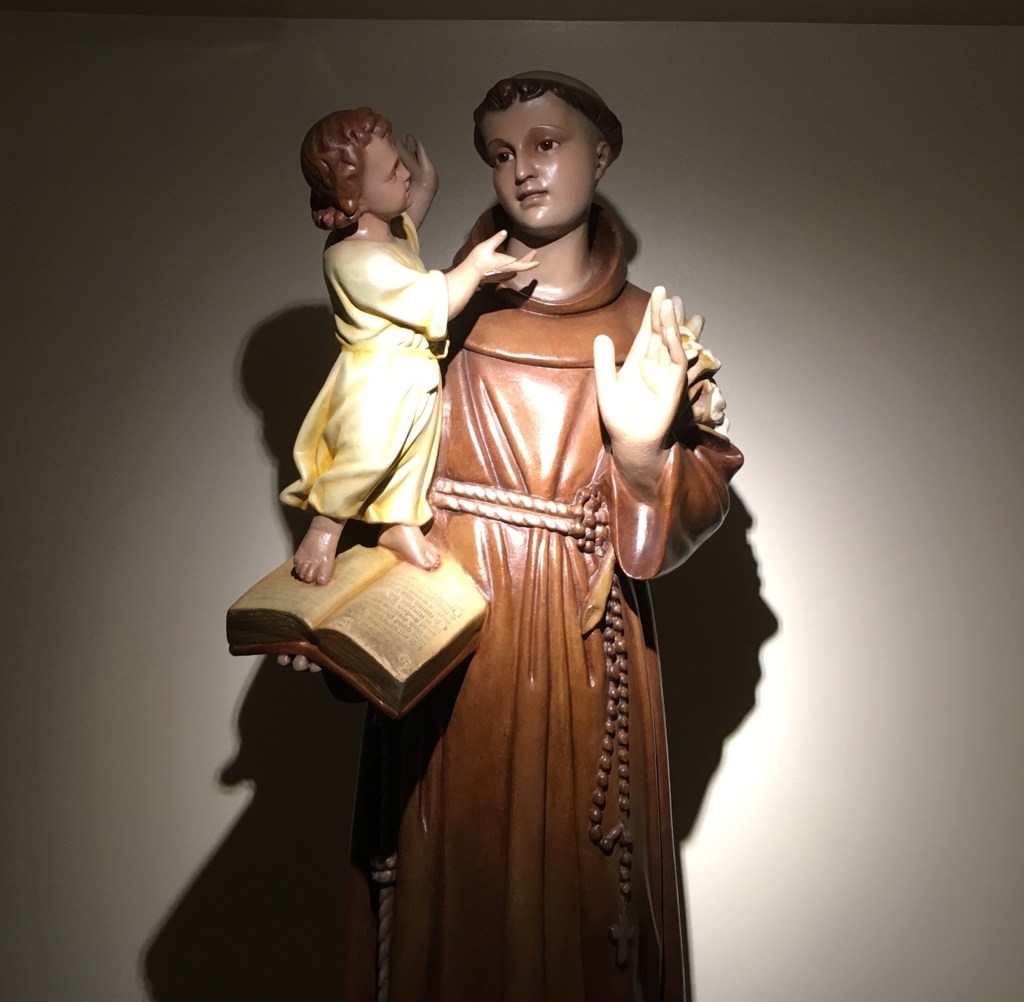
Among the list of Franciscan saints, the most popular among them, after Saint Francis of Assisi, is Saint Anthony of Padua (1195-1231). But, were it not for a chance encounter, things might have been different.
He was born in Lisbon, Portugal, with the name of Fernando Martins de Bulhoes. The family was well off, and arranged for him to be educated in a local cathedral school. He would eventually join an Augustinian community near Lisbon. He would be ordained a priest and was giving the responsibility of welcoming visitors and guests to the monastery. It was then, that one could say, that the Holy Spirit then took over. Near the monastery was a small community of newly arrived Franciscan friars. They had established a small hermitage, and Fernando had frequent contact with them. He found their evangelical way of life attractive.
The Franciscans had sent a group of their brothers to North African country of Morocco, to evangelize. This group would suffer beheading at the hands of the Moroccan rulers. Their remains were returned to Portugal, and were buried at the Augustinian monastery. Fernando was inspired by their courage and their faith. He asked for, and received permission from the Augustinians to transfer over to the Franciscan order. He took the name Anthony, after an early Saint, Anthony the Great.
He joined another group of Franciscan friars being sent to Morocco, but he became seriously ill upon arrival. He was sent home back to Portugal. But stormy weather drove his ship further into the Mediterranean, winding up in Sicily. He went to the last great gathering of Franciscan friars with Saint Francis present. At the conclusion of it, he was sent to a small community of lay brothers, in Italy. There, the story goes, the community was celebrating the ordination of a friar, but the guest speaker had not arrived. Anthony was asked to preached. It was then the depth of his learning was revealed, as was also his skill as a speaker. And the rest, as they say, is history.
He would be sent out on preaching tours, up and down throughout Italy. It was said the thousands of people gathered to hear him speak. They came away inspired to live the Gospel of Jesus Christ more intensely. Francis himself, gave Anthony the work of teaching theology to the friars, and how to preach.
He became ill in his thirties, and died on June 13, 1231, in Padua.
He was canonized as Saint in 1232. He proclaimed a Doctor of the Church by Pope Prius XII, in 1946.
St. Catherine was born into a noble family of Bologna, Italy, in 1413. As she grew into a teenage girl, it became obvious that she wanted to live a life very different from other daughters of the nobility. She persuaded her parents to allow her to join a community of lay Franciscan women (Secular Franciscan Order).
As a member of that community, she grew in the spiritual life, both the joys and challenges. She became known as a mystic; known to have experienced intense visions of Christ and the Blessed Mother. Now Bologna had a community of Poor Clare sisters, that must have been afflicted with laxity, because Catherine was ordered to take over the community.
She lead the convent by example, gentleness, and wisdom. The community became known for it’s holiness of life, attracting many new novices.
Saint Catherine died in 1463. She was canonized a Saint in 1712. Her feast day is March 9.




 Musings From St. Anthony's Walnut Tree