From a Franciscan Perspective – Blessed Frederic Ozanam and Care for the Poor

“1) Secular Franciscans should always act as a leaven in the environment in which they live through the witness of their fraternal love and clear Christian motivations.

2) In the spirit of minority, they should opt for relationships which give preference to the poor and to those on the fringe of society, whether these be individuals or categories of persons or an entire people;  they should collaborate in overcoming the exclusion of others and those forms of poverty that are the fruit of inefficiency and injustice.”  (Article 19, General Constitutions, Secular Franciscan Order)
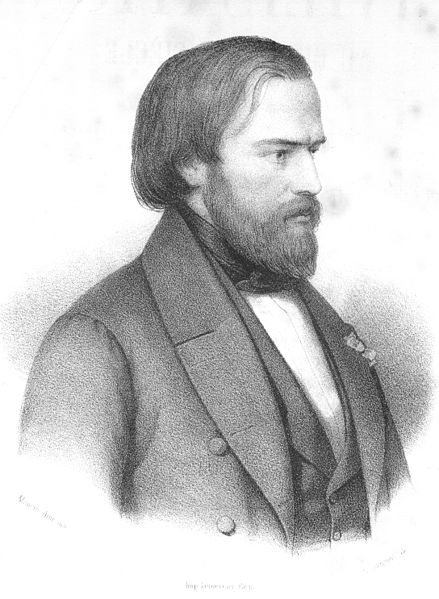
Gravure d'Antoine Maurin dit "Maurin l'aîné" (1793-1860) à partir d'un dessin de Louis Janmot (1814-1892)

Blessed Frederic Ozanam

On August 4th, the Catholic Church remembers and celebrates the life of Blessed Frederic Ozanam.  Born in France in 1813, he originally wanted to become a writer, but his father insisted that he become a lawyer.  In 1831, he went to the University of Sorbonne, in Paris, to study law.  While there, he noticed that the Catholic Church was being attacked by the intellectuals in Paris.  A devoted Catholic, he and some friends started a debate club, where they could discuss issues of faith with agnostics and atheists.  At one of these debates, Ozanam was challenged to prove his faith with actions, and not just talk.  Taking up the challenge, Frederic and a friend began visiting the poor in the slums of Paris, and providing whatever assistance they could.  Their approach was novel, instead of just giving money to some religious or church organizations; they went out and personally met the poor in their homes.  Other laypersons were attracted to work Ozanam was doing, and together they formed the Saint Vincent de Paul Society.  Frederic did earn a law degree, but would eventually also earn a doctorate in literature.  He married in 1841, and he and his wife had a daughter.  He continued his work with the Society.  Continuously suffering from poor health, he died in 1853.  Some time before his death, he supposedly joined the Third Order of Saint Francis; today known as the Secular Franciscan Order.  The Saint Vincent de Paul Society has grown into a worldwide organization, with local conferences based in most parishes.  They continue their work of personally visiting and providing assistance to the poor in their local communities.

There have been some negative comments about Pope Francis’ focus on the poor.  Some feel that he is neglecting the middle class, who are also suffering from a decrease in wages, the threat of foreclosure on their homes, and a loss of a sense of security that their parents had.  As an out of work member of the middle class, with shrinking resources; I understand the feeling of anxiety, uncertainty and fear people are experiencing.  I am experiencing that to.  But Jesus, through his Gospel, has told us that we are called to take up our crosses daily, and follow him.  And to follow Jesus means to proclaim the Good News to the poor, to heal the sick, to care for the widow and orphans, feed the hungry and to set free the imprisoned.  Even with our own anxieties and sufferings, we are still called to encounter the poor among us, and offer help.  We can accomplish this through God’s grace, and being open to the influence of the Holy Spirit.

Through Jesus Christ, God is with us, in good times and the difficult times.  Let us be open to that Presence, and open to sharing that gift with others.

Reflection on Last Weekend’s Retreat

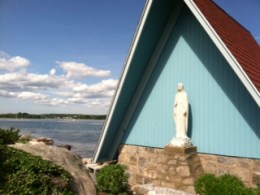
As I have posted previously, members of the Diaconate classes ordained in 2012, 2013, and 2014, are required to come together for a jointEnders Island Chapel retreat.  This year’s retreat was held at Saint Edmund’s Retreat Center, on Enders Island, Mystic, CT.  Our retreat director was Father William Murphy, who is on the staff of St. Pope John XXIII National Seminary, MA.
Some random thoughts from the retreat:

The Church’s primary message, received from Jesus Christ, what we Deacons are to proclaim by our words and actions: God loves us, God cares for us.

No matter what matter troubles afflict us, no matter what anxieties there are in our lives, “we are being held in God’s arms, we are safe!”

In the Book of Exodus, we see the Hebrews threatened by Pharaoh’s army, God tells them to stand firm, and not to be afraid, and He will save them.  God is also telling us to stand firm in the face of pain and suffering we may be experiencing; He will be there to help us.  God wants us bring all thing to Him, our joys and our fears.  In the Gospels, Jesus promises that He will be there to help us with our burdens.

As Deacons, we are to be witnesses of the Love of God.  When we proclaim the Good News of Jesus Christ, by the words we speak to others, by the care we give to others, we are witnessing to God’s love.  When we help to raise people up from their burdens, we are witnessing to the love and hope that comes to us through Jesus Christ.

I know that for some these words may sound hollow; I will admit that at times the road ahead right now looks dark threatening.  But I also know that God cares for me, and is trying to help me, right here, right now, if only I just open my heart and soul to his Presence.  I trust in the words of Jesus, when today, He promises to be with me, and will be with me till the end of the agEnders Chapel JFJe.

This is the truth all of us Christians, especially we ministers of His Word must witness to, at every moment of every day.

A task Father gave to us Deacons was to remember the words from our Ordination and live them: “receive the Gospel of Jesus Christ whose heralds you have become.  Believe what you read, teach what you believe, and practice what you teach.”

The retreat was definitely a time to practice deeper prayer, to be more present and open to my God.  The challenge now is carrying that experience forward into my daily life. Enders Island 3

Can We Linger for Awhile?

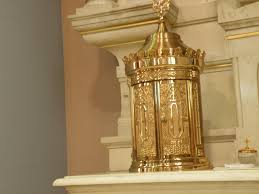
TabernacleKissing your feet with all the love I am capable of, I beg you to show the greatest possible reverence and honor for the most holy Body and Blood of our Lord Jesus Christ through whom all things, whether on earth or in the heavens, have been brought to peace and reconciled with Almighty God (cf. Col 1:20). (St. Francis of Assisi, Letter to a General Chapter. Omnibus of Sources)

Times that I have lingered. Before I continue on, a point of information for those who are not Catholic. The Church teaches, and Catholics believe that Jesus Christ is truly present, and remains present in the Bread and Wine, the moment the priest repeats Jesus’ words: “Take and eat; this is my body,” and “Drink from it, all of you, for this is my blood of the covenant,…” (Matt 26: 26-28) At the end of the distribution of Communion, any remaining consecrated Wine is consumed; any remaining consecrated Hosts are placed in a container, called a ciborium, and placed in a tabernacle.
As a Deacon, I assist at two Masses on Sunday morning. After the first Mass, I get everything set up for second Mass. One of my responsibilities is to check the ciborium, to see if I need to set out more unconsecrated hosts for Communion. I open the tabernacle; look into the ciborium, then close the tabernacle. It is at that moment that I may just stand there, because I am aware of a Presence, of Christ’s Presence. I cannot describe the experience, I just know, and that I do not want to leave the spot. Eventually, after a few minutes, the Lord lets me go, and I go on with my work.
I believe that God is always asking us to linger for just a moment, and be open to His Presence. Sometimes, we stop and open our minds and hearts; sometimes we let the anxieties, the cares, and the distractions of this world get in the way. We rush about, here and there, doing this or that. If Christ was to knock on the door of our heart, would we linger?
Linger

I Want to Fly to Assisi

Where would I go if could be immediately transported somewhere?  I and other bloggers were challenged to write a post, answering this question.

I would like to be soaring over the green Umbrian countryside of Italy, like a brown sparrow, heading towards the small Italian city of Assisi.  It is an ancient city; most of the buildings were built during the Middle Ages, still being occupied.  I am heading towards a large Catholic Basilica, the Basilica of San Francesco d’Assisi, the last resting place of Saint Francis of Assisi.

Saint Francis was born Giovanni di Pietro di Bernardone, the son of a wealthy cloth merchant.  His father, who made his money selling fine cloth to French merchants, nicknamed his son Francesco as a tribute to the French.  Francis was the city playboy; it was not a party if Francis was not invited.  He was a social climber, who longed to belong to the nobility, to become a knight.  He was a soldier, a prisoner of war, a veteran who was broken in body and soul.  And because of his brokenness, Jesus Christ entered into Francis’ heart; and Francis experienced a conversion, a conversion to the Gospel life.  He began to give his money to any poor person who asked for alms.  He went among the lepers, caring for them, washing their sores, and binding them with bandages.  In the solitude of caves, he began to develop a deep spiritual, prayer life.  He reflected on the gospels, he entered into an intimate relationship with God.  Francis strived to live the Gospel of Jesus Christ.

He gave away everything he owned, dressed like a beggar, in a grey, brownish robe.  He went about serving the poor, preaching in the streets, and marketplaces; proclaiming to all who would listen to him; that God loved them all.  Men, who heard his words, saw his lifestyle, were drawn to Francis, and soon he had twelve followers.  Twelve became a hundred; the hundred became thousands, all promising to live the Gospel of Jesus Christ, according to the example of Saint Francis.  They became the Order of Lesser Brothers, Order Friars Minor.  Women, like Clare of Assisi, were also drawn to this Troubadour of Christ.  With Clare, he formed a contemplative community of women, the Poor Ladies of Assisi, now known as the Poor Clares.  There were other men and women, farmers and tradesmen, wives and seamstresses, who also wanted to live the Gospel, and sought Francis’ guidance.  They became the Brothers and Sisters of Penance, the Third Order of St. Francis; today known as the Secular Franciscan Order.

I became attracted to St. Francis during my third and last year at the archdiocesan seminary.  I had decided to take years’ leave from the seminary; I spent the year with a Christian ecumenical organization which provided worship services in the National Parks.  I was sent to Yellowstone NP, lead services during the weekend, worked in the kitchen the rest of the time.  And in the midst of all that natural beauty, I read about Francis and the Franciscan life.  After two years, I entered formation to become a Friar.  I was to realize that God had another path for me, so I left the Friars, but the Franciscan spirit was already embedded in my heart.  I would later join the Secular Franciscan Order; I have been a professed member for over 25 years.  And I am always wishing I had the means to make a pilgrimage to Assisi, to visit that Basilica.

Francis died on the evening of October 3, 1226, at the age of 44 years old.  He was canonized a saint in 1228.  The friars were already beginning the construction of the Basilica.  The best architects, artisans and artists, the pioneers of the Italian Renaissance, were brought onto the project.  The Basilica was constructed in two levels, the upper church with vaulted ceilings, and large stain glass windows.  The lower church is more enclosed, but both levels are covered with beautiful frescoes, painted by Italian master artists.  The Basilica is considered an international treasure.  However, when the Basilica was finished; the Friars buried Francis in secret; for fear that rival cities would try to steal the remains.  They did such a good job hiding the burial site, that Francis’ body was lost until 1819.  When the burial site was rediscovered, a new crypt was constructed under the lower church.  The crypt has a small chapel, with an altar.  Above the altar is a stone coffin, containing the bones of St. Francis.  It is bound with iron straps, and an iron grill over the entrance.  The walls of the crypt are bare stone, simple, unadorned.  It is there I wish I could sit, contemplating, in the dim light, the last resting place of a man who continues to inspire Christians and non-Christians.  And in the stillness of that place, maybe I can hear a whisper, wishing me and all who come there: “Pace e Bene!”  “Peace and Good!”

Basilica of Saint Francis lower Church Tomb of St Francis Upper Church

Good Friday in Beverly – 2015

TGood Friday Crosshis is the first chance I have had to write some reflections on part of what I have been doing during this Holy Week, 2015.  Yesterday, Good Friday, I assisted at the service that was held at St. Margaret of Scotland parish in Beverly, MA.  The small church was built in the late 1800’s, and has a very unique design.  The interior has a dark wood ceiling, which sort of adds to the solemnity of the liturgy we were about to celebrate.


The Good Friday service commemorates the Passion and Death of Jesus Christ, it is the most solemn liturgy held during Holy Week.  Wearing red colored vestments, the Pastor and I silently processed into the church.  Entering the sanctuary, Father, I and the cantor kneeled in the sanctuary, and the service began with readings from Scripture.  I, the cantor, and our music director chanted the Passion of Jesus Christ according to the Gospel of John.  After the prayers of the faithful, I went to the rear of the church, picked up a plain wooden cross, and began to process down the main aisle, back to the sanctuary.  I stopped three times; each time intoning: “Behold the wood of the Cross, on which hung the Savior of the world!” to which the congregation responded: “Come let us worship.”  After Father and I had each venerated the Cross, members from the congregation came forwarded to also venerate it.  Some kissed the wood, others knelt and touched it, and others just bowed before it.  When everyone had come forward, Father and I set the Cross on a side altar, with two candles on either side.  A communion service followed, then Father and I processed out and we did in, in silence.

After greeting members of the Catholic community as they left the church, I went back in; back to the side altar with the Cross.  As I stood, looking at that bare wooden Cross, it came to me, how an instrument of public execution, has become a symbol of triumph, Christ’s triumph of death.  I think though we forget what suffering Jesus went through, for us, for our salvation.  We need to recall what was written by the prophet Isaiah:

“Because of his affliction he shall see the light in fullness of days; through his suffering, my servant shall justify many and their guilt he shall bear.  Therefore I will give him his portion among the great, and he shall divide the spoils with the mighty, because he surrendered himself to death and was counted among the wicked; and he shall take away the sins of many, and win pardon for their offenses.”  (Isaiah 52)

Tonight, we commemorate, we celebrate Jesus Christ victory over sin and death; we celebrate the peace and joy that is still being experienced by so many of us.

Palm Sunday, Beginning of Holy Week – 2015

Palm Sunday

Yesterday, March 29, 2015, Passion (Palm) Sunday, I began my third Holy Week as an ordained Deacon.  I assisted at Mass at two of the three parishes that make up the Beverly Catholic Collaborative.  At the beginning of each Mass, there was the blessing of the palms, followed by my proclaiming the Gospel reading according to Mark; of Jesus’ triumphant entrance into the city of Jerusalem.  Crowds gathered around Him, shaking palm branches, and yelling out “Hosanna,” and proclaiming that the Kingdom of David was at hand.  Yet, during that same liturgy, we would hear the Passion of Jesus Christ according to Matthew; during which the crowds are now yelling out, “Crucify Him!”

The five weeks of Lent were meant to be a time to prepare for this Holy Week, for in many ways, this week will be the most challenging of the Church’s liturgical year.  We are to recall the events that lead to the Crucifixion of Jesus, and to His Resurrection.  We are being challenged to reflect more deeply and personally on what those events mean to our world, our Church and for ourselves personally.  We are being summoned to; if just for this week, live a life of intensive prayer and meditation.  We are being challenged to open our minds, our hearts and our souls to the presence of our Resurrected Savior, and be willing to be transformed by Him; transformed into bearers of the Good News.  Evangelizers, by word and deed; to let others know of the love and mercy of our God!

An Old Argument Re-Surfaces; How to Receive Communion!

Communion in the hand

A long time ago, I was reading an issue of “Saint Anthony’s Messenger,” published by the Franciscan Friars.  I was scanning the comment letters, when I saw a letter in which the writer was complaining about a previous magazine cover depicting a woman holding a communion host in her cupped hands.  The writer was outraged that a Catholic magazine who depict a layperson (cannot remember if he made reference to gender) holding a consecrated Host.  The writer went on to state that because of this practice, the Eucharist was being demeaned in the eyes of the faithful.  Well, this letter got my dander up (I still had hair at the time!), and I wrote a reply, which actually was published.  As I recall what I wrote, I am sure I stressed that receiving on the tongue, or in the hand, were both valid choices.  What upset me, and continues to upset me, are those who believe that I am desecrating the Eucharist, when I receive in the hand.  For me, it is the greatest honor, the greatest joy, to be able to receive my Eucharistic Lord, in my hands.  To realize that Jesus Christ, the Son of God, loved me; loved all of us so much, that He humbles Himself each day to be with us, to feed and strengthen us.  He is willing be present in simple bread and wine, so He can be one with us.  This realization for me is awesome!

All this came to mind when I saw an article by Mathew N. Schmalz, a contributor to the website Crux.  He also was commenting on how divisive how one receives Communion has become.  It is becoming a litmus test, a way to determine if you are for Vatican II reforms or against them.  Are you a “traditionalist,” or a “liberal” Catholic?  Do you believe in the sacredness of the Eucharist or not?  What should be the highest experience of Christ’s Presence among, has become just another theological or liturgical argument!

Since I was ordained as a deacon in 2012, I have distributed Communion at many, many Masses.  The vast majority of those who come forward to receive Communion come with their right hand cradled in their left hand.  Many approach me with a look of anticipation, a look of reverence in their eyes, as they receive the Body of Christ in their hands.  There are some who do come up to me and receive the Host on their tongues.  I see the same sense of reverence, in their eyes and in their voices, as they say “Amen,” and I place the Host on their tongue.  Whatever way we chose to receive the Eucharist, it is vitally important that we remember who it is we are receiving, and be open to His Eucharistic Presence.

Reflection on the Readings for the First Sunday of Lent – 2015

Noah and the rainbow

Genesis 9:8-15
Psalm 25: 4-5, 6-7, 8-9 (10)
1 Peter 3: 18-22
Mark 1: 12-15
The story of Noah and the Ark has in many ways become a child’s fairy tale. Most depictions of the story are like a cartoon, showing friendly animals, lining up two by two, to enter the Ark. We see Noah and his family, smiling as they welcome the creatures coming towards them. Yet, like most of our modern fairy tales, the origin of the story of the Ark; the deeper meaning of the story, can be grim and frightening.

We see God, looking out at the humanity that inhabits His world and seeing only evil and corruption. Like a potter, unhappy with the pottery he has made, God intends to destroy His creation, wipe the slate clean. Yet, God is a creator, not a destroyer. While He intends to wipe out the evil, He sees the good that still exists, exists in Noah and his family. So God saves a remnant of humanity, and insures their survival. And in Noah and his family, humanity is reborn, life begins again. And the Creator promises never to destroy all humanity again, and the rainbow is the sign of that promise. He will seek another way to save His people from the power of sin.

And that way is found in Jesus Christ, the Son of God, who, through His death and resurrection, freed all humanity, past, present, and those yet to come from the power, and the consequences of sin. And with that freedom, with the fulfillment of the promise the Father made to His creation, the “kingdom of God is at hand.”

This is the Good News that Jesus is calling us to accept and believe. To believe that God does love this world, loves us; loves us so much He gave us His Son to save us, to heal us. That kind of love calls for a response from us, and that response is to change our lives, to follow the teachings of Jesus Christ, to live the Gospel!

The season of Lent is meant to be a time of preparation, a time of reflection, a time of conversion. A reflection on what our lives have been, and to see, in light of the Gospel, what needs to be changed. And we prepare our hearts to be open to experience the joy, and wonder of Easter morning, to celebrate the love of God

Reflection on Ash Wednesday – 2015

Ash Wednesday 2012

Joel 2: 12-18
2 Corinthians: 20-6:2
Matthew 6: 1-6, 16-18

“Even now, says the Lord, return to me with your whole heart, with fasting, and weeping, and mourning; rend your hearts, not your garments, and return to the Lord, your God.” (Joel 2: 2-13)

In the frozen, snowbound Commonwealth of Massachusetts, the celebration of Ash Wednesday goes on. I have been assisting at two Masses, and one service, distributing the ashes; marking each person’s forehead with the sign of the cross (or at least, I am trying to!). Each time, I tell the person: “Repent, and believe in the Gospel.” I want them to listen to the Good News, and to change their lives. Ashes on the forehead are an ancient symbol of repentance, from the time of ancient Israel, and further back in time. But it is only a symbol, it has no power, it has no meaning, if the recipient does not commit himself or herself to living the teachings of Jesus Christ.

Now this requires change; a change in the way we live our lives. It is a call to enter into a closer, more loving, and deeper relationship with our God. It is a call to let go of our selfishness, our self-centeredness, and reach out the Father; and to reach out to each other, friend and stranger alike. It is a call to let go of the negative self-image we can have of ourselves; and realize that God love us for who and what we are, no matter what. And we are called to reach out to the other wounded persons we meet, and share this Good News, whether by word, or by action.

Lent then, is the season wherein we can enter into a more disciplined way of life, with the aim of growing closer to God. We are encouraged to make even more time for prayer, where we can open our hearts wider, to let God in, so that we can experience that Love that surpasses all other types of love. And as our experience of that Love grows and grows, we are impelled to make more and more room in ourselves for God’s Presence. We need to discover what is our internal clutter, that personal junk, which is getting in our way of loving God. This is where the discipline of fasting comes in, where we can discover what we really need to live, and what we can do without. Where we can discover how it feels to be empty, and ready for Christ to come, and knock at the door of our hearts. And finally, after receiving such a great gift from the Father, we feel the need to share that gift of love with others, others who may be alone, feeling unloved, who believe that they are alone in a cruel, uncaring world. By practicing almsgiving, we learn to reach beyond ourselves, and touch those around us, whether they are family, friends or strangers. And we learn that we are not just called to share from our “surplus,” but to share ourselves totally with others.

The season of Lent has been, is, and always will be an opportunity to deepen our commitment to the Gospel of Jesus Christ. An opportunity and a challenge for all of us. The challenge to grow in our faith; and no matter often we might fail, we will pick ourselves up and begin again. We will not be alone on this Lenten journey, Jesus will be us, inspiring us by His Word, and He strengthens us with His Body and Blood. And on Easter morn, He will be there to welcome us, into a much more wonderful life.

Homily for the Feast of the Holy Family of Jesus, Mary, Joseph – 2014

The Holy Family      Genesis 15: 1-6; 21: 1-3

       Hebrews 11:8, 11-12, 17-19

       Luke 2: 22-40

Today we celebrate the Holy Family of Jesus, Mary, and Joseph, which comes on the Sunday after Christmas. This year, this Feast and Christmas are only a few days apart. How many of us are still recovering from the Christmas celebrations; the preparations, the clean up; the stresses and the joys of that day. And how many of us are just hoping for a quiet weekend. Can we suppose that Mary and Joseph may have felt the same way, after what had happened on the evening of the birth of their son? First there was the journey from Nazareth to Bethlehem, then finding shelter in a manger, a barn! Then that appearance of a group of scruffy shepherds, who have this story of angels flying in the night sky, proclaiming that this child, their child, is the long for Messiah. I am sure that what Mary and Joseph longed for was some normalcy, to just perform the rituals required by Law of Moses and then get back to Nazareth and their lives as quickly as possible.

So they go up to Jerusalem, to the Temple to make the required sacrifices. Now keep in mind that they were not the only ones going to the Temple that day. There would have been hundreds, if not thousands of worshipers going to the there. If you have ever seen a picture of the crowds assembled in front of St. Peter’s in Rome, you would have some idea of the crowds going in and out of the Temple courtyards. And yet, and yet; out of that massive crowd of humanity, Simeon, is able to find Jesus, Mary and Joseph. How? He was guided by the Holy Spirit, for God was fulfilling His promise, that Simeon would not see death, before seeing the Messiah. Simeon had such faith in that promise, that for so many years he kept going to the Temple. And despite so many disappointing encounters, he still had faith. Then comes the day his path crosses with Mary, Joseph and their infant son. He praises God that his faith has been rewarded, he has seen the Messiah. Then he tells Mary and Joseph what the destiny of their child would be, and what it would cost them. Now, after hearing this, who could blame Mary and Joseph, if they were to flee south to Egypt; or north to Syria, or east to Babylon? This was not what they signed up for. But they do not flee, they returned to Nazareth, Despite their fears of what the future may hold, they raised the child Jesus up into a strong young man, who was “filled with wisdom” and with the favor of God. They were able to do so because they had faith, faith that whatever trials and tribulations may come their way, God would not abandon them, that God would be there for them. It is that same faith that their ancestor Abraham had when he first listened to God, to a Presence he did not know, yet he believed, and left the safety of the Ur, for an unknown land. He had faith that, despite his old age, he believed that God would keep His promise of making from him a mighty nation.

And it is faith in God’s promise that through His Son, Jesus Christ, Emmanuel, “God is with us.,” we believe that we will never be alone, that indeed, God will be with us always, He will be with us in times of trial, and times of challenge:. He will be with us in the joyful times, and the sad times. It is faith in Him, that draws us here today, as a community of believers, that through Word and Sacrament, that faith will be continually renewed and strengthened. It is by faith in God’s love, which causes us to reach out to others, to share that love. And it is by faith that we look forward to the fulfillment of the promise that Jesus Christ will come again, and a new heaven and a new earth will be born.