
In TAU-USA issue #113, five of the 30 Regions are highlighted. La Verna region, Our Lady of the Angels Region, Tau Cross Region, Our Lady of …
Regional Roundup
Tag Archives: Secular Franciscan
The Influence of Francis of Assisi

Saint Francis of Assisi
“I have done what was mine to do. May Christ teach you what is yours.” Saint Francis of Assisi
Every October 4th, people around the world, Catholics, Protestants, persons with no declared religion; celebrate the memory of Saint Francis of Assisi. Born in the year of 1182, Francis was an energetic young man, talented, had a gift for drawing other young men of Assisi to himself for parties. He would soon felt the desire to become a knight, a heroic defender of Assisi. Being a commoner, that only way he could achieve this goal, was on the battlefield. He joined his fellow citizens in a military campaign against a rival Italian city state. The battle went terribly wrong for Assisi, Francis and others who survived the battle were captured and held in dungeons. There they waited for their families to ransom them. For some, like Francis, it was a long wait as families and friends tried to gather enough ransom money. Francis returned to Assisi as a broken man.
During his recovery, he would ride out into the countryside. On one such ride, he come across a beggar, who was also suffering from leprosy. Out of fear, Francis turned his horse around, ready to flee. But something made him stop, turn his horse around to face the leper. Getting off his horse, he went to the leper, took his money pouch and put it into the hands of the beggar. And then he kissed them. It was a moment of transformation, a moment of conversion.
Later, Francis found himself walking by a dilapidated chapel. He felt a strong desire to go into the chapel to pray. K in Before a wooden cross, with the image of the Crucified Christ, he knelt. Deep in prayer, Francis heard the Lord speak to him from the cross, “Francis, rebuild my church, which, as you see, is falling down.” And the rest, as they say, is history!
His life of prayer, voluntary poverty, and caring for the poor; has inspired thousands of men and women around the world. Men have joined the Order of Friars Minors, in it’s various formations, to work amongst the poor, to help the ill and disabled. Francis’ lifestyle inspired a young noblewoman, by the name of Clare, to take up a life of poverty and prayer. Drawn by her example, other women joined together to form like communities. Today, these communities bear her name, now called the Poor Clares. And still, the influence of Saint Francis continued to grow, indeed, continues to grow. Lay men and women also found inspiration from Francis’ example. The more they heard about the lives of Francis and his followers, the more they wished to imitate the Franciscan lifestyle. These lay followers soon formed their own groups, to pray together, to help the poor, to serve their families as well.
The Franciscan Family continues, it may experience times of growth, and times of loss; but it continues. Pace e Bene!!
Sons & Daughters of St. Francis and St. Clare.

St. Catherine was born into a noble family of Bologna, Italy, in 1413. As she grew into a teenage girl, it became obvious that she wanted to live a life very different from other daughters of the nobility. She persuaded her parents to allow her to join a community of lay Franciscan women (Secular Franciscan Order).
As a member of that community, she grew in the spiritual life, both the joys and challenges. She became known as a mystic; known to have experienced intense visions of Christ and the Blessed Mother. Now Bologna had a community of Poor Clare sisters, that must have been afflicted with laxity, because Catherine was ordered to take over the community.
She lead the convent by example, gentleness, and wisdom. The community became known for it’s holiness of life, attracting many new novices.
Saint Catherine died in 1463. She was canonized a Saint in 1712. Her feast day is March 9.
“Blessed be God in his angels and in his saints.”
Feast Day of All Saints of the Seraphic Order
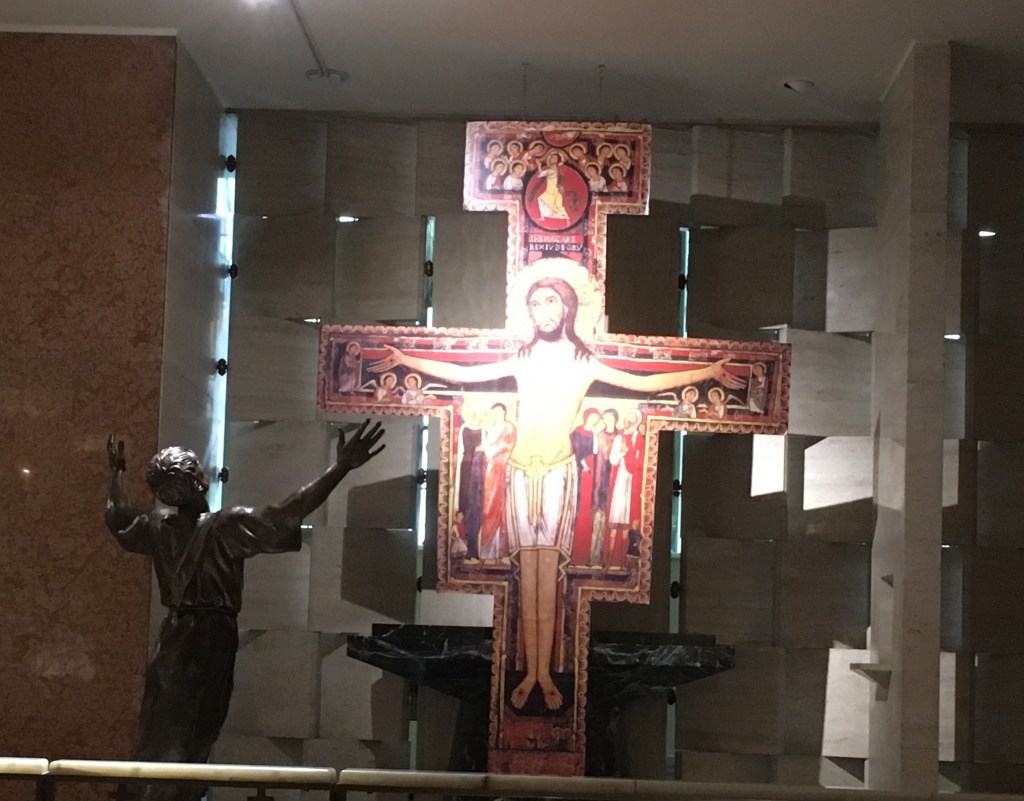
Working at home can distract one from other things happening in the world. Today I was busy, so I missed looking at my Franciscan calendar; and towards the end of the day, I suddenly found out that today was the feast day of all saints of the “Seraphic” Order; the Franciscan Order. It was a day to remember in prayer, those who had lived the Gospel, according to the example of St. Francis of Assisi, and lived it well.
I think is was originally established to recognize the the known and unknown saints of the Order of Friars Minor; all three branches, Regular, Conventual, and Capuchin. But on this day, I would remember those persons who were either Poor Clare’s, Third Order Franciscan Brothers and Sisters, or members of the Secular Franciscan Order. I am sure that there are many out, whose lives of prayer and charity has been an example for others.
“Almighty, eternal God, you were pleased to make your church illustrious through the varied splendor of the saints of the Seraphic Order. As we venerate their memory in one festival, may we also follow such shining examples of virtue on earth and thus obtain merited crowns in heaven.
We ask this through our Lord Jesus Christ, your Son, who lives and reigns with you and the Holy Spirit, one God, forever and ever. Amen”
Feast of Saint Elizabeth of Hungary

Born in the year, 1207, she was the daughter of the King of Hungary. At age three, she was betrothed to the Prince of Thuringia (part of Germany). Growing up, she began developing a strong prayer life and desire to help the poor. Married to Prince Louis, they would have four children.
She was known to be a loving mother, a person of deep faith, of prayer, and great charity. She endowed a hospital and regularly provided food for the poor in her city. And she believed that giving charity should be a hands on experience. She could be seen both serving food to the poor, and caring for the sick.
She encountered Franciscan friars; and was impressed with them and their way of life. She joined the lay Franciscans; now known as the Secular Franciscan Order. Her desire to live humbly, helping the poor, did not win her friends among the nobles of her husband’s court. When he died on his way back from the Crusades, they took advantage of the moment. They stripped her of her rightful assets, and cast her and her children from the palace.
She lived in poor accommodations, continued her charitable work. Finally, her supporters were able obtain better living quarters, supplies and clothing. She continued her work among the poor.
She passed away in 1231. Four years later, she was canonized by the Roman Catholic Church. She would be named as patroness of the Secular Franciscans; and of Catholic Charities.
Father, you helped Elizabeth of Hungary to recognize and honor Christ in the poor of the world.
Let her prayers help us to serve our brothers and sisters in trouble and need.
We ask this through our Lord Jesus Christ, your son, who lives and reign with you and the Holy Spirit, one God forever and ever. Amen!
From the Proper Offices of Franciscan Saints and Blessed in the Liturgy of Hours.
Random Thoughts
“The Rule and life of the Secular Franciscan is this: to observe the gospel of our Lord Jesus Christ by following the example of Saint Francis of Assisi, who made Christ the inspiration and the center of his life with God and people.” SFO Rule: Article 4
I have ten minutes to create a post for this blog, so here goes!
The Franciscan way of life, both religious and lay, has taken many different forms over the centuries. Different lifestyles, different ways of prayer, different emphasis of mission. But it must all remain rooted in this, the Gospel and the way Francis strove to faithfully live the Gospel!
For a lay Franciscan, this can prove to be a challenge. But in accepting this challenge, he or she enters a blessed way of living. The will be high moments, and low. There will be times of satisfaction, and frustration. But we are not alone in this journey; we will have brothers and sisters here on this earth; and others in heaven, who will encourage us on! The challenge is to get off our duffs and do it.
Saints Francis and Clare, and all Franciscan Saints, pray for us!
Blessed Jacoba of Settesoli, Secular Franciscan

Jacoba of Settesoli was born in the year 1190 into a noble Italian family. She married into a wealthy Roman family, and she and her husband would have children, including two sons. Sadly, her husband passed away.
While managing her household and caring for her children, she began to hear of an itinerant preacher, by the name of Francis. What she heard stirred her heart; and she desired to meet him.
An opportunity came when Francis and his band of brothers came to the city of Rome. Francis was seeking the Pope’s approval of his Rule of Life for his growing community. Lady Jacoba was able to speak to him about how she could live a more spiritual life, following Jesus. Francis advised her to continue caring for her family; that it was possible to live the Gospel life as both a mother and a householder. She followed his advice, although she did turn over management of the family lands to her two sons. She began living a life of prayer and charity. Francis and his brothers would visit her when they were in Rome. She gave a gift of land to the friars so that they could establish a shelter and hospital for local lepers.
During his final illness, he sent word to Jacoba, asking her to come to Assisi, with cloth to make a burial shroud. And he also asked her to bring some of those almond cookies she used to bake for him when he visited her home. She left Rome immediately.
When she reached Assisi; there was an argument among the brothers if it was appropriate for a woman to enter the friary! Francis settled the issue when he commanded them to let “Brother Jacoba” come in. She was present when he died; and mourned with the brothers.
Lady Jacoba remained to Assisi for the rest of her life. She died on February 8, 1273, and is buried in crypt of the Basilica of St Francis; near his tomb.
Happy Feast Day of Saint Elizabeth of Hungary, Patroness of the Secular Franciscan Order

“Father, you helped Elizabeth of Hungary to recognize and honor Christ in the poor of this world. Let her prayers help us help us to serve our brothers and sisters in time of trouble and need.
We ask this through our Lord Jesus Christ, your Son, who lives and reigns with you and the Holy Spirit, one God, forever and ever. Amen.”
From the Franciscan Supplement for Liturgy of Hours.
In times like the ones we are going through right now, we need St. Elizabeth’s example to inspire us; and her intercessions to strengthen us!
“Good Pope John”
 Today, the Catholic Church celebrates the life of St. John XXIII, was Pope, Supreme Pontiff of the Roman Catholic Church, from 1958 to 1963.
Born Angelo Roncalli, in the Italian province of Lombardy, to a family of sharecroppers, in 1881. He would be ordained a priest in 1904, serve as an stretcher bearer and chaplain in the Italian army, during World War I. After the war, he would be a bishop’s secretary, papal diplomat to Bulgaria, Turkey, and France. During World War II, he would use his diplomatic and ecclesial status to help hundreds of Jews escape the Holocaust.
He was appointed Patriarch of Venice, Italy, and made a Cardinal, in 1953. In 1958, after the death of Pope Pius XII, he joined other Cardinals in the Sistine Chapel, to elect the new Pope. After eleven ballots, Cardinal Angelo Roncalli was elected Pope. As is custom he took a new name, and became Pope John XXIII.
He was expected to be a “caretaker” Pope, his papacy was to be short and uneventful. He shocked everyone when in 1959, he summoned the world’s bishops to what became the Second Vatican Council. He would not live to see it’s conclusion, dying of stomach cancer in 1963.
I have no memories of his pontificate. As an altar server, I witnessed the steady changes that came in the liturgy. When I was in high school, I came across a book listing his memorable sayings, including his more humorous ones. I became attracted to this Pope from the Italian countryside. In seminary, I read his spiritual journal, “Journal of a Soul,” and encountered the deeply spiritual Pope John. And I have read, or at least tried to read his social justice papal encyclicals “letters,” especially his famous “Pacem in Terris.” I am finding that this letter still has something to say for our times.
Recently, I learned that there is something St. John XXIII and I share; we are both Secular Franciscans. He joined the OFS during his seminary days, I joined in 1988. So to my fellow Franciscan, I ask his intercession for our troubled Church, that the Holy Spirit will guide us into living the Gospel life more fully.
St. Elizabeth of Hungary – Patroness of Secular Franciscans
 Today, November 17th, Franciscans around the world, but especially Secular Franciscans, will celebrate the memory of Saint Elizabeth of Hungary. With St. Louis IX of France, she is Co-Patron Saint of the Secular Franciscan Order.
Born in Hungary, in 1207, she went to the German territory of Thuringia, to become the wife of its ruler, Louis. Together they would have four children. She would become well known for her acts of charity to the poor, establishing a hospital for the ill; and food for her poor subjects. Her husband would die from illness, while he was traveling to join an Imperial Crusade to the Holy Land. Court intrigue forced Elizabeth, with some of her children, to abandon the capital city, and flee. In a smaller, poorer city, she took residence and continued her service to the poor. Influenced by the recent arrival of Franciscan friars, she took one of them as her spiritual advisor. She would eventually become a Franciscan penitent. She would also eventually die relatively young.
St. Elizabeth can be, in fact, is a counter cultural example for our modern times. With our fascination with the rich and famous. With a minority of people controlling the majority of wealth in our country; to hear of a young, energetic woman willingly give up her riches for the poor, should shake our complacency. How best can we answer Christ’s command to feed the hungry; shelter the homeless; welcome the stranger. And what opportunities have we missed to do so?
Through the intercession of St. Elizabeth, may our eyes and hearts be open to those in need.
 Musings From St. Anthony's Walnut Tree