
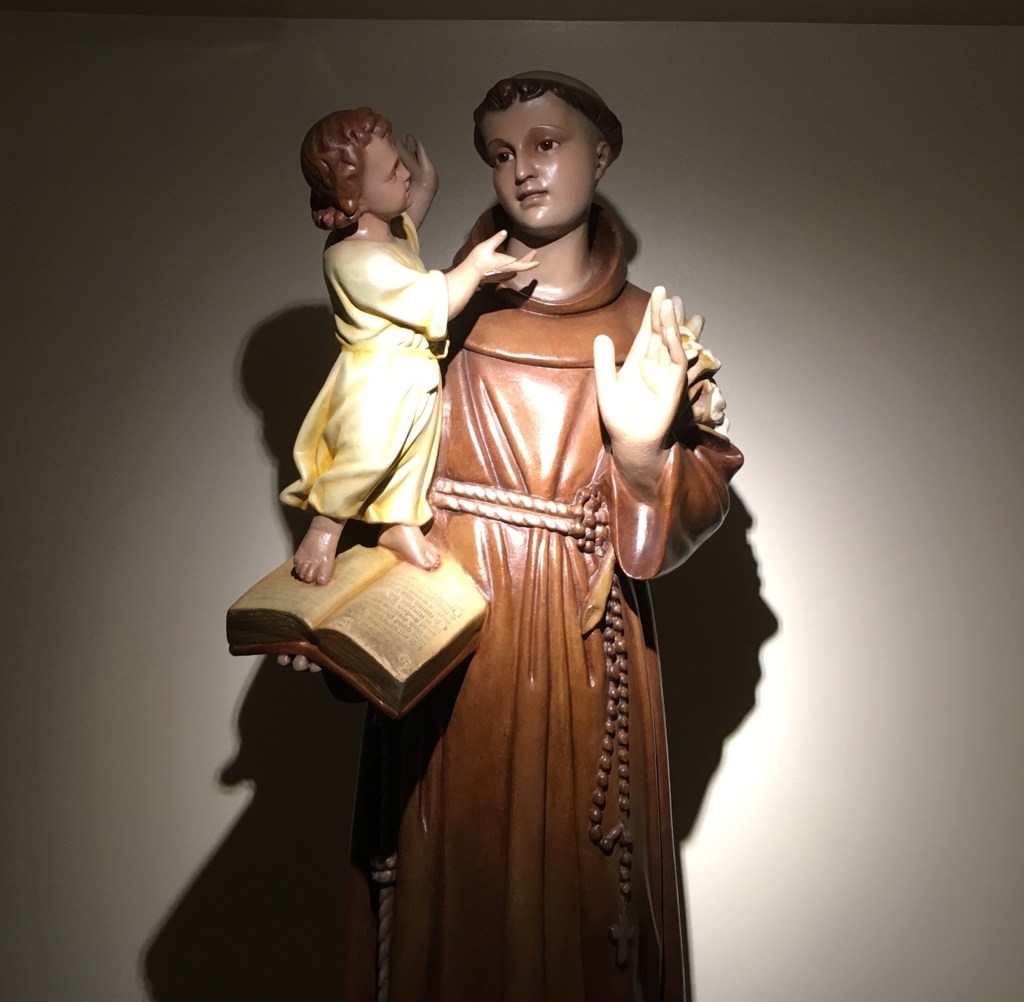
Among the list of Franciscan saints, the most popular among them, after Saint Francis of Assisi, is Saint Anthony of Padua (1195-1231). But, were it not for a chance encounter, things might have been different.
He was born in Lisbon, Portugal, with the name of Fernando Martins de Bulhoes. The family was well off, and arranged for him to be educated in a local cathedral school. He would eventually join an Augustinian community near Lisbon. He would be ordained a priest and was giving the responsibility of welcoming visitors and guests to the monastery. It was then, that one could say, that the Holy Spirit then took over. Near the monastery was a small community of newly arrived Franciscan friars. They had established a small hermitage, and Fernando had frequent contact with them. He found their evangelical way of life attractive.
The Franciscans had sent a group of their brothers to North African country of Morocco, to evangelize. This group would suffer beheading at the hands of the Moroccan rulers. Their remains were returned to Portugal, and were buried at the Augustinian monastery. Fernando was inspired by their courage and their faith. He asked for, and received permission from the Augustinians to transfer over to the Franciscan order. He took the name Anthony, after an early Saint, Anthony the Great.
He joined another group of Franciscan friars being sent to Morocco, but he became seriously ill upon arrival. He was sent home back to Portugal. But stormy weather drove his ship further into the Mediterranean, winding up in Sicily. He went to the last great gathering of Franciscan friars with Saint Francis present. At the conclusion of it, he was sent to a small community of lay brothers, in Italy. There, the story goes, the community was celebrating the ordination of a friar, but the guest speaker had not arrived. Anthony was asked to preached. It was then the depth of his learning was revealed, as was also his skill as a speaker. And the rest, as they say, is history.
He would be sent out on preaching tours, up and down throughout Italy. It was said the thousands of people gathered to hear him speak. They came away inspired to live the Gospel of Jesus Christ more intensely. Francis himself, gave Anthony the work of teaching theology to the friars, and how to preach.
He became ill in his thirties, and died on June 13, 1231, in Padua.
He was canonized as Saint in 1232. He proclaimed a Doctor of the Church by Pope Prius XII, in 1946.

 Musings From St. Anthony's Walnut Tree