The Catholic Worker – 85th Anniversary!

CW

Dot and PeteOn May 1, in the year 1933, a Socialist group was holding a May Day demonstration in New York City. The Great Depression had the nation in it’s grip. The demonstrators were protesting very strongly against the bankers, and capitalists they blamed for this economic disaster. On the edges of the demonstration, a small group of men and women were selling copies of a newspaper, for a penny. It was “The Catholic Worker,” and it heralded the beginning of a Catholic social movement by the same name. Co-founded by Dorothy Day, a Catholic convert, single mother, reporter, author and socialist; and Peter Maurin, former religious brother, philosopher, and traveling vagabond. They introduced a radical way of living the Gospel of Jesus Christ.

They established “houses of hospitality,” where the poor would be received as friends, brothers and sisters, fed and given shelter. They spoke out for the poor, powerless and downtrodden. They and their followers, down through the years, have worked to make the world a place “where it was easier to be good.”

The Catholic Worker continues this work, through autonomous Houses of Hospitality scattered throughout the country and the world. They have a different measure of success. If only one person is welcomed, clothed, and fed, it has been a good day. If they have gathered together for prayer, to reflect and discuss what it means to radically love the Gospel of Jesus Christ, it has been a good day.

The Catholic Worker continues, inspired by the words of Dorothy Day and Peter Maurin. May we all be inspired by them.

Servant Church – Diakonia

So when he had washed their feet and put his garments back on and reclined at table again, he said to them, ‘Do you realize what I have done for you?  You call me ‘teacher’ and ‘master,’ and rightly so, for indeed I am.  If I therefore, the master and teacher, have washed your feet, you ought to wash one another’s feet.  I given you a model to follow, so that as I have done for you, you should also do.  (John 13: 12-15)

In the above Gospel passage, and in many others, Jesus stressed that those who follow him, must be willing to serve both those within the faith community, and those who are outside of it.  Throughout all the Gospels, Jesus showed through his healing ministry, that the Messiah in their midst came as a servant to all.  So his Church was also to be a servant to all, providing aid and support to the poor, serving those both within and without the Church.  The Greek word “diakonia,” meaning “service,” has been applied to describe an aspect of life in the Christian Church.  As related in the Acts of the Apostles, the Apostles appointed seven men to serve the Hellenist Christian widows.  In Christian tradition, they became known as the first Deacons.  As the Church grew, so did the number Deacons, performing works of mercy to the poor.  They became an Order in the early Church, an official sign of Church acting as servant to all.

As Europe moved into medieval times, as Christianity became the dominant religion in Western Europe, as bishops and the Pope inherited secular power, changes began to take hold.  The papacy and the episcopacy began to take on the trappings of the nobility; some adopting the view that they, with the nobility, deserve to be served by the serfs and peasants.  The idea of a servant Church almost disappeared; it was preserved by laypersons who were inspired to serve the poor; by some bishops and priests who established hospitals, homes for orphans, lepersariums.   An active Diaconate also declined, becoming a transitional position that a man would acquire for a period of time before being ordained to the priesthood.

With the Second Vatican Council, the concept of a servant Church was reborn.  The Council, and many encyclicals since then, have stressed that all members of the Catholic Church are called to participate in the ministry of service to the poor, the homeless, and the forgotten.  Fulfilling this call can take many forms: giving financial support to charities; volunteering for food pantries, kitchens, homeless shelters and centers; visiting patients in hospitals and nursing homes.  We need to be open to promptings of the Holy Spirit; and discern whenever an opportunity to serve and show mercy, shows itself.

The Council turned once again to the Order of Deacons, to be a visible sign of being a Servant Church.  About fifty years ago, Pope Paul VI reestablished the permanent Diaconate in the Roman Catholic Church.  Men, married and single, from many countries, including the United States, have stepped up and been ordained.  They are servants to the Church and the world, through liturgical participation, works of charity, preaching and being religion educators.  In the Archdiocese of Boston newspaper, The Pilot, three Deacons have written an excellent column on the Permanent Diaconate of today.  I invite you to go read it.

In our country, in our world, there are people in need, who feel abandoned and discarded.  In such times the world needs a Servant Church, to bring hope and relief.  A Church who follows Our Lord Jesus command; “I have given you a model to follow, so that as I have done for you, you should also do.”
deacon red stole


Communion in the Hand – An Issue Again?

Communion in the handCardinal Robert Sarah, who is the senior Vatican official responsible for the liturgical practices of the Roman Catholic Church, has stirred things up in the Catholic blogosphere.  In a forward he wrote for a book on Eucharistic theology, he stated his belief that reception of Holy Communion in the hand, and standing, not kneeling and on the tongue, is a desecration of the Sacrament.  He states that the practice helps Satanic powers disrupt the work of the Church.

Now, keep in mind, Catholics  have been allowed to receive Communion on either the tongue, or in the hand since the 1960’s.  What is important is the disposition of one’s mind and soul.  I have received in the hand, since it was allowed in this country since the 1970’s.  I have helped distribute Holy Communion, as both an Extraordinary Eucharistic minister, and as a Deacon.  I have witnessed people of faith come up and reverently receive the Body of Christ, some on their tongue and consuming it, or in their cupped hand, and then consuming it.

What amazes me, is that after all this time, this is still an issue!  Looking back, I found a 2015 post I wrote, covering basically the same ground.  I have hoped that we had learned to accept that both approaches are valid, are holy, and expresses our love and devotion for our Savior.

Happy Birthday, Father Louis

MertonWednesday, January 31st, was the birthday of a Trappist monk and mystic, Father Louis, who was born in 1915.  Most of the world will know him as Thomas Merton.  Born to a New Zealander father and an American mother; he would eventually take up residence in the United States.  While attending college in New York, he had a conversion experience, that would eventually lead him to the Abbey of Gethsemane, in Kentucky.  In 1947, he became a professed member of the Trappist community; he was ordained a priest on May 26, 1949.  The year before, 1948, he published his autobiography, “The Seven Storey Mountain,”  which became the most popular book in American Catholic literature.
To be honest, I have never read the book; to the best of my recollection, my earliest encounter with his writings was either his history of the Trappist order, “The Waters of Siloe,” or one of his journals, “The Sign of Jonas.”  Since then I have acquired a good size collection of his books.  He had a talent for the making what it means to be a contemplative understandable; and more importantly, achievable by us ordinary folks.  His writings continue to inspire me to at least try to deepen my prayer life.  Some attempts have been more successful than others.

There have dry periods; sometimes very long dry periods.  But when I pick up one of his books and read, I get inspired again, and try once more to live contemplatively in my daily life.  And I am not alone, hundreds, if not thousands of individuals, both Christian and non-Christian, have taken up the journey, with Merton as our guide.

Christmas – 2017

Christmas Eve SBC 2017


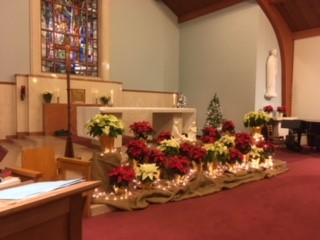
Christmas time has come around once more for all Christians, for all Catholics. The Church has put away it’s purple colored vestments and liturgical decorations. The Advent wreath has been taken down. In their place, the chapel sanctuary, where I worship, is strewn with red and white poinsettias, a Christmas tree, with white lights. A manger scene with Mary, Joseph, and the Baby Jesus, has been set up in front of the altar.

 
The chapel quickly fills for our 4:00PM Vigil Mass, and soon it is standing room only. Our guitar choral group leads us in song, we join in singing the old Christmas favorites. We have a guest priest as our celebrant this night, and the sacred liturgy begins. We hear the words of the prophet Isaiah spoken; telling of ancient Israel’s future vindication, and rebirth. Then we hear the Good News from St. Matthew, proclaimed by our celebrant:


“18
Now this is how the birth of Jesus Christ came about. When his mother Mary was betrothed to Joseph, but before they lived together, she was found with child through the holy Spirit.
19
Joseph her husband, since he was a righteous man, yet unwilling to expose her to shame, decided to divorce her quietly.
20
Such was his intention when, behold, the angel of the Lord* appeared to him in a dream and said, “Joseph, son of David, do not be afraid to take Mary your wife into your home. For it is through the holy Spirit that this child has been conceived in her.
21
She will bear a son and you are to name him Jesus, because he will save his people from their sins.”
22
All this took place to fulfill what the Lord had said through the prophet:
23
“Behold, the virgin shall be with child and bear a son,
and they shall name him Emmanuel,”
which means “God is with us.”
24
When Joseph awoke, he did as the angel of the Lord had commanded him and took his wife into his home.
25
He had no relations with her until she bore a son, and he named him Jesus. “ (Matt. 1: 18-25)

 
After hearing how Christ Jesus, though he was Son of God, willingly came into this world as a child, to begin the work of salvation; we are soon witness to another miracle. Christ is made present to us in the form of bread and wine, transformed into his Body and Blood. It was my privilege and honor to help distribute Holy Communion to those who approach. I feel something in my heart, as I hold up each host for the communicant to see, and say with conviction: “The Body of Christ.” And then place the host in the hands of the person, or on their tongue.

 
There the final prayers, and the blessing of the priest; we then sing joyful Christmas songs; celebrating the sacred event that happened in Bethlehem; the sacred moment we just experienced, and leave with the hope of Jesus’ promised return, when a new heaven and a new earth will come to be.

All peace and joy be yours this Christmas day, and God’s blessings on you for the coming year.

Pax et Bonum!


St. Elizabeth of Hungary – Patroness of Secular Franciscans

St. Elizabeth of HungaryToday, November 17th, Franciscans around the world, but especially Secular Franciscans, will celebrate the memory of Saint Elizabeth of Hungary.  With St. Louis IX of France, she is Co-Patron Saint of the Secular Franciscan Order.

Born in Hungary, in 1207, she went to the German territory of Thuringia, to become the wife of its ruler, Louis.  Together they would have four children.  She would become well known for her acts of charity to the poor, establishing a hospital for the ill; and food for her poor subjects. Her husband would die from illness, while he was traveling to join an Imperial Crusade to the Holy Land. Court intrigue forced Elizabeth, with some of her children, to abandon the capital city, and flee. In a smaller, poorer city, she took residence and continued her service to the poor. Influenced by the recent arrival of Franciscan friars, she took one of them as her spiritual advisor. She would eventually become a Franciscan penitent. She would also eventually die relatively young.

St. Elizabeth can be, in fact, is a counter cultural example for our modern times. With our fascination with the rich and famous. With a minority of people controlling the majority of wealth in our country; to hear of a young, energetic woman willingly give up her riches for the poor, should shake our complacency. How best can we answer Christ’s command to feed the hungry; shelter the homeless; welcome the stranger. And what opportunities have we missed to do so?

Through the intercession of St. Elizabeth, may our eyes and hearts be open to those in need.

“I am in Your Midst as One Who Serves.” An Ordination of Deacons – 2017

Deacon ordination 2017 4This past Saturday, my brother Deacons and I gathered at St. Edith Stein Church, in Brockton, MA. We were there to celebrate the ordination of 7 new Deacons for the Archdiocese of Boston. It was being held at St. Edith Stein, rather than at Holy Cross Cathedral, because the cathedral is undergoing a massive interior renovation. St. Edith Stein is a beautiful church, with an interior decoration that you do not see in more modern designed churches. It does have one drawback, very narrow stairs between the basement and main levels. The basement was where we gathered to vest for the ceremony.
Now, it had been raining heavily in eastern Massachusetts on Saturday, but the rain hadDeacon ordination 2017 stopped long enough for us to organize the procession into St. Edith Stein. The church itself was packed with the families and friends of the men to be ordained. A choral group from Holy Cross Cathedral lead the congregation in song, as we walked down the main aisle; bowed before the altar and took our seats
.
I have been graced with good spiritual experiences, when I attend Sunday liturgies of the Eucharist, the Mass. But there is something about a grand liturgy, like an ordination, that really draws me into a holy place. Our presider was Cardinal Sean O’Malley, OFM Cap, Archbishop of Boston, lead us in prayer. During his homily, he referred to the second Scripture reading, Acts of the Apostles, Chapter 6: verses 1 to 7. The passage describes how the Apostles had the early Christian community name seven men to serve the Hellenist widows. The Apostles laid their hands on the seven chosen men, and the Holy Spirit came upon them. Cardinal Sean noted that it was interesting that we now had before us seven candidates for ordination. He reminded us all that we, as deacons, are called to a life of service, both within the Church, and to the world.

 
After the ordination rite, we previously ordained went up into the sanctuary to welcome our new brothers into the fraternity of Deacons. We are joined together; to be servants by proclaiming the Good News to people, and by living the Good News. We are joined together; to be servants at the Eucharistic altar, to help add to the people’s experience of liturgy, to help distribute the Body and Blood of Jesus Christ to the community through Holy Communion. We are joined together, to be servants to the poor, to those in pain and are alone. As a fraternity of deacons, we support each other, and learn from each other. Together, we help the Church bring the Good News to the world.


deacon red stole


A Wedding Homily – 2017

Welcome, we are all here to witness something awesome!  We have come to witness two unique individuals come forward, and with God’s grace,  become one.  We are about to witness the power of their love for each other, and the power of God’s love, made present here before us; and that should fill us all with awe!
For that is one of the objectives that a celebration of a sacrament is suppose to accomplish.  It is an opportunity to encounter the Divine; through the ordinary objects that our God has created: water, olive oil, bread and wine,..a ring.  A sacrament is also a means by which God transforms the individual or individuals who are receiving the sacrament.  Through the waters of Baptism, we are cleansed of sin, and become born again as a child of God.  Through the anointing with holy oil, we are sealed with the Holy Spirit.  When we receive consecrated bread and wine, we receive the Body and Blood of Christ, and become one with Christ.  And in the exchange of rings, which symbolizes the pledge, in love, of a man and a woman to each other, to their union.  And it also symbolizes God’s pledge to you both; that He will be with you always.

For God is the source of all life, and of all love.  And through His Spirit, that love can fill your hearts, your souls, all the way down into the very depths of your being.  The power of God’s Presence within you, the power of His love; will help you experience the joyful times more intensely; will help you through the trying times with more hope.  Remember always the description of love we have just heard from the writings of St. Paul:

“It bears all things, believes all things, hopes all things, endures all things.  Love never fails.”                  (1 Corinthians)

Love will never fail, if we continually open our hearts, and be present to God, the Father.  A Dutch priest and author, had a personal revelation; reflecting on when God addressed Jesus, as He was coming up out of the waters of the Jordan River, as His “Beloved.”  And He also calls you, me,  all of us here, “Beloved.”  Whether we have been good or bad; whether we have ignored Him or not; whether we believe in Him or not; He still calls each one of us”Beloved.”

It is by the power of that love; by the gift of His Spirit, that you both have been drawn to this place, to this sacred moment of time.  And we have all been drawn here to witness something awesome.

Reform and the Roman Curia

Pope Francis was supposedly elected by the College of Cardinals to initiate reforms in the Vatican. For many Western Catholics, this meant doing something about the clergy abuse of children. Things looked hopeful for awhile; with the creation of a papal commission to propose reforms. The commission was headed by Cardinal Sean O’Malley, OFM Cap, Archbishop of Boston, MA; and included some survivors of clergy abuse.

Now, the last clergy abuse survivor on the commission has resigned. She has cited resistance from Curia members to proposed reforms; including a court to try bishops who either failed to deal with incidences of abuse or who protected accused priests.

While members of the Roman Curia deny this; there are reports of Curial officials just ignoring papal directives for reform. They may be figuring that they can wait out this Pope.

Maybe it is time for Pope Francis to take at one lesson from Trump; and became a “papal bull” on the Curial “china shop.” Maybe it is time to break it all down and begin from scratch!

(This my first post via e-mail.)

First Sunday of Lent – 2017


Since last Wednesday, “Ash Wednesday,” the Catholic Church, along with other Christian churches, began a 40 day period of fasting, prayer, and almsgiving.  This leads up to Holy Week, and the commemoration of the death and Resurrection of Jesus Christ.

Today, the First Sunday of Lent, the sanctuary of our church is decorated in somber, purple; with no flowers.  We process in, not with hymns, but chanting prayers, begging for God’s mercy; and for the intercession of the saints.

The scripture readings for today, first tell of how our first parents, gave into temptation, and brought sin and death into the world.  Then  we hear the Gospel, the “Good News,” of how Jesus resisted temptation, and began the journey that would lead to our liberation.  

So how will we spend these days of Lent; will we intensify our spiritual lives? Will we “repent and believe the Good News?”  Will we be lights to a world so threatened by darkness, by hate, and violence.  Let us “prepare the way of the Lord, and be witnesses of the power of His Love!