
There was an inscription over his head:
‘THIS IS THE KING OF THE JEWS’
.(Luke 23:38)
2 Sm 5: 1-3
Col 1: 12-20
Luke 23: 35-45
 Today, the Church celebrates the Feast of Christ the King. However, the Scripture readings for the day could lead to confusion for some of us. The first reading describes how the people of Israel came together and made David their king. It was to David, did the Lord make the promise: “Your house and your kingdom shall endure forever before me ; your throne shall stand firm forever” (2 Sm 7: 16). Even when their lands were occupied by foreign invaders; the people of Israel still hoped for the promised coming of the Messiah, a descendant of King David.
We believe that Jesus of Nazareth, of the line of King David; is the promised Messiah, the Christ of God, the Son of God. However, in the Gospel reading from Luke, we see Jesus not seated on a throne, but nailed to a cross, like a common criminal. Yet in this suffering, he was performing the greatest act a king can do; dying for his people. For by his death and resurrection; Jesus Christ, King of the Universe, freed us all from the power of sin and death. To Him, would come a glory that would surpass anything pomp and ceremony could bestow on a earthly king or queen.
Today, the Catholic Church is also ending the Jubilee Year of Mercy. It is fitting then, that today’s Gospel reading describes the last act of mercy Jesus would perform before his death. Despite enduring horrific suffering, he hears the plea of a repentant criminal, and promises him eternal peace. Thus, we are being challenged by Jesus; that no matter how much pain or suffering someone may have caused us, we must be ready to be merciful, to forgive and to heal. And no matter how hard life might be, at any given moment, we must be open to any opportunity, to give mercy to someone who needs it.
 Over a cup of coffee, I would apologize for not coming to the counter for a while. One could say I have been struggling with one huge case of writer’s block. It is a combination of trying to carve out a period of time to write something online; and not be able to think of anything to write.

 known as Padre Pio. Padre Pio was a Franciscan Capuchin friar, born in 1885, in Italy, and died on September 23, 1968. He was ordained a priest in 1910. In 1918, he received the stigmata, after experiencing a powerful vision of the Crucified Christ. He bore the five wounds of Christ for the rest of his life. News of this miracle got out to the world, crowds of people gathered to witness it. Padre Pio would be examined many times by physicians, with conflicting diagnosis’. The Church would investigate him many times; would forbid him to say Mass or hear confessions for a period of time. He would eventually be cleared of unorthodox thinking or practices, and returned to his priestly ministry. He would spend a good deal of his time hearing confessions, offering spiritual council, and celebrating the Eucharist. He remained at the Capuchin friary at San Giovanni Rotondo for the rest of his life. He worked at, and successfully caused a hospital to be built near the town. 34 years after his death, he was declared a saint, by Pope St. John Paul II.
 Yale Humanist Community, have been gathering in New Haven CT, Albany, NY, Providence, RI, and on September 27, 2016, in Boston, to hold a town meeting style discussions on the Bible. These locations, according to recent surveys, are the least Bible minded cities in America. The final meeting in Boston, will actually be held at Harvard University; the event will be
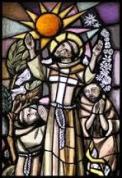

 The Catholic blogosphere is abuzz with the
  Today, Franciscans everywhere are celebrating the Feast of the Church of St. Mary of the Angels of the Porziuncola (Little Portion). Actually, a small chapel, it is one of several chapels around Assisi, Italy, that St. Francis of Assisi repaired; shortly after his conversion. He was doing this in response to a mystical encounter with the Crucified Christ, who commanded Francis to “Repair My House!” Taking the command literally, he began to repair the chapel of San Damiano, and the other chapels. It was only later that he understood his mission was to “repair,” (ie, renew) the Catholic Church.
 Musings From St. Anthony's Walnut Tree