
 From July 22 to July 26, 2018, 1,300 Catholic deacons, along with their wives and children, gathered in New Orleans, LA, for the 2018 National Diaconate Congress. This year’s meeting was significant because 2018 is the fiftieth anniversary of the restoration of the permanent Diaconate in the Latin Rite Catholic Church. Nationwide, there are 18,500 permanent deacons in the United States. Columnist, blogger, and Deacon, Greg Kandra, shares some of his experiences of the Congress.
Archbishop Christophe Pierre, the Apostolic Nuncio to the United States, presided at the opening Mass. In his comments to the deacons before the end of the celebration of the Eucharist, he challenged them “to be an evangelizing force in the world.” The homilist at the opening Mass, was Archbishop Gregory Aymond of New Orleans. He called on the deacons present to be the “conscience” of the Church; bringing it’s attention to the needs of the poor and powerless. “All Christians are called to charity by their baptism, but deacons lead us as a church in the works of charity,” he said. “We look to you in some ways as the conscience of the church. We ask you to find those who are in need and to invite us to serve them. And when we forget them or fail to be people of charity as a church, we ask you to be our conscience and to call us back to what God asks.”
It is a challenge that all of us deacons need to accept, and act on. Through reading and reflecting on the Scriptures, through prayer and being open to the Spirit, to realize new ways to serve the poor; to be a voice for the poor. To seek from the Holy Spirit the strength to reach out of our “comfort zones,” and encounter the poor where they are. Now is the time for us discover what new ways are open to us on how to live and minister as husbands, parents, and deacons.
 Amos 7: 12-15
 There has been a lot of
 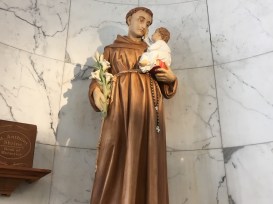 On this day, the Catholic Church, and especially members of the Franciscan family, celebrate the life of


 On May 1, in the year 1933, a Socialist group was holding a May Day demonstration in New York City. The Great Depression had the nation in it’s grip. The demonstrators were protesting very strongly against the bankers, and capitalists they blamed for this economic disaster. On the edges of the demonstration, a small group of men and women were selling copies of a newspaper, for a penny. It was “The Catholic Worker,” and it heralded the beginning of a Catholic social movement by the same name. Co-founded by Dorothy Day, a Catholic convert, single mother, reporter, author and socialist; and Peter Maurin, former religious brother, philosopher, and traveling vagabond. They introduced a radical way of living the Gospel of Jesus Christ.
 Cardinal Robert Sarah, who is the senior Vatican official responsible for the liturgical practices of the Roman Catholic Church, has stirred things up in the Catholic blogosphere. In a forward he wrote for a book on Eucharistic theology, he stated his belief that reception of Holy Communion in the hand, and standing, not kneeling and on the tongue, is a desecration of the Sacrament. He states that the practice helps Satanic powers disrupt the work of the Church.
 Wednesday, January 31st, was the birthday of a Trappist monk and mystic, Father Louis, who was born in 1915. Most of the world will know him as Thomas Merton. Born to a New Zealander father and an American mother; he would eventually take up residence in the United States. While attending college in New York, he had a conversion experience, that would eventually lead him to the Abbey of Gethsemane, in Kentucky. In 1947, he became a professed member of the Trappist community; he was ordained a priest on May 26, 1949. The year before, 1948, he published his autobiography, “The Seven Storey Mountain,” which became the most popular book in American Catholic literature.
 Today, November 17th, Franciscans around the world, but especially Secular Franciscans, will celebrate the memory of Saint Elizabeth of Hungary. With St. Louis IX of France, she is Co-Patron Saint of the Secular Franciscan Order.
