An Oasis in the Middle of a Concrete Canyon!

(The following post is one of my writing assignments for Blogging Univ.  Please enjoy!)

PO Sq ParkI was in Boston to attend a board meeting of the Massachusetts Bible Society.  I was way too early, so I
went to a green oasis in the middle of the Financial District.  It is known to most of the workers as the park in Post Office Square, its official title is the Norman B. Leventhal Park.  It was not always a park.  In the past, it was a rundown parking garage, four stories above the street level, with levels of parking below.  A group of public and private leaders gathered the funds needed to tear down the garage, renovate the parking levels below, and create a botanical wonder amidst a concrete jungle.

I went to the local café, paid way too much for an 8 oz. cup of coffee.  I sat on the iron bars bench that weaves it way around one side of the park.  The calendar may say it is spring, but the air temperature did not feel it.  As I sat sipping my coffee, I watched people walking through; some dressed in business causal, others in business suits.  I observed who were wearing dress shoes, and who were wearing sneakers.  People sat at iron wrought tables, either having lunch, or a power lunch, with papers and files underneath their plates.  Some couples sat on wooden benches, cuddling and smooching.  As people passed by, I heard financial words, legal terms, and just office gossip.  Where they were not gathering was on the grassy center of the park.  It was roped off, to allow the new grass to grow and take hold.  The trees were beginning to bud; some were wrapped in a muslin liked material, which to this person looked very odd.  My eyes looked up further, at the tall buildings that surround this park.  Buildings made of marble, concrete, and glass; each containing either business offices, or hotel rooms, or government agencies.

It is in the afternoon, yet the downtown traffic is very light.  The sounds of a city at work were not too intrusive on the quiet of the park.  I really do miss it here!  I got up from my seat, threw my empty cup into the trash, and headed back downtown.  I was going back into the bustle, and the noise, to grab a subway trolley to my next destination.

Letter Found on a Road; Hope is Renewed

TAU crossIn the early 13th century, a tradesman is walking down a road in the Umbrian valley of Italy.  He is bent over under the weight of the tools of his trade on his back.  It is not just the weight on his back that bends him over; it is the weight on his soul.  He is a God fearing man, he is a regular church attendee, he prays daily.  Yet, he is afraid that he will never encounter Christ, he will never entire the Kingdom of God.  He hears priests preaching that only those who enter the priesthood, those who are monks and nuns, sequestered in their monasteries and convents; will see the face of God.  And people like him, no matter how hard they strive to live a holy life; will only see Christ after eons in purgatory, being cleansed of their sins.

On the road, he suddenly notices a rolled up piece of parchment.  He picks it up, unrolls it, and sees a letter, written in rough Italian, signed with a Tau cross, “T.”  He begins to read:

“All who love the Lord with their whole heart, with their whole soul and mind, with all their strength (Mt 22:39), and love their neighbors as themselves (Mt 22: 39) and hate their bodies with their vices and sins, and receive the Body and Blood of our Lord Jesus Christ, and produce worthy fruits of penance:

Oh, how happy and blessed are these men and women when they do these things and persevere in doing them because ‘the spirit of the Lord will rest upon them’ (Is 11:2)…” *

The tradesman heart suddenly is unburdened; he sees the world anew with hope filled eyes.  He hears church bells ringing; he sets off again down the road, towards the city of Assisi.

*These are words written by St. Francis of Assisi, to a group of pious lay men and women.  The document has been entitled “Exhortation of Saint Francis to the Brothers and Sisters of Penance.”

Right in the Gut!

Laid off

Many of us will experience some sort of personal loss at some point in our lives.  It may take a while for that sense of loss to hit us; other times it will hit us in the gut almost immediately.  The loss I have experienced this year, the one that seems to be hitting me in the gut right now, is the loss of a job.  On January 7th, 2015, I was brought into a small conference room, outside of my work floor, and was told, that because of the loss of some major clients, after 19 years of employment, I was being let go.  I did not react too well to the news, at first.  And truth be told, my boss was not too happy over the situation either; he was known to try to retain the workforce by all means possible.  Still the realities of the business situation had forced their hands.  We went over the severance package, which was generous; and outplacement services that would be put at my disposal.  Now, because of the security requirements our clients have demanded of the company, I was not allowed back to my desk.  So I was escorted to the elevators, given a handshake, and that was that.

Now, let me say again, the company staff has been very supportive; my personal items were boxed and shipped back to me.  And they have been very helpful in clearing up some difficulties with my unemployment insurance.  But still, after 19 years, I found myself without any place to go in the morning.  I have been doing the usual things one does, when one is freshly unemployed.  I registered with the Commonwealth’s Unemployment Assistance office.  I registered with a career placement agency.  I worked with the outplacement specialist, who helped me retool my resume, and gave me a set of form letters, each covering a specific stage of the job search.  And I have been looking.

However, up till now, I have not been in touch with my feelings about this situation.  That is, till now, when we got this writing prompt about loss, and all of a sudden it hit me, right in the gut.  (Thanks a lot Blogging U.!)  So now, the depression, the fear, and all the anxiety; yep, right there, right in front of me!  Or I should say, right inside of me.  More about this in my future blog posts.

Some Very Random Thoughts on a Musical Theme

(This day’s post may seem a little odd.  I am taking an online course on writing for a blog.  Today’s assignment was to free write, just keeping typing what comes into our heads about three songs that are important to us.  So please enjoy these ramblings.)

My three favorite songs, the important one’s, the ones that mean something for my life.  The first song is from my childhood; “Snoopy and the Red Baron!”  It was a silly little song, sung by a pop rock group, whose name I cannot remember.  It is important, because I had just received my first phonograph record player, nd the song was on my first 45 record.  What pains me even as I am writing this, is that there will be readers of this post, who will be asking: “45?” “phonograph?” “What is a record player?”  It is amazing how much the technology of music has changes over the past 50 years!  The second song is a Church song, a hymn passed on the prayer “Peace Prayer of St. Francis.”  IT is a hymn that encapsulates all of the Franciscan ideals, service, seeking peace, emptying oneself for others, reacting in opposite way from what the how the world would react to a wrong.  What is ironic about this hymn and prayer, is that Franciscan scholars agree that Francis of Assisi never wrote these words, that it was written in the 20th Century.  The final song is a hymn also, the “Salve Regina.”  It is an ancient Marian hymn, a hymn asking for Mary’s intercession on our behalf.  It is a hymn that is sung in most monasteries after Night Prayer, the last prayer in the evening, usually in a darkened chapel, before the monks or nuns go back to their bedrooms.  Many religious orders will chant this hymn as a deceased member of their community is being taken to their final resting place.  When I was in formation to become a Deacon, the head of the program set as a goal for my class to be able to chant this hymn by the end of year.  It was and is a means of bringing all of us together, something that we could identify with as being part of the fraternity of Deacons.

Those are the three songs that come to mind right now; there have been others when I hear them, that will bring me close to tears, but I cannot remember the titles.  So these three will have to do!

I Want to Fly to Assisi

Where would I go if could be immediately transported somewhere?  I and other bloggers were challenged to write a post, answering this question.

I would like to be soaring over the green Umbrian countryside of Italy, like a brown sparrow, heading towards the small Italian city of Assisi.  It is an ancient city; most of the buildings were built during the Middle Ages, still being occupied.  I am heading towards a large Catholic Basilica, the Basilica of San Francesco d’Assisi, the last resting place of Saint Francis of Assisi.

Saint Francis was born Giovanni di Pietro di Bernardone, the son of a wealthy cloth merchant.  His father, who made his money selling fine cloth to French merchants, nicknamed his son Francesco as a tribute to the French.  Francis was the city playboy; it was not a party if Francis was not invited.  He was a social climber, who longed to belong to the nobility, to become a knight.  He was a soldier, a prisoner of war, a veteran who was broken in body and soul.  And because of his brokenness, Jesus Christ entered into Francis’ heart; and Francis experienced a conversion, a conversion to the Gospel life.  He began to give his money to any poor person who asked for alms.  He went among the lepers, caring for them, washing their sores, and binding them with bandages.  In the solitude of caves, he began to develop a deep spiritual, prayer life.  He reflected on the gospels, he entered into an intimate relationship with God.  Francis strived to live the Gospel of Jesus Christ.

He gave away everything he owned, dressed like a beggar, in a grey, brownish robe.  He went about serving the poor, preaching in the streets, and marketplaces; proclaiming to all who would listen to him; that God loved them all.  Men, who heard his words, saw his lifestyle, were drawn to Francis, and soon he had twelve followers.  Twelve became a hundred; the hundred became thousands, all promising to live the Gospel of Jesus Christ, according to the example of Saint Francis.  They became the Order of Lesser Brothers, Order Friars Minor.  Women, like Clare of Assisi, were also drawn to this Troubadour of Christ.  With Clare, he formed a contemplative community of women, the Poor Ladies of Assisi, now known as the Poor Clares.  There were other men and women, farmers and tradesmen, wives and seamstresses, who also wanted to live the Gospel, and sought Francis’ guidance.  They became the Brothers and Sisters of Penance, the Third Order of St. Francis; today known as the Secular Franciscan Order.

I became attracted to St. Francis during my third and last year at the archdiocesan seminary.  I had decided to take years’ leave from the seminary; I spent the year with a Christian ecumenical organization which provided worship services in the National Parks.  I was sent to Yellowstone NP, lead services during the weekend, worked in the kitchen the rest of the time.  And in the midst of all that natural beauty, I read about Francis and the Franciscan life.  After two years, I entered formation to become a Friar.  I was to realize that God had another path for me, so I left the Friars, but the Franciscan spirit was already embedded in my heart.  I would later join the Secular Franciscan Order; I have been a professed member for over 25 years.  And I am always wishing I had the means to make a pilgrimage to Assisi, to visit that Basilica.

Francis died on the evening of October 3, 1226, at the age of 44 years old.  He was canonized a saint in 1228.  The friars were already beginning the construction of the Basilica.  The best architects, artisans and artists, the pioneers of the Italian Renaissance, were brought onto the project.  The Basilica was constructed in two levels, the upper church with vaulted ceilings, and large stain glass windows.  The lower church is more enclosed, but both levels are covered with beautiful frescoes, painted by Italian master artists.  The Basilica is considered an international treasure.  However, when the Basilica was finished; the Friars buried Francis in secret; for fear that rival cities would try to steal the remains.  They did such a good job hiding the burial site, that Francis’ body was lost until 1819.  When the burial site was rediscovered, a new crypt was constructed under the lower church.  The crypt has a small chapel, with an altar.  Above the altar is a stone coffin, containing the bones of St. Francis.  It is bound with iron straps, and an iron grill over the entrance.  The walls of the crypt are bare stone, simple, unadorned.  It is there I wish I could sit, contemplating, in the dim light, the last resting place of a man who continues to inspire Christians and non-Christians.  And in the stillness of that place, maybe I can hear a whisper, wishing me and all who come there: “Pace e Bene!”  “Peace and Good!”
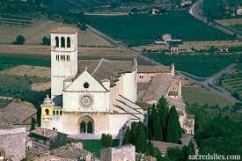
Basilica of Saint Francis lower Church Tomb of St Francis Upper Church

Reflections on the Easter Vigil – 2015

Easter Candle 2015

It is Saturday evening when I entered the Church of St. Mary, Star of the Sea.  I am there for the Easter Vigil Mass.  The church was built in the late 1800’s; it has high vaulted ceilings, large stain glass windows, dark wood pews.  Even with the all the church lights on, it is very dim inside.  I am assisting as a deacon at the Mass; I have been the responsibility of chanting the great Easter hymn, “the Exsultet,” which takes about 9 minutes to chant.  And I really do not want to muck it up!  From the sacristy, I stand in the sanctuary of the church, and pray: “My Risen Lord, be with me this night!  All good I am able to do to because of your grace; may your Spirit be within me!”  At that moment, I experience something, I cannot describe; I am rooted in that place, and for a few seconds I am not aware of what is happening around me.  The feeling passes and I go back into the sacristy.

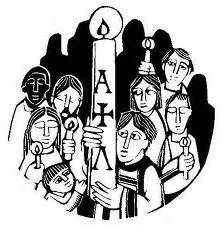
The church has some fine vestments, for the evening Mass, I put on a gold and white dalmatic, the deacon’s vestment.  It feels stiff to me; I usually wear only an alb and stole.  The priests and the other deacon, Michael, also vest.  We then head to the back of the church, as the lights begin to go out.  By the time we are ready, the entire church is in darkness.  Father Mark lights a fire in a brazier, by the light of that fire, he blesses the Easter Candle; from the fire he draws a flame to light the Candle.  The fire is extinguished, the only light that pierces the darkness in the church, is the flame of the Easter Candle.  Deacon Michael lifts the Candle, and he and I walked down the main aisle.  Deacon Michael stops, lifts high the Candle; and I intone: “Lumen Christi!”  The choir and the congregation respond: “Deo Gratias!”  Then from that one Candle, the light is shared with dozens of other candles, points of light begins to spread throughout the darken church.  Twice we stop, twice I chant “Lumen Christi,” twice the light is shared, until the entire church is full of points of light.  The Easter Candle in placed in its stand, its flame flickering throughout the sanctuary.

I climb into the pulpit, open my binder, take a deep breath, and sing out: “Exult, let them exult, the hosts of heaven,….Rejoice, let Mother Church also rejoice, arrayed with the lightning of his glory, let this holy building shake with joy, filled with the mighty voices of the peoples.”

“Christ is Risen!”  He is Risen Indeed!”

Good Friday in Beverly – 2015

TGood Friday Crosshis is the first chance I have had to write some reflections on part of what I have been doing during this Holy Week, 2015.  Yesterday, Good Friday, I assisted at the service that was held at St. Margaret of Scotland parish in Beverly, MA.  The small church was built in the late 1800’s, and has a very unique design.  The interior has a dark wood ceiling, which sort of adds to the solemnity of the liturgy we were about to celebrate.

The Good Friday service commemorates the Passion and Death of Jesus Christ, it is the most solemn liturgy held during Holy Week.  Wearing red colored vestments, the Pastor and I silently processed into the church.  Entering the sanctuary, Father, I and the cantor kneeled in the sanctuary, and the service began with readings from Scripture.  I, the cantor, and our music director chanted the Passion of Jesus Christ according to the Gospel of John.  After the prayers of the faithful, I went to the rear of the church, picked up a plain wooden cross, and began to process down the main aisle, back to the sanctuary.  I stopped three times; each time intoning: “Behold the wood of the Cross, on which hung the Savior of the world!” to which the congregation responded: “Come let us worship.”  After Father and I had each venerated the Cross, members from the congregation came forwarded to also venerate it.  Some kissed the wood, others knelt and touched it, and others just bowed before it.  When everyone had come forward, Father and I set the Cross on a side altar, with two candles on either side.  A communion service followed, then Father and I processed out and we did in, in silence.

After greeting members of the Catholic community as they left the church, I went back in; back to the side altar with the Cross.  As I stood, looking at that bare wooden Cross, it came to me, how an instrument of public execution, has become a symbol of triumph, Christ’s triumph of death.  I think though we forget what suffering Jesus went through, for us, for our salvation.  We need to recall what was written by the prophet Isaiah:

“Because of his affliction he shall see the light in fullness of days; through his suffering, my servant shall justify many and their guilt he shall bear.  Therefore I will give him his portion among the great, and he shall divide the spoils with the mighty, because he surrendered himself to death and was counted among the wicked; and he shall take away the sins of many, and win pardon for their offenses.”  (Isaiah 52)

Tonight, we commemorate, we celebrate Jesus Christ victory over sin and death; we celebrate the peace and joy that is still being experienced by so many of us.

Palm Sunday, Beginning of Holy Week – 2015

Palm Sunday

Yesterday, March 29, 2015, Passion (Palm) Sunday, I began my third Holy Week as an ordained Deacon.  I assisted at Mass at two of the three parishes that make up the Beverly Catholic Collaborative.  At the beginning of each Mass, there was the blessing of the palms, followed by my proclaiming the Gospel reading according to Mark; of Jesus’ triumphant entrance into the city of Jerusalem.  Crowds gathered around Him, shaking palm branches, and yelling out “Hosanna,” and proclaiming that the Kingdom of David was at hand.  Yet, during that same liturgy, we would hear the Passion of Jesus Christ according to Matthew; during which the crowds are now yelling out, “Crucify Him!”

The five weeks of Lent were meant to be a time to prepare for this Holy Week, for in many ways, this week will be the most challenging of the Church’s liturgical year.  We are to recall the events that lead to the Crucifixion of Jesus, and to His Resurrection.  We are being challenged to reflect more deeply and personally on what those events mean to our world, our Church and for ourselves personally.  We are being summoned to; if just for this week, live a life of intensive prayer and meditation.  We are being challenged to open our minds, our hearts and our souls to the presence of our Resurrected Savior, and be willing to be transformed by Him; transformed into bearers of the Good News.  Evangelizers, by word and deed; to let others know of the love and mercy of our God!

An Old Argument Re-Surfaces; How to Receive Communion!

Communion in the hand

A long time ago, I was reading an issue of “Saint Anthony’s Messenger,” published by the Franciscan Friars.  I was scanning the comment letters, when I saw a letter in which the writer was complaining about a previous magazine cover depicting a woman holding a communion host in her cupped hands.  The writer was outraged that a Catholic magazine who depict a layperson (cannot remember if he made reference to gender) holding a consecrated Host.  The writer went on to state that because of this practice, the Eucharist was being demeaned in the eyes of the faithful.  Well, this letter got my dander up (I still had hair at the time!), and I wrote a reply, which actually was published.  As I recall what I wrote, I am sure I stressed that receiving on the tongue, or in the hand, were both valid choices.  What upset me, and continues to upset me, are those who believe that I am desecrating the Eucharist, when I receive in the hand.  For me, it is the greatest honor, the greatest joy, to be able to receive my Eucharistic Lord, in my hands.  To realize that Jesus Christ, the Son of God, loved me; loved all of us so much, that He humbles Himself each day to be with us, to feed and strengthen us.  He is willing be present in simple bread and wine, so He can be one with us.  This realization for me is awesome!

All this came to mind when I saw an article by Mathew N. Schmalz, a contributor to the website Crux.  He also was commenting on how divisive how one receives Communion has become.  It is becoming a litmus test, a way to determine if you are for Vatican II reforms or against them.  Are you a “traditionalist,” or a “liberal” Catholic?  Do you believe in the sacredness of the Eucharist or not?  What should be the highest experience of Christ’s Presence among, has become just another theological or liturgical argument!

Since I was ordained as a deacon in 2012, I have distributed Communion at many, many Masses.  The vast majority of those who come forward to receive Communion come with their right hand cradled in their left hand.  Many approach me with a look of anticipation, a look of reverence in their eyes, as they receive the Body of Christ in their hands.  There are some who do come up to me and receive the Host on their tongues.  I see the same sense of reverence, in their eyes and in their voices, as they say “Amen,” and I place the Host on their tongue.  Whatever way we chose to receive the Eucharist, it is vitally important that we remember who it is we are receiving, and be open to His Eucharistic Presence.