The Solemnity of Our Lord Jesus Christ the King – Homily

St. Peter’s Church, Plymouth MA

“Amen I say to you, whatever you did for one of the least brothers of mine, you did it for me.”


Recently, on different media platforms, there have been debates on what it means to be Catholic. These discussions are taking place in some of our Catholic newspapers, magazines, and of course the Web. They run the gamut of being restrained and thoughtful; to hot and heavy. They draw the attention of some Catholics, while others show no interest whatsoever.


In today’s Scripture readings, we are seeing another approach being placed before us. Jesus outlines what it means to be a follower of His; to care for the poor, the imprisoned, the abandoned. And we are left with the question, as this year draws to a close; how did we as individuals, as a family, as a community of believers, answer the needs of the poor around us. We are summoned to share with others, not only from our surplus, but from our scarcity. We are called to reach out our hands to others who are distressed, and provide comfort and hope. To embrace the stranger, the wounded, whether physically or mentally, and give them hope.


Now the challenge then is to find out in what ways can we answer those needs. Because we are many different types of people, with different strengths, different skills, different attitudes. There are some us who are very out going, who are comfortable with strangers. Others among us, maybe not so much, but are generous, being able provide for the persons physical needs. Sometimes, all it takes is a smile and a handshake to lift a persons spirits.


There are many ways that we as individuals or as a group can care for those in needs, there are many different approaches that we can take to provide for those in need. We only need to take that first step, that first reaching out our hand; Jesus will take care of the rest.


“Then the king will say to those on his right; ‘Come, you who are blessed by my my Father. Inherit the kingdom prepared for you from the foundation of the world.’ “

Changes in the Franciscan Family

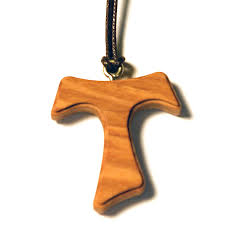
St. Francis of Assisi

On October 17, 2023, six American Provinces of Franciscan Friars (Order of Friars Minor) gathered together in a joint Chapter. The Friars then officially merged into one Province, to be known as the Province of Our Lady of Guadalupe. One can see the need for such an action; the number of Friars have been dwindling. It was probably felt that the Friars could be more effective together in one Province, than in multiple Provinces.

At one time, a loooong time ago, I entered the formation program for the Franciscan Friars of Holy Name Province. I would eventually feel that I was being called elsewhere, but I treasured my experiences with the Friars. When I was working in Boston, I would regularly visit St. Anthony’s Shrine, located in downtown Boston. It was maintained by the Friars of HNP. It was and still is a place where people can find spiritual refreshment. A place where one can find a kind and understanding Friar for confession.

Hopefully, this merger will be a source of rebirth for the American Franciscans.

If you are interested in learning more the Franciscans merger, go on Facebook and look for “The Anthonian Franciscan.”

Happy Feast Day, Francis!

Today, the Church, indeed, the world, celebrates the life and works of Saint Francis of Assisi! He was born into a merchant class family, in the town of Assisi, in the province of Umbria, Italy.

In his youth, he was known as a party boy. He had dreams of being something more. He dreamed of becoming a knight, of entering the noble class. He got the opportunity to earn a knighthood, when Assisi went to war with its rival town of Perugia. The battle went badly for Assisi, and its army was decimated. Francis found himself a prisoner of war, held in very harsh conditions. When he was released, his body and spirit were broken.

Back in Assisi, he underwent a conversion experience, determined to live a holy life. He began to visiting chapels that dotted the Umbrian countryside. He came upon a chapel, named San Damiano, that was dilapidated. While praying before its crucifix, he heard it speak to him, “Rebuild my house, for it is nearly falling down!” So began Francis life of service, starting with repairing chapels, to caring for the poor, to striving to live the Gospel life. By words and deed, he would attract followers from all over Italy. His example would inspire millions.

This day, in the days that follow, it be good for us to reflect on his life. To read his words, to follow his example of prayer and service, we can bring the Gospel to life, as he did!

Pax et Bonum!!!

“And Now You Know The Rest Of The Story!” Sermon for the Twenty-First Sunday of Ordinary Time

Saint Peter’s Church, Plymouth MA

“And so I say, you are Peter, and upon this rock I will build my church, and the gates of the netherworld shall not prevail against it.” Matt 16


There are some of us who probably remember radio reporter and commentator, Paul Harvey. He had a segment during which he would describe a historical event, a story of some famous person. He would always end the segment with the words; “ And now you know…the rest of the story.”


In today’s Gospel reading, we are seeing Jesus trying to learn how the crowds are describing him. And he gets various responses, various descriptions. I picture Simon, getting very antsy, he has something he has to let out. So when Jesus specifically asks the other disciples how they would would describe him, Simon blurts it out, excitedly, forcefully; “You are the Christ!” One can picture the other disciples stunned by his response, the force behind it. Then they will be stunned again when they hear Jesus’ response; he declares that from that moment on, Simon will be known as Peter, and on this “rock” Jesus will bring about a community of believers dedicated to proclaiming the Good News by word and deed.


Yet, we all know what is coming. The Gospels tell of the many times Peter seemed not to get the point of Jesus’ teachings. And when Jesus is arrested and sentenced to undergo crucifixion, Peter denies knowing Jesus, when the crowd accuses him, in order to save his own skin.
Now Jesus knew that this was coming, and he had earlier told Peter that he would be able pull himself together, and that it would be Peter’s responsibility to help the other Apostles to do likewise.


And when Christ ascended back into heaven, Peter fulfilled that role, pulling that little band of believers together. And on the day of Pentecost, empowered by the Holy Spirit; he and the others came out proclaiming the Good News about Jesus Christ. And the number of believers grew.


We are all gathered here today, as baptized believers, as believers who entered into the Body of Christ, through receiving the Eucharist. We are the spiritual descendants of the Saint Peter, of the other Apostles; of Saint Paul of Tarsus, and all of the other saints. We are all called to proclaim the Good News of Jesus Christ, by our words and our deeds.


However, we have to acknowledge that sometimes, like Peter, we may find ourselves failing to put the teachings of Jesus fully into practice, in our lives. We may find ourselves overwhelmed by the way Jesus is asking us to follow.


Again, we turn to the example that the life of Saint Peter sets before us. His recovery from his failures, is an example to all of us. His life provides us a light, which shows us the way. That we too can recover from our own failures and sins. His life, and his actions encourages us to pick ourselves up when we fall; and begin again with a renewed commitment, to follow Jesus, and by our example, to bring others along with us on that journey.


“And now you know the rest of the story!”

The Feast Day of Our Lady of the Angels (Portiuncula).

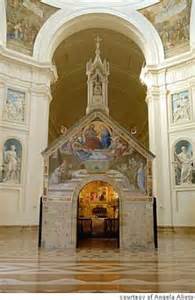
The Portiuncula

The Portiuncula (“Mary’s little portion) was a small chapel built on the outskirts of Assisi. Owned by a local Benedictine monastery, the chapel had deteriorated over the years. By the time of St. Francis of Assisi, it was a shell of it’s former self. Francis had gone through his time of conversion, and was going about the Assisi countryside, repairing these abandoned chapels, including the Portiuncula.

Many of us have a place of worship that means a lot for us. It is a place where we may feel the Presence of God more deeply. So it was with Francis, and his brothers. But, as important as the Portiuncula was to them, it did not prevent them from going out into the fields, towns, and villages. They went out proclaiming the Good News, by word and deed.

Eventually, this chapel would become very dear to Francis and his brothers. They prayed in it daily together; celebrated Mass together. I once saw an illustration of the chapel, with it surrounded by small huts, built by the friars.

We are all called to go out and meet with others. We are all called to share the Good News of Jesus Christ with all we come in contact with.

Feast Day of Saint Bonaventure, Franciscan

The man who would become to be known in Franciscan history as Bonaventure, was born in central Italy, in the town of Bagnoregio. There is some disagreement over the year of his birth, though many experts and scholars have agreed on the year 1217. The son of a physician and housewife, he was baptized with the name “John.” He grew into manhood, and desired to become a scholar. In 1234, at seventeen, he entered the University of Paris. Now a new religious order of men were making news in Europe, the Franciscans. Founded by Saint Francis of Assisi, the “Poor Man of Assisi,” his followers were making a name for themselves, for their poverty, their sanctity, and their evangelical zeal. Their preaching and lifestyle drew many young men to come and join them. Among them was John, who received the name Bonaventure when he was admitted into the Order.

Upon his entry into the Order, Bonaventure took up the study of theology. In either 1253 or 1254, he became a master of theology, and head of the Franciscan school in Paris, until he was elected as the Minister General of Franciscan Order in 1257. His time in that office was spent trying to keep the Order from splintering into different factions. He strove to maintain a moderate approach to poverty, while at the same time, taking full advantage of the learning, the scholarship of his times. Always, he strove to remain faithful to the teachings and example of Saint Francis.

In 1273, Pope Gregory X named Bonaventure a cardinal bishop, and drew on his assistance in preparing for the Second Council of Lyons. It was during this Council that Bonaventure became ill and died on July 15th, 1274.

Bonaventure would be canonized on April 14th, 1482; and on March 14th, 1588, he was declared a Doctor of the Universal Church. He was given the title: “Seraphic Doctor.”

“Here Begins the Prologue To The Life Of Blessed Francis

In these last days the grace of God our Savior has appeared in his servant Francis to all who truly humble and lovers of holy poverty.

In him they can venerate God’s superabundant mercy and be taught by his example to utterly reject ungodliness and worldly passions, to live in conformity with Christ and to thirst after blessed hope with unflagging desire.

He was poor and lowly, but the Most High God looked upon him with such condescension and kindness that he not only lifted him up in his need from the dust of a worldly life, but made him a practitioner, a leader and a herald of Gospel perfection and set him up as a light for believers so that by bearing witness to the light he might prepare for the Lord a way of light and peace into the hearts of his faithful.”

From the Prologue of the Life of Saint Francis (Legenda Maior) by Saint Bonaventure

Independence Day; “Happy Fourth of July!!!”

Prayer for the Nation, written in 1791 by Archbishop John Carroll of Baltimore, Maryland, for the inauguration of President George Washington.

We pray, O almighty and eternal God, who through Jesus Christ has revealed thy glory to all nations, to preserve the works of your mercy, that your Church, being spread through the whole world, may continue with unchanging faith in the confession of your name.

We pray Thee, who alone are good and holy, to endow with heavenly knowledge, sincere zeal and sanctity of life, our chief bishop, the pope, the vicar of Our Lord Jesus Christ, in the government of his Church; our own bishop, all other bishops, prelates and pastors of the Church; and especially those who are appointed to exercise among us the functions of the holy ministry, and conduct your people into the ways of salvation.

We pray O God of might, wisdom and justice, through whom authority is rightly administered, laws are enacted, and judgement decreed, assist with your Holy Spirit of counsel and fortitude the president of these United States, that his administration may be conducted in righteousness and be eminently useful to your people over whom he presides; by encouraging due respect for virtue and religion; by a faithful execution of the laws in justice and mercy; and by restraining vice and immorality.

Let the light of your divine wisdom direct the deliberations of Congress, and shine forth in all the proceedings and laws framed for our rules and government, so that they may tend to the preservation of peace, the promotion of national happiness, the increase of industry, sobriety and useful knowledge; and may perpetuate to us the blessing of equal liberty.

We pray for his excellency, the governor of this state, for the members of the assembly, for all judges, magistrates, and other officers who are appointed to guard our political welfare, that they may be enabled, by your powerful protection, to discharge the duties of their respective stations with honesty and ability.

We recommend likewise, to your unbounded mercy, all our brethren and fellow citizens throughout the United States, that they may be blessed in the knowledge and sanctified in the observance of your most holy law; that they may be preserved in union, and in that peace which the world cannot give; and after enjoying the blessings of this life, be admitted to those which are eternal.

Finally, we pray to you, O Lord of mercy, to remember the souls of your servants departed, who are gone before us with the sign of faith and repose in the sleep of peace, the souls of our parents, relatives and friends; of those who, when living, were members of this congregation, and particularly of such as are lately deceased, of all bene who, by their donations or legacies to this Church, witnessed their zeal for the decency of divine worship and proved their claim to our grateful and charitable remembrance. To these, O Lord, and to all that rest in Christ, grant, we beseech you, a place of refreshment, light and everlasting peace, through the same Jesus Christ, Our Lord and Savior.

Amen.

Feast Day of Saint Anthony of Padua

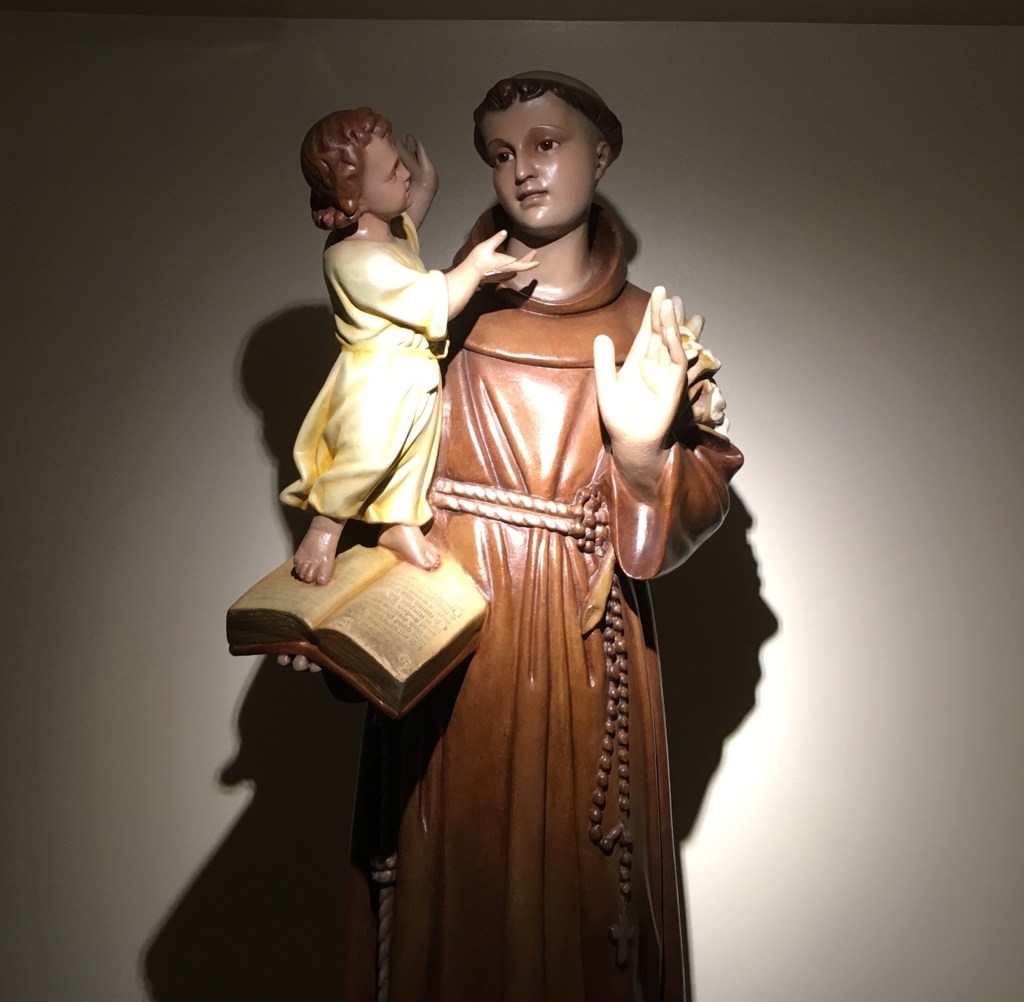
Saint Anthony of Padua with the Christ Child

Among the list of Franciscan saints, the most popular among them, after Saint Francis of Assisi, is Saint Anthony of Padua (1195-1231). But, were it not for a chance encounter, things might have been different.

He was born in Lisbon, Portugal, with the name of Fernando Martins de Bulhoes. The family was well off, and arranged for him to be educated in a local cathedral school. He would eventually join an Augustinian community near Lisbon. He would be ordained a priest and was giving the responsibility of welcoming visitors and guests to the monastery. It was then, that one could say, that the Holy Spirit then took over. Near the monastery was a small community of newly arrived Franciscan friars. They had established a small hermitage, and Fernando had frequent contact with them. He found their evangelical way of life attractive.

The Franciscans had sent a group of their brothers to North African country of Morocco, to evangelize. This group would suffer beheading at the hands of the Moroccan rulers. Their remains were returned to Portugal, and were buried at the Augustinian monastery. Fernando was inspired by their courage and their faith. He asked for, and received permission from the Augustinians to transfer over to the Franciscan order. He took the name Anthony, after an early Saint, Anthony the Great.

He joined another group of Franciscan friars being sent to Morocco, but he became seriously ill upon arrival. He was sent home back to Portugal. But stormy weather drove his ship further into the Mediterranean, winding up in Sicily. He went to the last great gathering of Franciscan friars with Saint Francis present. At the conclusion of it, he was sent to a small community of lay brothers, in Italy. There, the story goes, the community was celebrating the ordination of a friar, but the guest speaker had not arrived. Anthony was asked to preached. It was then the depth of his learning was revealed, as was also his skill as a speaker. And the rest, as they say, is history.

He would be sent out on preaching tours, up and down throughout Italy. It was said the thousands of people gathered to hear him speak. They came away inspired to live the Gospel of Jesus Christ more intensely. Francis himself, gave Anthony the work of teaching theology to the friars, and how to preach.

He became ill in his thirties, and died on June 13, 1231, in Padua.

He was canonized as Saint in 1232. He proclaimed a Doctor of the Church by Pope Prius XII, in 1946.

Easter Morning

Jesus Christ is Risen! He is Risen indeed!!

We all awake with the hope that only comes from our Risen Lord! Now some of us may be experiencing hard times; some may be experiencing normal times! Some may be feeling down; some struggling. Some of us are feeling unsure of the moment; or of the future.

Today, though, the Church cries out; that In Jesus Christ there is hope. In letting Christ in, there is peace, there is hope!

Let us open wide our hearts, and let in the King of Glory!!

Sons & Daughters of St. Francis and St. Clare.

Saint Catherine of Bologna

St. Catherine was born into a noble family of Bologna, Italy, in 1413. As she grew into a teenage girl, it became obvious that she wanted to live a life very different from other daughters of the nobility. She persuaded her parents to allow her to join a community of lay Franciscan women (Secular Franciscan Order).

As a member of that community, she grew in the spiritual life, both the joys and challenges. She became known as a mystic; known to have experienced intense visions of Christ and the Blessed Mother. Now Bologna had a community of Poor Clare sisters, that must have been afflicted with laxity, because Catherine was ordered to take over the community.

She lead the convent by example, gentleness, and wisdom. The community became known for it’s holiness of life, attracting many new novices.

Saint Catherine died in 1463. She was canonized a Saint in 1712. Her feast day is March 9.

“Blessed be God in his angels and in his saints.”