“…And In His Saints!” A Work of Fiction from a Real Tragedy

niceThe French EMT helps load another stretcher into the ambulance, and shuts its doors as it takes off.  She wearily turns around and looks down the street of tragedy; lined with the injured, and the dead.  Just a little while ago it was full of people, celebrating the founding of a republic, celebrating Bastille Day.  Then tragedy struck in this city of Nice; one maniac in a truck, mowing the people down.  Now, there is fear, agony, and grief.  And her heart is screaming:  “Where are You in all of this?”

She closes her eyes for second.  When she opens them, she is looking at the curbside.  She notices for the first time, a little friar, dressed in a patched brown habit.  He is holding the hand of an injured child, singing a French ditty for her.

The sound of sobbing draws her attention to two women, kneeling over a covered body.  One of them is bent over with grief; the other has her arm around the grieving woman’s shoulders, holding her tight.  This woman looks like she is from the Middle East.  She is wearing a long blue veil; her face looks as if she has known much sorrow in her life, and now she is comforting another woman through hers.

The EMT looks further down the street of tragedy and saw a police officer standing guard.  He nervously stares out into night, holding his rifle tight.  The EMT blinks her eyes, because she could swear there was a girl standing next to him.  She is dressed like a French peasant, with short-cropped hair.  Her hand is gripping the officer’s shoulder, as with fierce eyes, she also stares into night with him.  Is that a sword in her other hand?

Movement next to her drew the EMT’s attention.  She stares at her medical bag, and sees that someone has placed a red rose in it.  She looks quickly behind her and thinks she sees a nun, a Carmelite nun, disappearing into the crowds.  She turns around again, but the people she saw, the friar, the woman in blue, the peasant girl, have also disappeared.  She looks down to her bag, the rose is real.  As she looks at it; she suddenly no longer feels so alone.  She grabs her medical bag, takes a deep breath, and walks back down the street of tragedy.

“Blessed be God in His Angels and in His Saints.”

San Damiano Cross Is Going Home!

San Damiano crossThe Franciscan blogosphere is buzzing with the news that the Cross from which Christ spoke to St. Francis of Assisi, is returning to the chapel of San Damiano!

During his period of conversion, Francis was known to visit some of the chapels that dotted the Italian landscape around Assisi.  Many were in ill-repair, one of them was the chapel of San Damiano.  Francis was said to have been drawn to the icon cross of Christ Crucified that was hanging in the chapel.  The painter of the Byzantine style cross is unknown, but experts estimate its creation took place around 1100 AD.

The story goes that when Francis entered the chapel, and knelt before the cross, he heard the voice of Jesus Christ coming from the image on it.  The Crucified Christ said to Francis: “go and repair my house, which as you can see is falling into ruins.”  Francis immediately assumed that the Divine command referred only to the chapel he was in.  He leaped to his feet, gave some coins to the priest in residence there, to keep the votive lamp burning in front of the cross, and then set off to purchase building materials.  And the rest is, as they say, history.  After rebuilding San Damiano, Francis went on to rebuild several other countryside chapels.  Christ would soon lead Francis to the realization the his call was not just to repair a few chapels, but to repair the whole spiritual edifice known as the Catholic Church.  The Franciscan movement he founded would draw thousands of individuals to join him.  Among them, a young woman by the name of Clare of Assisi, and other women as well.  They became known as the Poor Ladies of Assisi.  We know them today as the Poor Clares.

Francis installed Clare and her sisters in San Damiano, and they became the custodians of the crucifix.  Later, after the death of St. Clare, a basilica church was built within walls of Assisi, to house her remains.  The Poor Clare community also moved into Assisi, for safety, and they brought the crucifix with them.  The San Damiano Cross has been on display within the Basilica of St. Clare for many years.  Now it is being returned to San Damiano, it is going home.

San Damiano Monastery


The First Novitiate – Friday Fictioneers

RivoTorto photo-by-piya-singh-bittercharm-6The farmhand walks through the Italian woods, heading for home.  His body aches from his labors; his heart aches because he will barely feed his family with what he earned today.  In the twilight, he is passing by an abandoned farmhouse, when he hears the sound of chanting, coming from it.  He peers in, and sees a group of men, dressed in brown robes, kneeling on the dirt floor.  They circle a little thin man, who is leading them in prayer.  The farmhand sees a glow of light emanating from him, touching the others, touching him.  He experiences great peace.


NB:  After Francis of Assisi won provisional papal approval for his rule of life; he and his small group of brothers went down to a small Italian area known as RivoTorto.  There they lived; during the day they cared for lepers.  Some would work in the fields, and get paid in food and drink.  They spent their evenings in prayer, and being taught by Francis.  It was the Order’s first novitiate.  One day, a farmer pushed his donkey into the hut, and pushed the brothers out, into the wider world.

The Birds (A Different Take)

Friday Fictioneers grey-day-with-pigeons-roger-bultot (1)

He slowly gets out of bed; not wanting to face the coming day.  Looking out of his window, he sees the outside reflecting his mood.  He notices the birds, sitting on the wire, huddled together against the damp.  Suddenly, they all take flight; they appear to be heading for his building!  The birds wheel about and head downward.  It is then, that he notices the little man, dressed in a brown robe.  The birds land all around the little man.  He blesses them, and they all take off; filling the air with their birdsong.  Staring out his window, he smiles.


A Victory, Won by Words and Respect.


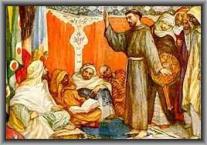
Francis and the SultanThe holy man from Assisi is standing in the tent, waiting for a message.  His body was still sore from the beating, he and his companion received from the Sultan’s guards, when they first approached his camp.  He is remembering the scenes he saw in the Crusader’s camp; scenes of anger and hate, directed at Muslims; scenes of loss and grieving for dead comrades.  He felt the same emotions from the Sultan’s soldiers, only directed towards Christian soldiers.  He wants to bring both sides together, by convincing the Sultan and his people to accept Christ.

He remembers the day they were brought before the Sultan, who invited the holy man to speak.  He saw that the Sultan’s men were fingering the hilts of their swords, ready to draw blood if he should insult Allah and His Prophet.  He looked into eyes of the Sultan, and saw curiosity.  He took a deep breath, whispered a prayer, and began to speak.  He spoke not of doctrine, or polemics, but from his heart, from his own experience of the Beloved.  He spoke with respect for his audience.  He felt a flame beginning to burn within his heart.  It grew as he spoke of the love of Christ, and the joy of God.  The fire of the Holy Spirit blazed out from him as he proclaimed the Good News!  The Sultan and his court stood back, amazed at the sight.  When he was finished, he stood, feeling drained, but at peace.  He bowed before the Sultan, who sent him and his companion back to their tent.

Now he sees a messenger approaching; who invites the little man and his companion back to Sultan’s tent.  The Sultan appreciates the respect that the holy one showed him and his court.  He acknowledges the strength of the little poor man’s convictions, but he and his people will remain committed to their faith.  The man from Assisi is disappointed, and saddened; but then the Sultan gives him a passport, permission for his brother friars to go to Jerusalem and reside there.  The little man receives it with joy, and bows deeply before the Sultan.  The Sultan and his court bow in return towards the little poor man from Assisi.

He and his companion walk back to the Crusader camp.  He is disappointed that he did not achieve his goal; but he carries back with him a sign of victory.  It is a victory that the Crusaders will not achieve; but a band of brown rob brothers will see the walls of holy Jerusalem.  It will be achieved not with swords, but by words, spoken with conviction and respect.


A Little Friar During the Night of Terror!

(MARTIN BUREAU/AFP/Getty Images)

(MARTIN BUREAU/AFP/Getty Images)

He walks among the wounded, and the dead.  The City of Lights has become the City of Fear.  The tears well up in the eyes of the little poor one, because he loves the French people.  His father made his fortune selling French cloth,and he had the name of his first-born son changed from Giovanni to Francisco to honor France.  In his youth, the little one would dress as a French troubadour, entertaining the young ladies of Assisi with French love songs.

He kneels down beside one of the wounded, who is crying in pain and fear.  He takes the person’s hand, bends over, and sings to him in French.  An EMT rushes towards the wounded person, he thinks he sees a dark robed friar kneeling over him.  He blinks and the friar is gone.  He kneels beside the injured, who is now quiet, and has a peaceful look on his face.  “Paix!”

New Executive Council Elected for the National Fraternity (USA) of the Secular Franciscan Order!

“The Secular Franciscan Order holds a special place in this (Franciscan) family circle.  It is an organic union of all Catholic fraternities scattered throughout the world and open to every group of the faithful.  In these fraternities the brothers and sisters, led by the Spirit, strive for perfect charity in their own secular state.  By their profession they pledge themselves to live the gospel in the manner of St. Francis (of Assisi) by means of this rule approved by the Church”  (Rule of the Secular Franciscan Order, Art. 2)

“The Secular Franciscan Order is divided into fraternities of various levels-local, regional, national, and international.  Each one has its own moral personality in the Church.  These various fraternities are coordinated and united according to the norm of this rule and the constitutions.

On various levels, each fraternity is animated and guided by a council and minister (or president) who are elected by the professed according to the constitutions.”  (Rule OFS, Art. 20-21)

National Council NAFRA OFS

When the Secular Franciscan Order was first established in 1221, it was a movement that was lead by laypersons, elected by the professed members.  As time went on, for various reasons, the Franciscan Friars began to exercise more authority over the movement.  The Order was divided among the First Orders’ provinces.  After the Second Vatican Council, with its directive for religious orders to rediscover their roots and charism, the Seculars took a new look at their founding history and documents.  A renewal took place; the various worldwide OFS fraternities were united under one Minister General and international council.  Nationally and regionally, fraternities were united, governed by their own elected ministers and councils, with guidance from Franciscan friars and sisters.

On October 17th, representatives from the regional fraternities gathered in Clinton, New Jersey, in a Chapter of Elections.  The results being that Jan Parker, OFS, is our new National Minister.  The names of the rest of the National Executive Council are available at this link.  Through the intercession of St. Francis, may God bless them with wisdom, charity, and inspiration, which will guide us well in coming years.

Reflecting Again on Why I Write.

Writing

Writing

Why do I write?  That is a very interesting question today, especially since I have been finding it to sit in front of a keyboard, or to pick up a pen.  It was not too long ago, that I would be posting on my blog every other day, if not every day.  I have a serious case of writer’s block, which is why I am trying out Writing 101.

Why do I want to write?  Because sometimes I feel have something to share with the rest of the world.  As a Christian Catholic, a Secular Franciscan, and a Deacon, I feel the need to share my experiences of my encounters with God through Scripture, the Eucharist, prayer, and life.  I want to share the Good News of Jesus Christ with a world that more skeptical, that is a little darker, more violent, and where the poor and powerless have no voice.  I want share the Good News with those who are struggling with the challenges of everyday life; by sharing my own struggles with living the faith daily.

I want to write about, and express my belief that the Catholic Church, this community of believers, is still relevant for our society today.  While not turning a blind eye to its sins and failings, to express the joys, comfort, and inspirations I have experienced for myself.  And I want to share my opinions with a voice that accepts others, whether they agree with me or not.

When I write, I hope I am becoming, like St. Francis of Assisi, a Herald of the Great King, Jesus Christ!

Franciscans Feeding the Hungry

From the very beginnings of the Franciscan Order, concern for the poor and the outcast has been an important ministry of the Friars, the Poor Clares, and the Secular Franciscans.  And this remains true today; the Franciscans Friars of St. Francis Church on W 31st St. in Manhattan, NYC, have provided food assistance for those who are homeless, and the poor who cannot leave their homes.

In 1930, duringSt Francis breadline Depression the depths of the Great Depression, the Franciscans started a breadline; distributing sandwiches and coffee to men who had no jobs, and no homesSt Francis breadline today.  The St. Francis Breadline continues today; every morning at 7:00 AM, the Friars and volunteers distribute sandwiches and fruit to the homeless.  They also give a listening ear, a handshake, and a hug to those individuals whom the rest of society has written off.

In recent times, the Friars have become aware of another group of individuals who need food assistance, those poor persons who may not have enough money to buy the food they need, and because of health issues cannot leave their homes to go to food pantries.  So they set up the program “Franciscans Deliver.”

Franciscans DeliverThey established a food pantry, and those in need contact them, and a grocery list is made up.  The Franciscans and volunteers fill the orders and deliver them to the individuals’ apartments.  Again, besides bringing groceries, the volunteers bring human contact, companionship; so that the shut-ins do not feel alone and abandoned.

There are many government and private programs that try to alleviate hunger in this country.  And they do serve many needy people.  But what I like about the Franciscan approach, is that they are not just addressing a physical hunger, but a social and spiritual hunger as well.