The First Novitiate – Friday Fictioneers

RivoTorto photo-by-piya-singh-bittercharm-6The farmhand walks through the Italian woods, heading for home.  His body aches from his labors; his heart aches because he will barely feed his family with what he earned today.  In the twilight, he is passing by an abandoned farmhouse, when he hears the sound of chanting, coming from it.  He peers in, and sees a group of men, dressed in brown robes, kneeling on the dirt floor.  They circle a little thin man, who is leading them in prayer.  The farmhand sees a glow of light emanating from him, touching the others, touching him.  He experiences great peace.


NB:  After Francis of Assisi won provisional papal approval for his rule of life; he and his small group of brothers went down to a small Italian area known as RivoTorto.  There they lived; during the day they cared for lepers.  Some would work in the fields, and get paid in food and drink.  They spent their evenings in prayer, and being taught by Francis.  It was the Order’s first novitiate.  One day, a farmer pushed his donkey into the hut, and pushed the brothers out, into the wider world.

New Executive Council Elected for the National Fraternity (USA) of the Secular Franciscan Order!

“The Secular Franciscan Order holds a special place in this (Franciscan) family circle.  It is an organic union of all Catholic fraternities scattered throughout the world and open to every group of the faithful.  In these fraternities the brothers and sisters, led by the Spirit, strive for perfect charity in their own secular state.  By their profession they pledge themselves to live the gospel in the manner of St. Francis (of Assisi) by means of this rule approved by the Church”  (Rule of the Secular Franciscan Order, Art. 2)

“The Secular Franciscan Order is divided into fraternities of various levels-local, regional, national, and international.  Each one has its own moral personality in the Church.  These various fraternities are coordinated and united according to the norm of this rule and the constitutions.

On various levels, each fraternity is animated and guided by a council and minister (or president) who are elected by the professed according to the constitutions.”  (Rule OFS, Art. 20-21)

National Council NAFRA OFS

When the Secular Franciscan Order was first established in 1221, it was a movement that was lead by laypersons, elected by the professed members.  As time went on, for various reasons, the Franciscan Friars began to exercise more authority over the movement.  The Order was divided among the First Orders’ provinces.  After the Second Vatican Council, with its directive for religious orders to rediscover their roots and charism, the Seculars took a new look at their founding history and documents.  A renewal took place; the various worldwide OFS fraternities were united under one Minister General and international council.  Nationally and regionally, fraternities were united, governed by their own elected ministers and councils, with guidance from Franciscan friars and sisters.

On October 17th, representatives from the regional fraternities gathered in Clinton, New Jersey, in a Chapter of Elections.  The results being that Jan Parker, OFS, is our new National Minister.  The names of the rest of the National Executive Council are available at this link.  Through the intercession of St. Francis, may God bless them with wisdom, charity, and inspiration, which will guide us well in coming years.

Franciscans Feeding the Hungry

From the very beginnings of the Franciscan Order, concern for the poor and the outcast has been an important ministry of the Friars, the Poor Clares, and the Secular Franciscans.  And this remains true today; the Franciscans Friars of St. Francis Church on W 31st St. in Manhattan, NYC, have provided food assistance for those who are homeless, and the poor who cannot leave their homes.

In 1930, duringSt Francis breadline Depression the depths of the Great Depression, the Franciscans started a breadline; distributing sandwiches and coffee to men who had no jobs, and no homesSt Francis breadline today.  The St. Francis Breadline continues today; every morning at 7:00 AM, the Friars and volunteers distribute sandwiches and fruit to the homeless.  They also give a listening ear, a handshake, and a hug to those individuals whom the rest of society has written off.

In recent times, the Friars have become aware of another group of individuals who need food assistance, those poor persons who may not have enough money to buy the food they need, and because of health issues cannot leave their homes to go to food pantries.  So they set up the program “Franciscans Deliver.”

Franciscans DeliverThey established a food pantry, and those in need contact them, and a grocery list is made up.  The Franciscans and volunteers fill the orders and deliver them to the individuals’ apartments.  Again, besides bringing groceries, the volunteers bring human contact, companionship; so that the shut-ins do not feel alone and abandoned.

There are many government and private programs that try to alleviate hunger in this country.  And they do serve many needy people.  But what I like about the Franciscan approach, is that they are not just addressing a physical hunger, but a social and spiritual hunger as well.

Praying Before the San Damiano Cross

Most High, Glorious God,

Enlighten the darkness of my heart,

And give me true faith, certain hope,

And perfect charity, sense, and knowledge,

Lord, that I may carry out

Your holy and true command.

(Prayer before the San Damiano Cross – Saint Francis of Assisi)

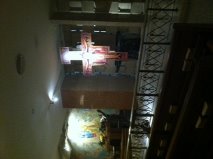
Francis and San Damiano CrossOnce a month, I go into Boston, MA, for a meeting with my spiritual director; who is a Franciscan friar at St. Anthony Shrine on Arch St.  I was crossing that street, on my way for my July session, when I ran into two of my former co-workers.  We exchanged pleasantries; I learned that the company was still having a rough time of it.  We said our goodbyes, and I entered the Shrine.  Now this all took place on July 7th, I was entering the seventh month of unemployment.  I have been sending electronic job applications, three to six of them on a weekly basis.  To date, I have had two telephone interviews, each lasting, on average, about fifteen minutes.  I have been to several job fairs, left resumes with prospective employers; never heard anything back.  Life is getting a little “interesting.”

Usually, when I enter the first floor chapel of the Shrine, I go to the left side, where the tabernacle with the Blessed Sacrament.  That day I went to the right side of the chapel, where in the sanctuary is a statue of St. Francis of Assisi, praying before a large representation of the San Damiano cross.  The original cross was in the Assisian chapel of San Damiano, where a young Francis went to pray.  The origins of the cross are shrouded in mystery, but it is made in the Byzantine icon style.  Praying before the cross, Francis heard the voice of Jesus speaking from the cross: “Francis, rebuild my church!”  The rest, as they say, is history!

I seated myself before the large replica of the San Damiano cross, and began to pray, saying over and over the Jesus Prayer: “Lord Jesus Christ, Son of the Living God, have mercy on me, a sinner.”  I was focused on the face of the Crucified Jesus.  I was drawn to the eyes, which are unique.  I cannot describe the experience, only to say that at that moment, I was in a different space.  The anxieties, the concerns, the worries, suddenly disappeared from my consciousness, if only for a moment in time.  A light dispelled the darkness that was in my heart.

Many of us, perhaps most of us, when times get tough, will pray to God for some kind of miracle that will solve all of our problems.  Usually we are hoping the Lord will influence the interviewer, or we will win the Lottery!  And miracles can happen, will happen, and does happen!  But what we can really hope; what we need to be aware of is that we are never alone.  We may be carrying a burden, but we do not carry it alone.  Jesus calls us to take up our crosses daily, and follow him.  The One who carried his cross to Calvary, knows our suffering, knows what pains, and fears weigh us down.  He is walking with us, encouraging us onward.  His Spirit is within us, filling us with peace, with hope.  We need only to keep our hearts; our souls open to that light.  And hear Jesus assure us, that over that dark hill of Calvary, a new dawn does await us!

A Franciscan’s Perspective: Blessed Ramon Lull, His Life and the Takeaway.

Blessed Ramon Lull“Therefore, any brother who, by divine inspiration, desires to go among the Saracens and other unbelievers should go with the permission of his minister and servant…As for the brothers who go, they can live spiritually among [the Saracens and nonbelievers] in two ways.  One way is not to engage in arguments or disputes, but to be subject to every human creature for God’s sake (1 Pet 2:13) and to acknowledge that they are Christians.  Another way is to proclaim the word of God when they see that it pleases the Lord, so that they believe in the all-powerful God-Father, Son, and Holy Spirit-the Creator of all, in the Son Who is the Redeemer and Savior, and that they be baptized and become Christians; because whoever has not been born again of water and the Holy Spirit cannot enter into the Kingdom of God (cf. Jn 3:5).  (The Early Rule of the Order Friars Minor; Chap XVI: 2-3, 5-7)The

Today, June 30th, the Catholic Church remembers Blessed Ramon Lull, who was a member of the Secular Franciscan Order.  He was born in 1232 AD, on the island of Majorca.  He was extremely well-educated and served in various royal courts on the Iberian Peninsula.  After listening to a sermon that touched his heart, he earnestly strived to live the Gospel life as a Secular Franciscan.  He promoted missionary work among the peoples of North Africa; working to establish mission colleges, where missionaries could learn Arabic.  He firmly believed that the way to bring non-believers to Christ was not with the sword, but through prayer and dialogue.  He took time away from his college building efforts, and lived the life of a hermit for nine years.  During this time, he produced a substantial amount of spiritual and philosophical works.  In 1314, at age seventy-nine, he went to North Africa, to be a missionary himself.  There he encountered a mob of hostile Muslims, who stoned him, and mortally injured him.  Some merchants were able to get him on a ship bound for Europe.  He did in 1315.

Francis of Assisi once described himself as a herald of the Great King, Jesus Christ.  He encouraged his brother friars to go out and preach about the love of God, to all they came in contact with, believer and non-believer alike.  But he also wanted their words to be backed up by their actions; by their works of charity, and showing respect to all they came in contact with.  In the first draft of the Order’s Rule (Regula Non Bullata), he describes the two ways his friars were to evangelize, by way of life, or open proclamation of the Gospel of Jesus Christ.

The Catholic Church, and especially the Church here in the Archdiocese of Boston, are being called to engage in a New Evangelization.  One way of evangelization is live our lives as believers of the Good News; as those who have a relationship with God through Jesus Christ.  This relationship should color how we interact with others, in our families, our workplaces, and in the marketplace.  The other is to never be shy about sharing what our personal encounter with Christ has meant for us; what it has changed in us.  We share our struggles with our faith; we share the joys of our faith.  And we have the courage to invent others to come and see.

Evangelization is something God is calling us to be involved in, in our world today; right now, right here.  We are all called to be heralds of the Great King!

What is Behind a Title?

st anthony walnut tree 2What was the genesis of my blog’s title?  To answer the question, I need to write a little about where I was coming from, when I finally decided to begin blogging.  Most of my adult life, from my college years, to the 1980’s, I have been in some type of religious, spiritual formation; feeling called to life as a Catholic priest, and later, to be a Franciscan friar.  I would finally discern that God wanted me to follow a different path; which lead me into the business world, and to my wonderful wife, Peg.  One thing that did not change for me, though, was the Franciscan spirit I inherited from the friars.  I found myself joining the Franciscan lay movement, known as the Secular Franciscan Order.

Fast forward a few years, to around 2008; where I was becoming more acquainted with the concept of Web blogging.  I inherited my interest in personal computing from my Dad, and I was finding this blogs, with these interesting articles.  I was wondering if there was anything I could contribute to mass of online information.  One day, I browsing through Border’s bookstore, (it was still in existence then!) when I came across a book, “The Huffington Post Complete Guide to Blogging!”  I purchased it, and devoured it in a few days.  I decided to give it a try, and in 2009, I opened my first blog on “Blogger.”  But what was I going to call this new blog?  It was suggested that any title I picked had to be unique, to separate it from the other blogs.  My hope was to share my observations of what was happening in my country, the world, and in my Church.  I would draw on whatever insights came to me from my Catholic, Franciscan spiritual life.  Now, for Franciscans, out of all the saints in the movement, the key ones are Saint Francis of Assisi, Saint Clare of Assisi, and Saint Anthony of Padua.

Saint Anthony of Padua has been popular with Roman Catholics, because of his reputation as a miracle worker; “Miracles waited on your every word, which you were ever ready to speak for those in trouble or anxiety.”  This is part of a prayer, addressed to St. Anthony; asking for his intercession.  However, St. Anthony was also famous as a preacher.  A trained theologian when he joined the Franciscan Order, he was sent on preaching tours throughout northern Italy, and southern France.  He was successful not only because of the quality of his sermons, but also the example of his life.  After many years of bringing the Gospel of Christ to all who would listen, he sensed his life was drawing to an end.  He went to a friary, located in a small village near the Italian city of Padua.  There, he asked his fellow friars to build him a tree house, in a walnut tree.  There, he intended to spend his last days in deep prayer and contemplation.  However, people still sought him out; seeking spiritual guidance, or a word on the Love of God.  St. Anthony died on June 13, 1231.

So I decided to name my blog; “From Saint Anthony’s Walnut Tree.”  Later, I would reestablish the blog on WordPress; and one of the Blogging 101 assignments was to tweak our titles.  It suddenly came to me tweak the title to:  “Musings from Saint Anthony’s Walnut Tree.”  I think it more accurately indicates what I hope to accomplish with this

All About Me

blog.

Laudato Si’ is Out; And it is Shaking Things Up!

Laudato Si 2On June 18th, the Vatican officially released Pope Francis’ encyclical on the environment:  “Laudato Si’.”  Truth be told, I have not actually read the document myself; I am basing my own observations on the analysis and commentary of others, whose opinions I trust.  Chief among them is John Allen, Jr. of Crux who has done some analysis on the encyclical.

The theological analysis of the document I have; comes from Father Dan Horan OFM, of Dating God, who gives a Franciscan perspective on the encyclical.  The other comes from Jay Michaelson, of Religion News Service.  He brings out some of the theological points in the document that he considers truly radical.

As a Franciscan, the theological points that grabbed my attention were found in Chapter 2: “Human life is grounded in three fundamental and closely intertwined relationships: with God, with our neighbors, and with the earth itself.”  And in Chapter 3: “Our ‘dominion’ over the universe should be understood more properly in the sense of responsible stewardship.”  To Western ears these statements may seem very strange, but they are not new.  If one was to get beyond the image of St. Francis of Assisi as a statue holding a birdbath, one can see a Francis who knew that because of his intimate relationship with God, he had to have an intimate relationship with all people, and all creation.  Joined intimately with Christ, through the Gospels, through the Eucharist, and prayer, he was fully open to, and accepted the reality that he shared a kinship with all people, with all creatures, with everything that exists.

Francis passed this realization on to his followers, through his words and his actions.  Sadly, some of his children did not realize the depth of his teaching, but in recent times, we are finally beginning to get the point.  In our Secular Franciscan Rule, we have Article 18: “Moreover they should respect all creatures, animate and inanimate, which bear the imprint of the Most High, and they should strive to move from the temptation of exploiting creation to the Franciscan concept of universal kinship.”

It is this idea of “universal kinship” that Pope Francis is calling on the world, on all of us, to realize, and to act on.  It is a call to change our way of life, that is abusing our earth, and live in ways that will enhance our planet.

I do plan to read this encyclical myself, and hopefully I will be able share my own insights with you soon.  Pace e Bene!

I Want to Fly to Assisi

Where would I go if could be immediately transported somewhere?  I and other bloggers were challenged to write a post, answering this question.

I would like to be soaring over the green Umbrian countryside of Italy, like a brown sparrow, heading towards the small Italian city of Assisi.  It is an ancient city; most of the buildings were built during the Middle Ages, still being occupied.  I am heading towards a large Catholic Basilica, the Basilica of San Francesco d’Assisi, the last resting place of Saint Francis of Assisi.

Saint Francis was born Giovanni di Pietro di Bernardone, the son of a wealthy cloth merchant.  His father, who made his money selling fine cloth to French merchants, nicknamed his son Francesco as a tribute to the French.  Francis was the city playboy; it was not a party if Francis was not invited.  He was a social climber, who longed to belong to the nobility, to become a knight.  He was a soldier, a prisoner of war, a veteran who was broken in body and soul.  And because of his brokenness, Jesus Christ entered into Francis’ heart; and Francis experienced a conversion, a conversion to the Gospel life.  He began to give his money to any poor person who asked for alms.  He went among the lepers, caring for them, washing their sores, and binding them with bandages.  In the solitude of caves, he began to develop a deep spiritual, prayer life.  He reflected on the gospels, he entered into an intimate relationship with God.  Francis strived to live the Gospel of Jesus Christ.

He gave away everything he owned, dressed like a beggar, in a grey, brownish robe.  He went about serving the poor, preaching in the streets, and marketplaces; proclaiming to all who would listen to him; that God loved them all.  Men, who heard his words, saw his lifestyle, were drawn to Francis, and soon he had twelve followers.  Twelve became a hundred; the hundred became thousands, all promising to live the Gospel of Jesus Christ, according to the example of Saint Francis.  They became the Order of Lesser Brothers, Order Friars Minor.  Women, like Clare of Assisi, were also drawn to this Troubadour of Christ.  With Clare, he formed a contemplative community of women, the Poor Ladies of Assisi, now known as the Poor Clares.  There were other men and women, farmers and tradesmen, wives and seamstresses, who also wanted to live the Gospel, and sought Francis’ guidance.  They became the Brothers and Sisters of Penance, the Third Order of St. Francis; today known as the Secular Franciscan Order.

I became attracted to St. Francis during my third and last year at the archdiocesan seminary.  I had decided to take years’ leave from the seminary; I spent the year with a Christian ecumenical organization which provided worship services in the National Parks.  I was sent to Yellowstone NP, lead services during the weekend, worked in the kitchen the rest of the time.  And in the midst of all that natural beauty, I read about Francis and the Franciscan life.  After two years, I entered formation to become a Friar.  I was to realize that God had another path for me, so I left the Friars, but the Franciscan spirit was already embedded in my heart.  I would later join the Secular Franciscan Order; I have been a professed member for over 25 years.  And I am always wishing I had the means to make a pilgrimage to Assisi, to visit that Basilica.

Francis died on the evening of October 3, 1226, at the age of 44 years old.  He was canonized a saint in 1228.  The friars were already beginning the construction of the Basilica.  The best architects, artisans and artists, the pioneers of the Italian Renaissance, were brought onto the project.  The Basilica was constructed in two levels, the upper church with vaulted ceilings, and large stain glass windows.  The lower church is more enclosed, but both levels are covered with beautiful frescoes, painted by Italian master artists.  The Basilica is considered an international treasure.  However, when the Basilica was finished; the Friars buried Francis in secret; for fear that rival cities would try to steal the remains.  They did such a good job hiding the burial site, that Francis’ body was lost until 1819.  When the burial site was rediscovered, a new crypt was constructed under the lower church.  The crypt has a small chapel, with an altar.  Above the altar is a stone coffin, containing the bones of St. Francis.  It is bound with iron straps, and an iron grill over the entrance.  The walls of the crypt are bare stone, simple, unadorned.  It is there I wish I could sit, contemplating, in the dim light, the last resting place of a man who continues to inspire Christians and non-Christians.  And in the stillness of that place, maybe I can hear a whisper, wishing me and all who come there: “Pace e Bene!”  “Peace and Good!”
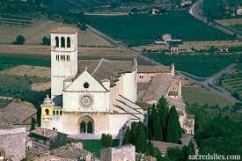
Basilica of Saint Francis lower Church Tomb of St Francis Upper Church

Walking the Way of the Cross

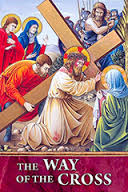
Way of the Cross

This past Friday, I was given the opportunity to lead people in the Stations of the Cross.  The devotion was held at St. Mary Star of the Sea Church, in downtown Beverly, MA.  The church is old, big, the interior cavernous.  Even with the lights on, it seemed dark inside.  The old furnace has a hard time heating the church, so there was a bit of a chill in the air.  We had about 30 individuals attending the service.  I came out into the sanctuary, dressed in my alb and purple deacon stole.  And for the first time, a wireless microphone; the interior of St. Mary’s soaks up sound, even my loud voice.  I invited those in the pews to join me in walking the Way the Cross; after a short prayer, we began.

This devotion has a long history.  Most scholars credit the Franciscan Friars with establishing the Way of the Cross in its present form.  The Franciscans had already been given responsibility for the Holy Places in the Holy Land, by the Pope.  In Jerusalem, the friars would lead pilgrims through the streets, along the route Jesus would have walked to Calvary.  During the 15th and 16th centuries, Franciscans in other countries began to set up outdoor shrines, imitating the places (or stations) where Jesus would have stopped on His way to His crucifixion.  Later, they requested, and received papal permission to set up Stations of the Cross in their churches.  It was not long afterward, that Rome extended that permission to bishops who wished to also set up Stations in their own churches.

The Way of the Cross is a devotion that helps us Christians to remember that Jesus, though the Son of God, was also human; that for Him, the Way of the Cross was a journey into suffering and death.  Realizing this, as I walked and prayed each of the Stations, I found myself entering into a different spiritual space, a solemn space, a sorrowful space.  Sorrowful, because I was sensing the pain and suffering that Jesus went through for us.  For us, He was willing to empty Himself totally, give all that He had on the Cross, so that we would be freed from the power of sin and death.  How often do we forget that?  The Way of the Cross helps us to remember.

The devotion also reminds us that if we decide to follow Christ, we follow Him everywhere, even to Calvary.  If we follow Him, it means that we are willing to empty ourselves in service to Him, and our brothers and sisters in Christ.  First to empty ourselves of our selfishness, our pride, our self-centeredness, anything that gets in our way of loving God and others.  Then we empty ourselves of our talents, our skills for the sake of Christ, and the world.  It is not easy; it can be very hard and painful.  Still, Jesus Christ calls us to follow; but if we answer that call, we can be assured that we will not be alone on this journey.  Christ assures us that though the journey may be full of suffering, Easter dawn awaits.

After the Station where Jesus in laid in the tomb, I walked to a large bas relief in the church.  It portrays the Resurrection, and standing before it, I read a passage from the Gospel of Luke (24: 1-8), where the women find the empty tomb.  And two men appear before them and announce:  “He is not here; he has arisen!”  On that note of hope, I stood before altar, and blessed those who are in the church, turned and bowed before the Eucharistic Presence in the tabernacle, and left the sanctuary.

Thomas Merton, 100th Birthday of a Trappst Monk…And a Secular Franciscan?

Merton

Today, January 31, 2015, would have been the 100th birthday of Father Louis Merton, OSCO; better known to the world as Thomas Merton. The Catholic, Christian blogosphere is abuzz with reports, stories, and reflections on the life of this Trappist monk, one I read on Crux, by Dennis Sadowski, of the Catholic News Service; another by Margery Eagan, On Spirituality columnist for Crux, and finally a very moving post by Father Dan Horan, OFM on his blog.

I do not know how many will share this opinion, but I think of Thomas Merton, as the one person who brought Christian spirituality, especially contemplative spirituality to the modern American Catholic population. After him, I think we see an increase in the number of books on spirituality, and prayer, geared for the Catholic laity, and new authors, like Thomas Keating, M. Basil Pennington, Richard Rohr, and Emilie Griffin. I know for myself, my spiritual life became much deeper, more enriched by reading his writings. He showed me a path to walk, and encouraged me to seek out other spiritual fathers and mothers, for inspiration and guidance.

I am still discovering new things about Merton, especially as heretofore unpublished journals, books, and essays are becoming public. This has given a much more rounded view of Merton, his life, his struggles, and his achievements. Now there are some facts that I was not aware of until I recently read Father Dan Horan, OFM book on Merton, was that Thomas Merton had some deep Franciscan roots. After his conversion to Catholicism, he felt a call to the Order of Friars Minor, and had applied to the Order, and was initially approved to enter into formation as a friar. Before he was to enter, something happened; scholars are not completely sure what, that caused Merton to withdraw his application. Still attracted to Franciscanism, he found himself at the Franciscan university, St. Bonaventure’s, in western New York. There, he joined the faculty as an instructor in English. It was during his time there, that he became a member of the Third Order of St. Francis, now known as the Secular Franciscan Order. This bit of information floored me. Now I knew that Merton had a Franciscan connection. When I was once a Franciscan novice myself, and attended some summer classes at St. Bonaventure’s, I daily would look up at a hillside clearing, known as “Merton’s Heart.” But to learn that Merton had been a Secular Franciscan, “Wow!”

Of course, this brings a whole bunch of questions: what fraternity did he belong to? Is the fraternity still in existence? Is the fraternity’s register, with his name listed in it, still available? Did he attend monthly fraternity meetings, or was he an isolated tertiary, attached to a fraternity, but unable to make the meetings? Maybe someday, some scholar, maybe even a Secular Franciscan, will be able to find answer to these questions.

I owe a debt of thanks to Father Louis, for prodding me to go ever deeper into my relationship with God. May he rest in peace!