The Birds (A Different Take)

Friday Fictioneers grey-day-with-pigeons-roger-bultot (1)

He slowly gets out of bed; not wanting to face the coming day.  Looking out of his window, he sees the outside reflecting his mood.  He notices the birds, sitting on the wire, huddled together against the damp.  Suddenly, they all take flight; they appear to be heading for his building!  The birds wheel about and head downward.  It is then, that he notices the little man, dressed in a brown robe.  The birds land all around the little man.  He blesses them, and they all take off; filling the air with their birdsong.  Staring out his window, he smiles.


Over a Cappuccino – Friday Fictioneers

coffee_in_mirror_02-1


After the interview, he entered the coffee shop.  His mind full of anxieties; his unemployment assistance ended, and savings shrinking.  He swore, as he discovered he could not afford a cup of coffee!  Suddenly, a little man with gentle eyes, dressed in a brown robe, stood next to him, offering him a cappuccino.  They sat at a table, and he felt compelled to reveal his fears to this friar.  The friar tells him “Trust Jesus, he will share your burdens!  Open your heart!”  Suddenly, he feels at peace, he sips the cappuccino, lowers his cup, and discovers he is alone!


(N.B.  The cappuccino is supposed to have been named for the Capuchin friars, a branch of the Franciscan Order.  The Capuchin friars’ distinctive brown habit was seen as the same color of the coffee beverage.)

A Victory, Won by Words and Respect.


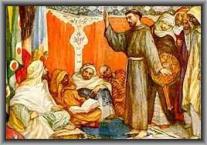
Francis and the SultanThe holy man from Assisi is standing in the tent, waiting for a message.  His body was still sore from the beating, he and his companion received from the Sultan’s guards, when they first approached his camp.  He is remembering the scenes he saw in the Crusader’s camp; scenes of anger and hate, directed at Muslims; scenes of loss and grieving for dead comrades.  He felt the same emotions from the Sultan’s soldiers, only directed towards Christian soldiers.  He wants to bring both sides together, by convincing the Sultan and his people to accept Christ.

He remembers the day they were brought before the Sultan, who invited the holy man to speak.  He saw that the Sultan’s men were fingering the hilts of their swords, ready to draw blood if he should insult Allah and His Prophet.  He looked into eyes of the Sultan, and saw curiosity.  He took a deep breath, whispered a prayer, and began to speak.  He spoke not of doctrine, or polemics, but from his heart, from his own experience of the Beloved.  He spoke with respect for his audience.  He felt a flame beginning to burn within his heart.  It grew as he spoke of the love of Christ, and the joy of God.  The fire of the Holy Spirit blazed out from him as he proclaimed the Good News!  The Sultan and his court stood back, amazed at the sight.  When he was finished, he stood, feeling drained, but at peace.  He bowed before the Sultan, who sent him and his companion back to their tent.

Now he sees a messenger approaching; who invites the little man and his companion back to Sultan’s tent.  The Sultan appreciates the respect that the holy one showed him and his court.  He acknowledges the strength of the little poor man’s convictions, but he and his people will remain committed to their faith.  The man from Assisi is disappointed, and saddened; but then the Sultan gives him a passport, permission for his brother friars to go to Jerusalem and reside there.  The little man receives it with joy, and bows deeply before the Sultan.  The Sultan and his court bow in return towards the little poor man from Assisi.

He and his companion walk back to the Crusader camp.  He is disappointed that he did not achieve his goal; but he carries back with him a sign of victory.  It is a victory that the Crusaders will not achieve; but a band of brown rob brothers will see the walls of holy Jerusalem.  It will be achieved not with swords, but by words, spoken with conviction and respect.


A Little Friar During the Night of Terror!

(MARTIN BUREAU/AFP/Getty Images)

(MARTIN BUREAU/AFP/Getty Images)

He walks among the wounded, and the dead.  The City of Lights has become the City of Fear.  The tears well up in the eyes of the little poor one, because he loves the French people.  His father made his fortune selling French cloth,and he had the name of his first-born son changed from Giovanni to Francisco to honor France.  In his youth, the little one would dress as a French troubadour, entertaining the young ladies of Assisi with French love songs.

He kneels down beside one of the wounded, who is crying in pain and fear.  He takes the person’s hand, bends over, and sings to him in French.  An EMT rushes towards the wounded person, he thinks he sees a dark robed friar kneeling over him.  He blinks and the friar is gone.  He kneels beside the injured, who is now quiet, and has a peaceful look on his face.  “Paix!”

New Executive Council Elected for the National Fraternity (USA) of the Secular Franciscan Order!

“The Secular Franciscan Order holds a special place in this (Franciscan) family circle.  It is an organic union of all Catholic fraternities scattered throughout the world and open to every group of the faithful.  In these fraternities the brothers and sisters, led by the Spirit, strive for perfect charity in their own secular state.  By their profession they pledge themselves to live the gospel in the manner of St. Francis (of Assisi) by means of this rule approved by the Church”  (Rule of the Secular Franciscan Order, Art. 2)

“The Secular Franciscan Order is divided into fraternities of various levels-local, regional, national, and international.  Each one has its own moral personality in the Church.  These various fraternities are coordinated and united according to the norm of this rule and the constitutions.

On various levels, each fraternity is animated and guided by a council and minister (or president) who are elected by the professed according to the constitutions.”  (Rule OFS, Art. 20-21)

National Council NAFRA OFS

When the Secular Franciscan Order was first established in 1221, it was a movement that was lead by laypersons, elected by the professed members.  As time went on, for various reasons, the Franciscan Friars began to exercise more authority over the movement.  The Order was divided among the First Orders’ provinces.  After the Second Vatican Council, with its directive for religious orders to rediscover their roots and charism, the Seculars took a new look at their founding history and documents.  A renewal took place; the various worldwide OFS fraternities were united under one Minister General and international council.  Nationally and regionally, fraternities were united, governed by their own elected ministers and councils, with guidance from Franciscan friars and sisters.

On October 17th, representatives from the regional fraternities gathered in Clinton, New Jersey, in a Chapter of Elections.  The results being that Jan Parker, OFS, is our new National Minister.  The names of the rest of the National Executive Council are available at this link.  Through the intercession of St. Francis, may God bless them with wisdom, charity, and inspiration, which will guide us well in coming years.

Care for Creation – A Franciscan Perspective

Francis and Brother Sun

The Canticle of Brother Sun

Most high omnipotent good Lord,

Yours are the praises, the honor and all blessing.

To you alone, Most High, do they belong,

And no person is worthy to mention you.

Praise be you, my Lord, with all your creatures,

Especially Sir Brother Sun,

Who makes the day and through whom you give us light.

And he is beautiful and radiant with great splendor,

and bears the signification of you, Most High.

Praised be you, my Lord, for Brother Wind,

And for the air-cloudy and serene-and every kind of weather,

By which you give sustenance to your creatures.

Praised be you, my Lord, for Sister Water,

Which is very useful and humble and precious and chaste.

Praised be you, my Lord, for Brother Fire,

By whom you illumine the night,

And he is beautiful and cheerful and robust and strong.

Praise be you, my Lord, for our Sister Mother Earth,

Who sustains and governs us,

And produces various fruits with colored flowers and herbs.

Praised be you, m Lord, for those who give pardon for love of you

And bear infirmity and tribulation

Blessed are those who endure in peace,

For by you, Most High, they will be crowned.

Praised be you, my Lord, for our Sister Bodily Death

From whom no living man can escape.

Woe to those who die in mortal sin.

Blessed are those whom death will find in your most holy will,

For the second death shall do them no harm.

Praise and bless my Lord and give him thanks

And serve him with great humility.

(Translated by Fr. Regis Armstrong OFM CAP)

Franciscans Feeding the Hungry

From the very beginnings of the Franciscan Order, concern for the poor and the outcast has been an important ministry of the Friars, the Poor Clares, and the Secular Franciscans.  And this remains true today; the Franciscans Friars of St. Francis Church on W 31st St. in Manhattan, NYC, have provided food assistance for those who are homeless, and the poor who cannot leave their homes.

In 1930, duringSt Francis breadline Depression the depths of the Great Depression, the Franciscans started a breadline; distributing sandwiches and coffee to men who had no jobs, and no homesSt Francis breadline today.  The St. Francis Breadline continues today; every morning at 7:00 AM, the Friars and volunteers distribute sandwiches and fruit to the homeless.  They also give a listening ear, a handshake, and a hug to those individuals whom the rest of society has written off.

In recent times, the Friars have become aware of another group of individuals who need food assistance, those poor persons who may not have enough money to buy the food they need, and because of health issues cannot leave their homes to go to food pantries.  So they set up the program “Franciscans Deliver.”

Franciscans DeliverThey established a food pantry, and those in need contact them, and a grocery list is made up.  The Franciscans and volunteers fill the orders and deliver them to the individuals’ apartments.  Again, besides bringing groceries, the volunteers bring human contact, companionship; so that the shut-ins do not feel alone and abandoned.
There are many government and private programs that try to alleviate hunger in this country.  And they do serve many needy people.  But what I like about the Franciscan approach, is that they are not just addressing a physical hunger, but a social and spiritual hunger as well.

From a Franciscan Perspective – Blessed Frederic Ozanam and Care for the Poor

“1) Secular Franciscans should always act as a leaven in the environment in which they live through the witness of their fraternal love and clear Christian motivations.

2) In the spirit of minority, they should opt for relationships which give preference to the poor and to those on the fringe of society, whether these be individuals or categories of persons or an entire people;  they should collaborate in overcoming the exclusion of others and those forms of poverty that are the fruit of inefficiency and injustice.”  (Article 19, General Constitutions, Secular Franciscan Order)

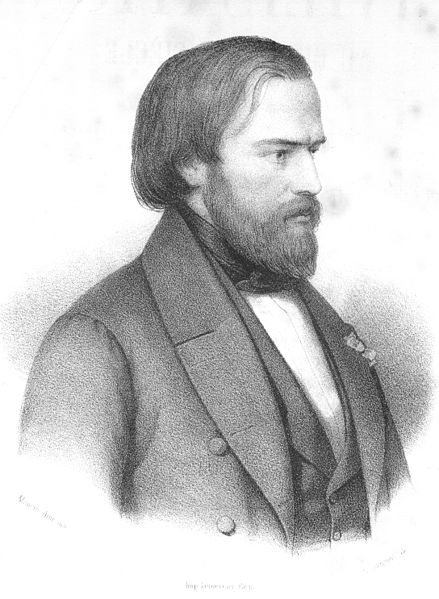
Gravure d'Antoine Maurin dit "Maurin l'aîné" (1793-1860) à partir d'un dessin de Louis Janmot (1814-1892)

Blessed Frederic Ozanam

On August 4th, the Catholic Church remembers and celebrates the life of Blessed Frederic Ozanam.  Born in France in 1813, he originally wanted to become a writer, but his father insisted that he become a lawyer.  In 1831, he went to the University of Sorbonne, in Paris, to study law.  While there, he noticed that the Catholic Church was being attacked by the intellectuals in Paris.  A devoted Catholic, he and some friends started a debate club, where they could discuss issues of faith with agnostics and atheists.  At one of these debates, Ozanam was challenged to prove his faith with actions, and not just talk.  Taking up the challenge, Frederic and a friend began visiting the poor in the slums of Paris, and providing whatever assistance they could.  Their approach was novel, instead of just giving money to some religious or church organizations; they went out and personally met the poor in their homes.  Other laypersons were attracted to work Ozanam was doing, and together they formed the Saint Vincent de Paul Society.  Frederic did earn a law degree, but would eventually also earn a doctorate in literature.  He married in 1841, and he and his wife had a daughter.  He continued his work with the Society.  Continuously suffering from poor health, he died in 1853.  Some time before his death, he supposedly joined the Third Order of Saint Francis; today known as the Secular Franciscan Order.  The Saint Vincent de Paul Society has grown into a worldwide organization, with local conferences based in most parishes.  They continue their work of personally visiting and providing assistance to the poor in their local communities.

There have been some negative comments about Pope Francis’ focus on the poor.  Some feel that he is neglecting the middle class, who are also suffering from a decrease in wages, the threat of foreclosure on their homes, and a loss of a sense of security that their parents had.  As an out of work member of the middle class, with shrinking resources; I understand the feeling of anxiety, uncertainty and fear people are experiencing.  I am experiencing that to.  But Jesus, through his Gospel, has told us that we are called to take up our crosses daily, and follow him.  And to follow Jesus means to proclaim the Good News to the poor, to heal the sick, to care for the widow and orphans, feed the hungry and to set free the imprisoned.  Even with our own anxieties and sufferings, we are still called to encounter the poor among us, and offer help.  We can accomplish this through God’s grace, and being open to the influence of the Holy Spirit.

Through Jesus Christ, God is with us, in good times and the difficult times.  Let us be open to that Presence, and open to sharing that gift with others.

From a Franciscan Perspective: “Preach it man!”

Lawrence of Brindisi“Preaching, therefore, is a duty that is apostolic, angelic, Christian, divine.  The word of God, is replete with manifold blessings, since it is, so to speak, a treasure of all goods.  It is the source of faith, hope, charity, all virtues, all gifts of the Holy Spirit, all beatitudes of the Gospel, all good works, all the rewards of life, all the praise: Welcome the word that has taken root in you, with its power to save you.

(From a sermon by Saint Lawrence of Brindisi, OFM CAP)

July 21st is the Feast day of Saint Lawrence of Brindisi, a Franciscan Capuchin priest, born in Italy in the year 1559.  A scholar, he was famous for his mastery of many languages.  Because of this, he was sent into various European countries, on preaching missions.  He became known as an effective and forceful preacher.

As an ordained deacon in the Catholic Church, one of my ministries is to proclaim the Gospel during the celebration of the Eucharist; and occasionally to preach on that reading from the Gospel.  The above quote from Saint Lawrence strikes a chord within me; because the act of preaching can have an effect not only on the congregation hearing the homily, but also on the preacher himself.  I prepare a week before I am scheduled to preach, prayerfully going over the Scripture readings for that Sunday.  I try to open my mind and my heart to what the Word, Jesus Christ, wishes to reveal to me.  I reflect on how the Gospel speaks not only to myself, but how it will speak to those sitting in front of me.  What is that they need to hear; what words of comfort they need to experience.  There have been times that I will delete a whole written page, because I have been inspired to take a different tack.

To preach is far different than any other type of public speaking.  I stand behind the pulpit, with my written text; as I look over the people before me, I whisper a little prayer.  Then, more often than not, the Holy Spirit takes over, guiding me, inspiring me; the words on the paper, takes on a life of their own.  When I am done, I know that for me, it was a holy, sacred moment.

I have come to realize that there are many ways one can preach the Good News.  It is why I am attracted to blogging; it is another way to share my experience of God’s love.  And it is becoming a means of hearing about others experiences.  And finally, the other means we all have to preach the Gospel, by the way each one of us strive to live in our daily lives; with our families, in our workplaces, in the stores, and on the streets.